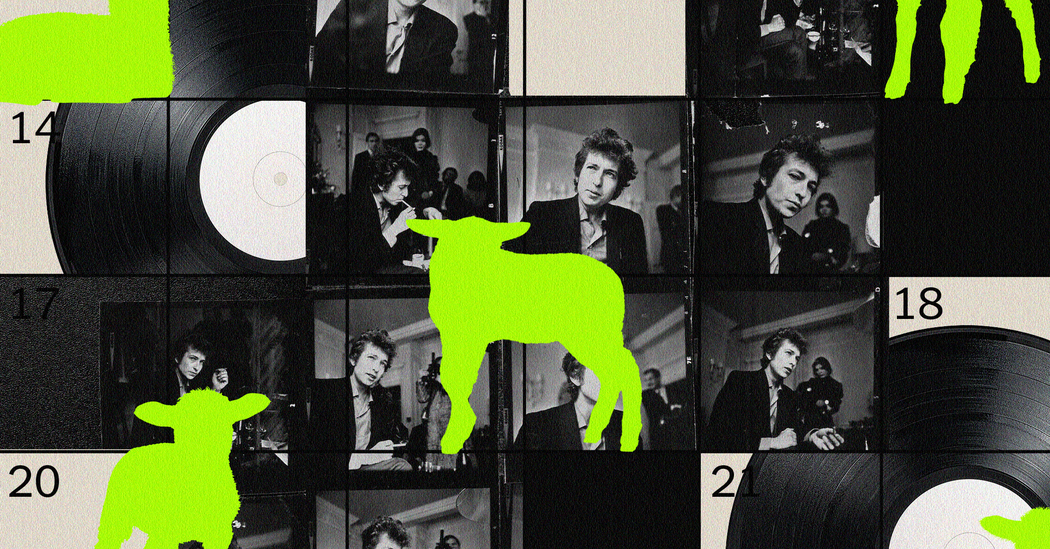
The New York Times regularly publishes Special crossword puzzles for subscribers. The puzzles are designed to have the difficulty of an early-week puzzle and to use the theme throughout. The title of this puzzle is “The Answer, My Friend …”. It was constructed by Kate Jensen.
Bob Dylan’s concert on Oct. 1, 1965, wasn’t an ordinary one. At first, he took the stage at Carnegie Hall in New York City solo, as usual. He opened with a few acoustic numbers, and the lights dimmed halfway into his set. It was Dylan’s first night as the frontman of an ensemble that’d soon be known to the world as the Band.
That year, Dylan had been working on this debut behind the scenes. In the spring, he released “Bringing It All Back Home,” followed by “Highway 61 Revisited” in August, both offering a preview of his transition from acoustic to electric. The latter’s opener, “Like a Rolling Stone,” ran over six minutes at a time when pop radio singles were half that length. The anthem shattered radio norms and redefined what a pop single could be, paving the way for the extended rock tracks that would come after it. He’d performed an electric set at the Newport Folk Festival that summer. Dylan’s backing band, as introduced at Carnegie, was composed of the Hawks guitarist Robbie Robertson, the organist Garth Hudson, the bassist Rick Danko, the pianist Richard Manual and the drummer Levon Helm.
The reactions, as many tell it, were divided: The advent of the electric guitar — let alone the genre of rock ’n’ roll itself — drew ire from a certain class of purists. When asked in 2017 about the “death of” the now widely commercial instrument and the “why” behind declining sales, one guitar dealer, George Gruhn, retorted: “What we need is guitar heroes” — in other words, a disruption. “You don’t see a bunch of kids emulating John Mayer and listening to him and wanting to pick up a guitar because of him.” While Dylan, now 85, was never hailed as a traditional electric “guitar hero,” he embodied that very renegade spirit. He was the composer known for taking aim at the corruption, inequality and militarism of American society — all during the civil rights and Vietnam-era antiwar movements, with McCarthyism still abound.
Earlier this year, the critic Jody Rosen explored Dylan’s many iterations in The New York Times’s list of the 30 Greatest Living American Songwriters. There’s the “Greenwich Village greenhorn, wrangling folk song tropes and visionary protest poetry into generational anthems,” and there’s “the rock ’n’ roll hero, armed with a Stratocaster and a sneer, howling, ‘How does it feel?’” Dylan’s voice didn’t bar him from commercial success: By the time the stint at Carnegie had rolled around, his subject matter had turned inward. He’d become consumed by alcohol and drugs; he’d discovered Jesus, and claimed to be an Orthodox Jew. He’d even told some that he was no longer interested in politics.
This month’s Special Crossword, authored by the Diverse Crossword fellow Kate Jensen, brings Dylan’s many iterations to the grid. For the editor Christina Iverson, a self-proclaimed “Bob Dylan superfan,” this puzzle holds a certain weight: Her father, Ed Newman, co-wrote “Bob Dylan in Minnesota: Troubadour Tales from Duluth, Hibbing and Dinkytown”; has written dozens of articles about Dylan; and has even painted his portrait a few times “He can tie just about anything to Dylan, so I was trying to channel my dad when I was editing,” she said. This Special puzzle features lyric references, cultural landmarks and even historic events tied to Dylan. You’re bound to walk away learning something new about him — I certainly did.
Solve the Puzzle.
Try This Clue
73-Across: Scornful expression that some hear in the delivery of “Like a Rolling Stone”
About The Author