But Singapore’s plan to exercise greater control over foreign-worker intake has raised questions about whether the recent surge in Bangladeshi migration can continue
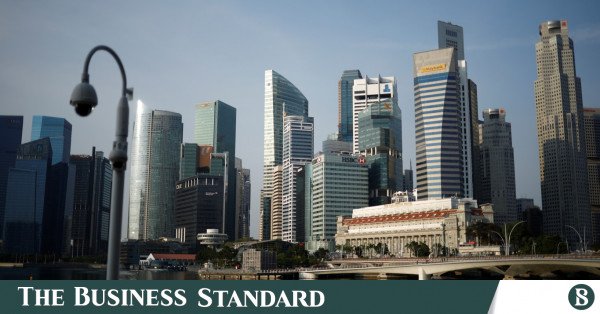
A general view of surveillance cameras near the central business district in Singapore March 5, 2019. Picture taken March 5, 2019. Photo: REUTERS/Edgar Su/File Photo
“>

A general view of surveillance cameras near the central business district in Singapore March 5, 2019. Picture taken March 5, 2019. Photo: REUTERS/Edgar Su/File Photo
Highlights:
- Singapore became Bangladesh’s second-largest labour market this year
- More than 55,000 Bangladeshis travelled to Singapore by September 16
- Tighter foreign-worker controls could shift demand towards skilled workers
- Singapore’s construction boom continues supporting migrant worker demand
- Migration costs have reached as high as Tk16 lakh
- Many Singapore-bound workers are returnees, not new migrants
Singapore has emerged as Bangladesh’s second-largest overseas labour market so far this year, with more than 55,000 Bangladeshis travelling there for work amid prolonged restrictions on recruitment to several traditional destinations.
But Singapore’s plan to exercise greater control over foreign-worker intake has raised questions about whether the recent surge in Bangladeshi migration can continue.

According to Bureau of Manpower, Employment and Training data, 55,614 Bangladeshi workers went to Singapore until 16 September, accounting for 10.34% of the 537,637 Bangladeshis who migrated during the period.
In 2022, 64,383 Bangladeshis went to Singapore, accounting for 5.67% of the 1,135,000 workers who secured overseas jobs that year.
Infograph: TBS
“>

Infograph: TBS
The number fell to 53,265 in 2023, when Singapore accounted for 4.08% of Bangladesh’s total 1,307,000 overseas jobs.
Recruitment picked up again in 2024, with 56,847 workers travelling to Singapore, representing 5.62% of the 1,010,909 Bangladeshis who migrated for jobs.
The number rose sharply to 70,832 in 2025, while Singapore’s share increased to 6.26% of the 1,132,368 overseas jobs recorded that year.
Saudi Arabia remained the largest destination, with 295,695 workers.
The rise comes as recruitment to major labour markets, including Oman, Malaysia, UAE and Bahrain, has remained off for years.
Singapore is also becoming a major source of remittances. Inflows from the country rose from $385.2 million in FY22 to $423.3 million in FY23, $632.3 million in FY24 and $980.3 million in FY25.
The figure surged to $1.49 billion in FY26, making Singapore Bangladesh’s 10th-largest source of remittances.
Singapore signals tighter foreign-worker controls
Concerns over the market’s future intensified after Singapore Prime Minister Lawrence Wong said the country would continue to welcome foreign manpower, but in a “careful and controlled way”.
Speaking at the National Day Rally on 23 August, Wong said Singapore’s overall population, including its labour force, would grow more slowly in the coming years.
“We will always ensure that Singaporeans remain the majority in our own country,” he said.
While businesses, particularly in the services sector, continue to seek easier access to foreign workers, Wong cautioned that even modest policy relaxation could significantly increase the number of foreign workers.
He said technology and productivity would have to drive a larger share of economic growth.
‘Recruitment unlikely to stop’
Migration expert Dr Mohammad Jalal Uddin Sikder, an associate professor at North South University, said Singapore’s move should not be interpreted as a decision to stop recruiting foreign workers.
“Even if Singapore imposes tighter controls on foreign worker recruitment, it is unlikely to stop hiring workers from Bangladesh altogether because migrant workers remain necessary for its economy,” he told TBS.
However, demand may increasingly shift from low- and semi-skilled workers to skilled and highly skilled workers, he said.
Singapore has around 60 lakh people, including about 16 lakh foreign workers. An estimated 200,000 Bangladeshis work there, mainly in construction, shipbuilding and gardening.
Its demographic challenge is also becoming more pronounced. The total fertility rate fell to 0.87 in 2025 from 1.24 a decade earlier.
Sikder said Bangladesh should prepare for a shift in demand.
“Singapore is moving far ahead in technology, artificial intelligence, digital technology and high-tech industries. So we cannot continue thinking only about sending ordinary semi-skilled workers,” he said.
Bangladeshi workers generally obtain skill certification from designated training centres before travelling to Singapore. Several specialised centres in Bangladesh are authorised to provide certification in around 22 trades, mostly related to construction.
Local recruiters said Bangladeshi workers lag in new skills as employers increasingly prefer workers with multiple certifications.
Migration costs reach Tk16 lakh
High migration costs have emerged as another major concern. Bangladeshi workers who recently travelled to Singapore told TBS that they paid up to Tk16 lakh to secure jobs.
Lutfor Mia of Tangail, who went to Singapore in 1996 as a construction worker after paying Tk2 lakh, said the cost for new workers has now crossed Tk14 lakh.
State Minister for Expatriates’ Welfare and Overseas Employment Nurul Haque Nur said six companies in Singapore effectively have a monopoly over the recruitment process and are charging unusually high amounts.
“Where the actual cost should perhaps be around Tk4 to Tk5 lakh, workers are reportedly being charged up to Tk16 lakh,” he told TBS.
The government has decided to summon the agencies concerned and examine where the additional costs are being incurred, he said.
Bangladesh has also discussed the issue with Singapore’s Building and Construction Authority and other relevant agencies to reduce migration costs, the state minister added.
Many migrants are returnees
The surge in migration figures also needs careful interpretation, said Hasan Ahmed Chowdhury, former secretary general of an association of agencies involved in sending workers to Singapore.
A significant share of workers travelling to Singapore are returnees rather than first-time migrants, he said.
Many Bangladeshi workers return home after completing their employment contracts and later go back to Singapore with new visas or clearances.
Therefore, the headline migration figure does not necessarily represent the number of new Bangladeshi entrants into the Singapore labour market.
Construction boom sustains demand
For now, Singapore’s construction sector continues to support demand for foreign workers.
The sector grew 11.8% year-on-year in the first quarter of 2026, making it one of the economy’s strongest-performing sectors. Advance estimates showed another 6.2% growth in the second quarter.
The continued construction boom is sustaining demand for migrant workers even as Singapore moves towards a more controlled and skills-focused foreign-worker policy.
About The Author