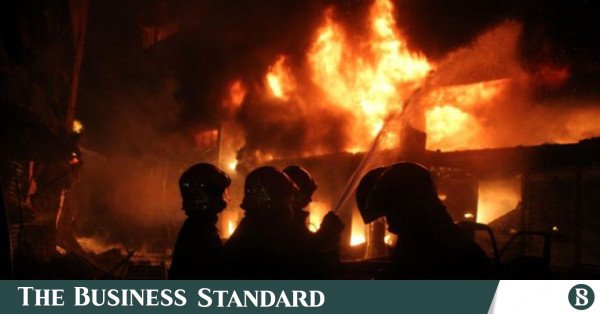
Seven years ago, on the night of 20 February 2019, a devastating fire tore through Haji Wahed Mansion beside Churihatta Shahi Jame Mosque in Old Dhaka, claiming 71 lives and leaving a wound that has yet to heal.
Selim Ahmed Liton, whose shop stood beside the mosque, still shudders at the memory. “Around 10:30pm, a deafening explosion ripped through the darkness. Flames are devouring everything, and charred bodies are lying scattered on the street. I was injured while fleeing. I still cannot say where it began or how it spread,” he recalled, his voice heavy with the trauma of that night.
Seven years later, survivors and families remain haunted by the memories, their grief raw and unyielding. The day after the blaze, Md Asif, one of the victims, filed a case at Chawk Bazar Police Station. The trial drags on unresolved, and promised compensation has yet to reach the victims.
Justice delayed, hopes denied

Lawyers admit there is no clear timeline for its conclusion. The case is now before Dhaka’s 8th Additional Metropolitan Sessions Judge, Md Khorshed Alam, with only six of 167 witnesses having testified so far.
The victims’ families continue to bear deep emotional and financial scars. Asif Ahmed, son of the late Jummon, one of the victims, said: “Every year, people only call on this day to ask how we are. The other 364 days, no one seems to care. Many families lost their sole breadwinner – my father was the only one supporting us. Only we know the depth of the crisis we’ve endured.”
He added, “Private banks promised Tk30 crore to the then prime minister’s relief fund for victims, but we haven’t even received 30 paisa. The government failed to compensate us as well.”
Asif also recalled failed promises of employment by then-mayor Sayeed Khokon. “We spent countless hours waiting for jobs in the hope of a future. But only master roll positions were offered to some. How can someone with a master’s degree survive on that? Nearly 75% of the affected families lost everything. The smell of death still haunts us when we see the rebuilt buildings.”
What happened that night?
Investigations revealed the blaze’s complex origins. A preliminary report by the Ministry of Industries stated that a cylinder explosion in a private car near Asgar Lane, Nobokumar Dutta Road, and Haider Box Lane triggered the fire.
Flames spread rapidly, fueled by gas cylinders in a pickup truck, a restaurant, and street electrical transformers. Unlicensed depots in Haji Wahed Mansion, storing perfume cans and plastic granules, acted as accelerants, engulfing five buildings, including Razzak Bhaban.
Another investigation suggested a transformer might have sparked the fire, while the Explosives Department found that vapours from perfume cans created an explosive mixture ignited by an electrical spark.
The principal plaintiff named two primary accused and 10-12 unidentified individuals. Charges were filed against eight people, including the mansion’s owners, Hasan (Hasan Sultan) and Sohel (Shahid/Hossain), chemical warehouse owner Imtiaz Ahmed, director Mozammel Haque, manager Mozaffar Uddin, and employees Mohammad Jawad Atik, Md Nabil, and Mohammad Kashif. All remain out on bail.
Witness testimony has been painfully slow. Public Prosecutor Omar Faruq Faruki urged both sides to act responsibly, stressing police must ensure attendance. Defence lawyer Mostafa Pathan argued the accused are themselves victims, calling it an accident rather than a crime.
For the families, seven years later, the trauma remains raw. “The building looks completely different now, with new offices and shops,” said Asif Ahmed. “But when we see it, the smell of death from that night still lingers. The wounds may have faded in the building, but they remain in our hearts.”
Chawk Bazar remains a ticking time bomb. Despite repeated government efforts to move chemical warehouses to safer locations, unlicensed storage units continue to appear as owners chase bigger profits. With danger looming in plain sight, it may be only a matter of time before another tragedy strikes, forcing a new generation to pay the price.
About The Author