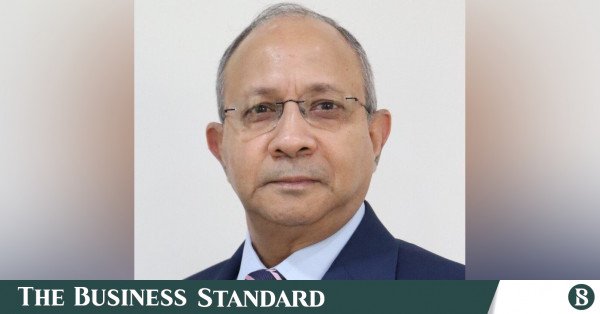
The aspect of security is a very important element of India’s policy in the neighbourhood, said Pankaj Saran, convener of NatStrat, a Delhi-based independent centre for research on strategic and security issues, noting that India is keen to build a “new page” in ties with Bangladesh after its elections.
“We have to see how the new government in Bangladesh will manage its relations with China, Pakistan and the United States, and where India will fit into this,” said the expert, who served in key positions within the government of India in the Prime Minister’s Office, the National Security Council Secretariat, the Ministry of External Affairs and in several Indian missions abroad.
On the one hand, India has a focus on security for its own interests, but on the other hand, India also wants to ensure that it pursues policies in the neighbourhood, minus Pakistan, he said during an interaction with a visiting media delegation from Bangladesh at Sushma Swaraj Institute, highlighting India’s relations with the South Asian countries and beyond amid changing global scenarios.

“China has borders with Afghanistan, Pakistan, Nepal, Bhutan and Myanmar. So China’s relationship with all these countries also becomes important for us,” said Saran, a former diplomat with 40 years of experience in foreign, strategic and national security affairs.
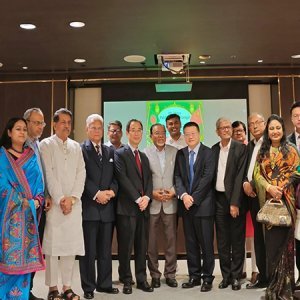
NatStrat Adviser Shantanu Mukharji, Diplomatic Correspondents Association, Bangladesh (DCAB) President AKM Moinuddin and General Secretary Emrul Kayesh were present.
The media delegation is on a week-long visit to India from 3-9 May.
“So this world, which we are living in, is a cruel bird. And we should be happy that despite all our difficulties, we have not degenerated to that level of brutality and enmity,” Saran said.
He said they should only openly pray that they never do it like this. “Despite all the differences, whatever we may have, we should be able to teach Europe and West Asia how to live with each other. That is the most important.”
Saran, who in the past served as Indian high commissioner to Bangladesh, said many countries including Afghanistan, Pakistan and Myanmar are in a lot of trouble.
He said there are a few countries that are showing a lot of potential for improvement and a lot of promise because of the establishment of democracy.
“Nepal, Bangladesh, Sri Lanka and even the Maldives – we are seeing that genuine democracy has come to these four countries and new leaderships have taken over,” he said, adding that all four countries are beginning a new journey in their political life.
Saran said they are living in a period where there is no contact between India and Pakistan and diplomatic relations are frozen, with a complete stalemate between India and Pakistan.
With Myanmar, both India and Bangladesh have very similar problems because of the complete breakdown of internal stability, he said.
On Bangladesh, Pankaj Saran said it is remarkable that the day after the election, Indian Prime Minister Narendra Modi sent a congratulatory message to new Prime Minister Tarique Rahman, and the next day, Tarique also tweeted back, acknowledging Modi’s congratulatory message.
“This is very different from the atmosphere in the relationship under the Yunus regime. So India did not waste a moment to express its willingness and desire to open a new page with the new prime minister and to recognise the result of the elections in Bangladesh,” he said.
Modi’s message was immediate, very friendly and positive, said the Indian expert.
“There was a phone call. And this has set the stage for finding a new kind of relationship with Bangladesh,” Saran said.
A few days ago, the Indian government also announced its new high commissioner, Dinesh Trivedi, a veteran politician. He is the first political appointee since 1971.
“And what it means, basically, is that the prime minister personally wants someone to go there to represent him and who has his full confidence,” said Saran, adding that he is a seasoned politician with a sense of how to deal with the complicated environment they have in Bangladesh.
“So, these are early days. Your visit is taking place at a good time because the relationship, I think, is building up gradually,” he said.
“But all I would say is, regardless of who’s in power in Delhi or in Dhaka, this reality can never change. You cannot defy our history, geography and culture,” Pankaj Saran said, noting that the relationship is so deep and so rich.
In the past, Saran said, Bangladesh-India relations have suffered for many reasons.
“One was security. If you remember, the period from 2001 to 2006 was a period in which the relationship almost broke down because of Indian concerns over the use of Bangladeshi territory for terrorist activities against India in the Northeast and Bangladesh’s denials. So, we were actually stuck,” he said.
Saran said there was no dialogue taking place at that time, adding that India would say something, but Bangladesh would reject it.
“And the result was that people suffered, everyone suffered, and our initiatives could not move forward,” he said.
About The Author