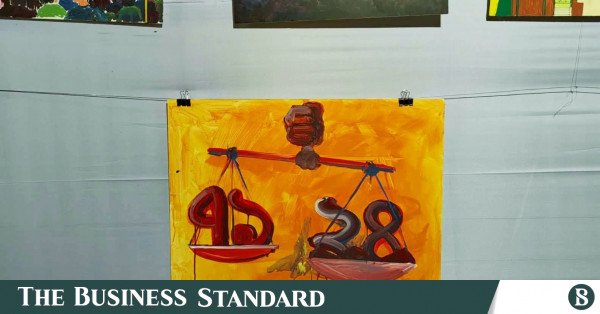
The artist says the work was meant to depict the ‘unequal comparison’ between the Liberation War and the July Uprising, while a Fine Arts faculty official admits the artworks were displayed without verification.
An artwork showing “71” and “24” on opposite sides of a pair of scales at Rajshahi University’s July Uprising exhibition. Photo: TBS
“>

An artwork showing “71” and “24” on opposite sides of a pair of scales at Rajshahi University’s July Uprising exhibition. Photo: TBS
The Rajshahi University administration today (10 August) removed an artwork from an exhibition after it drew criticism for allegedly portraying the 2024 July Uprising as outweighing the 1971 Liberation War.
The artwork was displayed at the three-day exhibition titled “July Mass Uprising: A Free Homeland Through Colours and Brushes,” which began today and features 80 artworks, organised by the university’s Faculty of Fine Arts to mark the second anniversary of the July Uprising.
The artwork shows a clenched fist holding a pair of scales, with “71” written in red on one side, representing the 1971 Liberation War, and “24” in dark colour on the other, representing the July Uprising.

The side marked “24” hangs visibly lower, making it appear heavier than the “71” side.
Criticism over the artwork began this afternoon, following which the university administration removed it from the exhibition.
Fuad Ratul, convener of the university unit of the Socialist Students’ Front, said, “The tendency to put 1971 and 2024 against each other destroys unity among people. Only the defeated forces benefit from this.”
Sultan Ahmed Rahi, president of the university unit of Jatiyotabadi Chhatra Dal, said, “1971 is our core history. Although 2024 is an important chapter, 2024 does not become greater by belittling 1971. There is no need to insult one history to establish another.”
Mehedi Hasan, general secretary of the university unit of Islami Chhatra Shibir, said, “1971 and 2024 are events from different contexts. We do not want to put them against each other; rather, we want to move forward by embracing the inspiration of both.”
However, speaking on condition of anonymity, the artist of the artwork told The Business Standard that the work was intended to portray the “unequal comparison” between the Liberation War and the July Uprising, rather than place the two events in opposition.
“I have wanted to portray the unequal comparison between 1971 and 2024. It is not right to view my work in that sense; it is an allegorical presentation,” the artist added. “Since July, a group has been trying to put 2024 against 1971.”
The controversy also raised questions about how the artwork was selected for display.
Professor Ariful Islam of the Faculty of Fine Arts, who was in charge in the absence of the dean, said, “To be honest, I only signed a letter. The pictures were sent without being verified.”
University Public Relations Administrator Professor SM Kamruzzaman said the artwork was removed because its presentation of a historical issue had ignited controversy.
“We have removed the artwork because presenting a historical issue in this manner created controversy. The Faculty of Fine Arts was responsible for organising the exhibition. We will ask them to explain the artwork,” he added.
About The Author