Ship handlers said currents during high tide are currently 5-6 nautical miles stronger than usual, making it difficult for lighter vessels to berth alongside mother vessels.
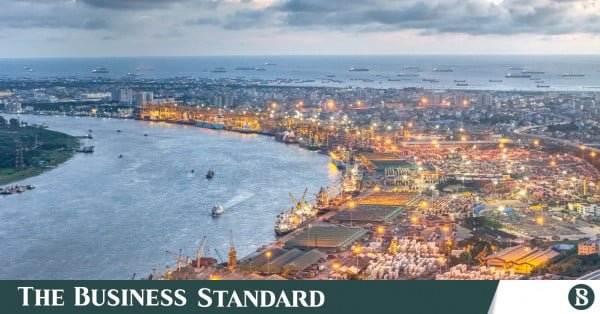
A view of Chattogram Port. Photo: Mohammad Minhaj Uddin/TBS
“>

A view of Chattogram Port. Photo: Mohammad Minhaj Uddin/TBS
Rough seas triggered by a low-pressure system in the Bay of Bengal have disrupted cargo handling at Chattogram Port’s outer anchorage for the past two weeks, with lighter vessels struggling to approach mother vessels amid unusually strong currents.
The Bangladesh Meteorological Department (BMD) has asked all maritime ports, including Chattogram, to display local cautionary signal No 3 as the low-pressure area over the Bay developed into a well-marked low-pressure system.

Infographics: TBS
“>

Infographics: TBS
Ship handlers said currents during high tide are currently 5-6 nautical miles stronger than usual, making it difficult for lighter vessels to berth alongside mother vessels.
Under normal conditions, two lighter vessels can operate alongside a mother vessel simultaneously, one on each side.
But the rough seas are allowing only one lighter vessel to approach during high tide and two during low tide, operators said. At times, smaller vessels cannot approach mother vessels at all.
The disruption is affecting the unloading of food grains and other bulk cargoes handled at the outer anchorage.
Around 50 mother vessels are currently waiting at the outer anchorage to unload their cargo, according to the ship handlers.
Ship handlers said the delays are significantly increasing vessel turnaround time. A mother vessel that normally takes 10-12 days to complete cargo discharge is now taking up to 20-25 days.
Shipowners are also incurring additional operational costs and demurrage of around $2,500-$3,000 a day, which ultimately add to importers’ costs and can push up prices for consumers.
Chittagong Port Authority (CPA) Secretary Syed Refayet Hamim said some disruption to cargo handling during periods of rough seas and signal No 3 is normal during the monsoon.
“From June to August, the sea generally remains rough. So cargo handling is somewhat lower than usual during this period. This is a normal phenomenon for the port,” he told The Business Standard.
Sarwar Hossain Sagar, president of the Bangladesh Berth Operators and Ship Handling Operators Association, said rough seas are making it difficult for operators to deploy lighter vessels on schedule.
“Lighter vessel masters are reluctant to cross the rough sea and head towards the Kutubdia channel. As a result, ship handling is being delayed,” he said.
About The Author