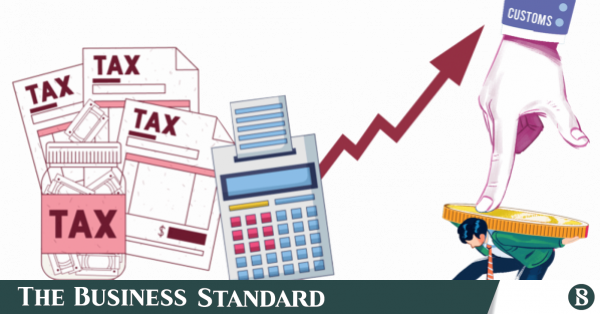
Economists, business leaders and tax experts have warned that the proposed national budget’s heavy reliance on VAT and other indirect taxes will place a disproportionate burden on low- and middle-income households.
They cautioned that, without comprehensive tax reforms, the current approach could widen economic inequality while failing to address persistent revenue shortfalls. They also raised concerns over limited budget allocations for key public services and the capacity of the revenue administration to improve tax collection.
The remarks came at a discussion titled “Tax Justice in the National Budget: Observations on Fiscal Proposals for FY2026-27”, organised by the Centre for Policy Dialogue (CPD) and Christian Aid yesterday.

At the programme, CPD presented a report which noted that Bangladesh’s tax-to-GDP ratio was the lowest among South Asian countries, while the country lost around Tk2,26,236 crore in revenue in the 2022-23 fiscal year due to tax evasion and avoidance.
The report also said only 28-29% of potential VAT collection was being realised.
The think tank said a revenue-focused approach without structural reforms risked deepening inequality, as indirect taxes continued to account for the majority of NBR revenue.
According to the report, around 65-66% of total NBR revenue comes from indirect taxes, including VAT and consumption-based levies, placing a greater burden on low- and middle-income groups.
The budget’s reliance on VAT as the single largest revenue source, accounting for 38% of revenue, also drew criticism from participants.
While the five-year personal income tax roadmap and the introduction of a new 35% tax slab for incomes above Tk35 lakh from FY29 were welcomed as progressive steps, CPD said the current tax-free threshold of Tk3.75 lakh did not provide adequate inflation-adjusted relief for low- and middle-income taxpayers.
CPD also criticised the absence of an inheritance tax framework and the failure to reduce the standard VAT rate from 15% to a more competitive 10%.
It further noted that the health sector allocation stood at only 1.01% of GDP, far below the desired 5%. The legalisation of undisclosed real estate investments was also flagged as raising “significant fairness concerns” by potentially rewarding non-compliance.
Concerns over business impact
Speaking about the impact of tax policies on businesses and the relationship between entrepreneurs and revenue authorities, Dhaka Chamber of Commerce and Industry (DCCI) President Rizwan Rahman said the gap between the NBR and businesses needed to be reduced.
“The middle-income group is a major driving force of the country’s economy. If they are not given opportunities to grow, economic growth will be hindered,” he said.
He also called for reducing unnecessary government spending.
Dhaka Tax Bar Association President Mizanur Rahman Dulal expressed concern over the restructuring of tax slabs and the impact of taxes imposed at the import stage.
“Although there are some positive aspects in this budget, the restructuring of tax slabs means low-income taxpayers are receiving fewer benefits than before,” he said.
He warned that advance tax at the import stage could increase difficulties for businesses.
Speaking about the social impact of the tax system and difficulties faced by non-profit organisations in obtaining loans, FBCCI Senior Vice-President Priti Chakraborty said non-profit institutions faced discrimination when seeking loans.
“At the same time, increasing the tax burden on low-income people goes against social justice,” she said.
Bangladesh Knitwear Manufacturers and Exporters Association President Mohammad Hatem expressed concerns over the possible impact of new tax proposals on industries.
He said the proposal to impose a 3% interest charge on companies providing financial support to related weak companies could harm the industrial sector. He added that additional tax pressure on affected contracting firms would make it more difficult for them to survive.
NBR defends tax measures
NBR Tax Policy Department Member Barrister Mutasim Billah Faruqui said sustainable revenue collection was not possible without a fair tax system.
“This budget has given importance to tax justice and efforts have been made to expand the tax base without putting additional pressure on existing taxpayers,” he said.
He said tax was being considered not only as a means of collecting revenue but also as an effective tool for implementing economic policies.
About The Author