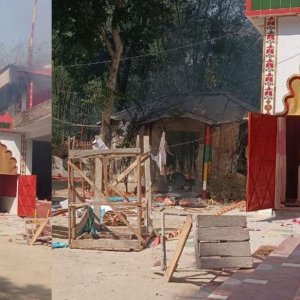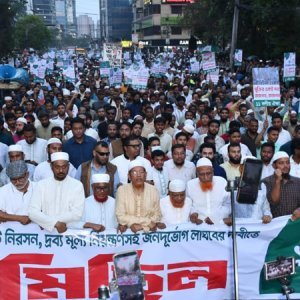
It was 14 April 2001. As every year, crowds gathered at Ramna Batamul to welcome Pahela Baishakh. Suddenly, a powerful blast ripped through the celebration. Thick black smoke engulfed the area, and people ran in panic to save their lives.
Within moments, Pahela Baishakh – the Bengali new year and a symbol of heritage – turned into a scene of grief and horror. Nine people were killed on the spot, while another died later in hospital.
Today, on the day of another Pahela Baishakh and a quarter of a century later, justice remains incomplete.

Of the two cases filed over the attack, one has reached a verdict, while the other is still awaiting conclusion. The murder case saw a verdict delivered 13 years after the incident.
However, proceedings in the explosives case remain unfinished. The case is currently stuck at the stage of recording statements from the accused under Section 342 of the Code of Criminal Procedure.
Court records show the court concluded the recording of witness testimonies on 21 March 2022. On the same day, it fixed a date for the defence hearing under Section 342 of the Code of Criminal Procedure.
The case was later transferred between tribunals, eventually landing at Dhaka’s Special Tribunal-15 in January 2023. The case remains at the same stage four years later, awaiting the defence statements.
The latest hearing, scheduled for 31 March, could not proceed as several accused were not produced in court from prison. Judge Tawhida Akhter of Special Tribunal-15 has now set 9 July as the next date.
Dhaka Metropolitan Public Prosecutor Omar Faruq Faruqi said the explosives case is nearing completion. Of 84 listed witnesses, 54 have testified so far.
“There was little progress during the previous fascist regime. The court also faced difficulties in securing key witnesses. The case was also pending before the High Court at one stage,” he said.
Additional Public Prosecutor Mahfuz Hasan said the prosecution is trying to conclude the trial swiftly. “However, seven accused are currently in custody in different jails across the country in multiple cases, making it difficult to ensure their presence in court.”
Defence counsel Md Jashim Uddin said some of the accused are in custody for 17 to 18 years. “They were implicated later based on confessional statements, despite not being named in the original complaint.”
He also said a confession, without corroborative evidence, cannot justify prolonged detention. “Keeping individuals detained while a criminal case drags on for two decades is contrary to the principles of justice.”
Md Idi Amin, another defence lawyer, accused the prosecution of negligence. He said repeated appeals were made to complete the proceedings, but they failed to produce the accused in court, citing security concerns.
“The accused have already spent 20 to 25 years in jail. Even if convicted in the explosives case, how much further punishment could be imposed. They have effectively served more than sufficient time,” he added.
Who are the accused
The accused in the explosives case are Arif Hasan, Shahadat Ullah, Abu Bakar, Sabbir, Mufti Abdul Hai, Shawkat Osman, Shafiqul Rahman, Md Tajuddin, Jahangir Alam Badar, Maulana Abu Taher, and Maulana Akbar Hossain. Of them, the first seven are in jail, the next two are absconding, and the last two are on bail.
On 23 June 2014, Dhaka’s Second Additional Metropolitan Sessions Judge Ruhul Amin delivered the verdict in the murder case, sentencing eight to death and six others to life imprisonment.
On 13 May 2025, the High Court commuted the sentences after a hearing on death references and appeals submitted by the convicts in the case.
The charges state that the bomb attack was carried out during Pahela Baishakh celebrations at Ramna Batamul on 14 April 2001. Sergeant Amal Chandra of Nilkhet police outpost filed two cases – one for murder and another under the Explosives Act – on the same day.
Nearly eight years later, the Criminal Investigation Department (CID) submitted charge sheets against 14 accused. The trial was delayed due to repeated changes in investigation officers, supplementary charge sheets, and the failure of investigators to appear in court despite repeated summons.
The cases were sent to Dhaka Metropolitan Sessions Court for trial in January 2009, and charges were framed in April that year. While the murder case was transferred to a speedy trial tribunal and concluded, the explosives case remains pending in the trial court.
About The Author