Early disaster warning systems through community radio remain constrained by very limited transmission ranges, leaving deep-sea fishermen largely outside coverage.
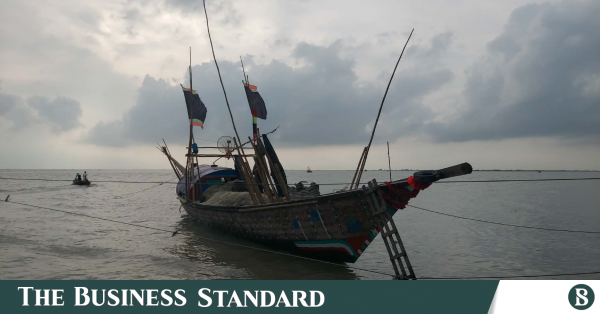
A fishing boat remains anchored at Motirhat Ghat in Lakshmipur, 1 May 2026. Photo: TBS
“>

A fishing boat remains anchored at Motirhat Ghat in Lakshmipur, 1 May 2026. Photo: TBS
For the past two years, Kamal Pyada, a trawler owner from Barguna, has not returned to the sea for fishing after narrowly surviving a devastating accident that nearly ended his life – and his fishing business.
“I somehow survived that time, but no fishermen who were with me ever came back. If we had received an early warning about the storm, we wouldn’t have stayed at sea for even a second – we would have headed straight to shore,” said the 25-year veteran fisherman.
He said there is no mobile internet, Facebook, or television service in the deep sea. Out there, radio is our only source of information. There used to be Krishi Radio in Barguna, though it may no longer be operating. Even if it were, if its broadcasts reached farther offshore, we could at least receive weather forecasts,” he added.

Kamal’s experience reflects a wider reality for hundreds of thousands of fishermen across the coastal districts of the Barishal division, who risk their lives daily in the Bay of Bengal.
However, early disaster warning systems through community radio remain constrained by very limited transmission ranges, leaving deep-sea fishermen largely outside coverage.
Apart from the Barishal Betar Centre, three community radio stations operate in the coastal region: Lokbetar in Barguna Sadar, Krishi Radio in Amtali, and Radio Meghna in Bhola.
While these stations were licensed to improve livelihoods and broadcast cyclone warnings, their limited transmission capacity has prevented them from fully delivering on that mandate.
According to officials, Lokbetar has a transmission range of 51 kilometres, Krishi Radio covers 45 kilometres, and Radio Meghna reaches only 25.5 kilometres – far below the zones where deep-sea fishermen typically operate.
Lokobetar Barguna Director Monir Hossain Kamal said, “We continue radio operations despite numerous challenges. But with a broadcast range of only 51 kilometres, our programmes do not reach the deep sea.”
“We have sought permission to extend our coverage to 100 kilometres. If approved, we will be able to deliver weather updates to fishermen in the middle of the sea,” he said.
Umme Nishi, assistant station manager of Radio Meghna, said every year, cyclones and storm surges hit the area. Yet our broadcast range is only 25 kilometres. If the broadcast range is expanded, weather warnings could reach fishermen in the deep sea. This would help reduce casualties and enable them to make timely decisions to return to safety.
According to Barishal Fisheries Department data, 259 fishermen were killed and 172 went missing between 2016 and 2022. These incidents occurred in 609 boat accidents over the seven-year period, leaving 1,106 people injured. The highest number of deaths (77) was recorded in 2016, while 2018 saw the highest number of missing fishermen (62).
Call for modernising coastal radio networks
Experts say that simply establishing radio stations is not enough; they also need to be modernised and made more effective.
Associate Professor Hafiz Ashraful Haque, head of the Department of Coastal Studies and Disaster Management, said even state-run radio is often difficult to receive clearly, making community radio even less reliable in offshore areas.
“Most fishing boats in the country have an operating capacity of less than 90 nautical miles, whereas fish are often found nearly 200 nautical miles offshore. Fishermen take these risks to catch fish for us, yet their safety is not given sufficient importance,” he said.
He questioned, “If radio stations exist but fail to serve fishermen, then what is the point of merely approving them?
With proper monitoring, modernisation and institutional support, these community radio stations can play a vital role in enhancing coastal safety and supporting the economy, he added.
About The Author