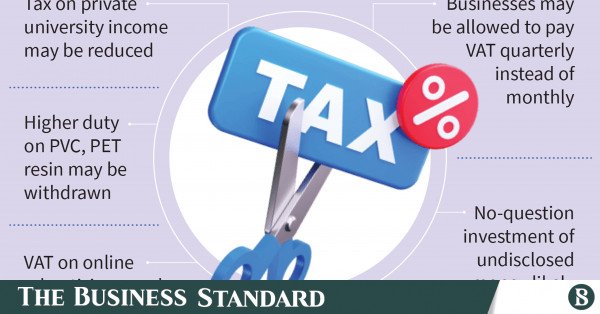
The government is considering a series of tax relief measures for businesses and taxpayers. The capital gains tax on proceeds from gold sales may be reduced from 15% to 5%. Taxes on private university income may also be lowered. The increased import duty on plastic raw materials – PVC resin and PET resin – may be withdrawn, while VAT on online advertising could be cut from 15% to 5%.
Businesses may also be allowed to pay VAT once every three months instead of monthly. A special concession may also be introduced for the supplementary duty on tobacco companies. Meanwhile, the controversial provision allowing no-question investment of undisclosed money in the housing sector is likely to be repealed.
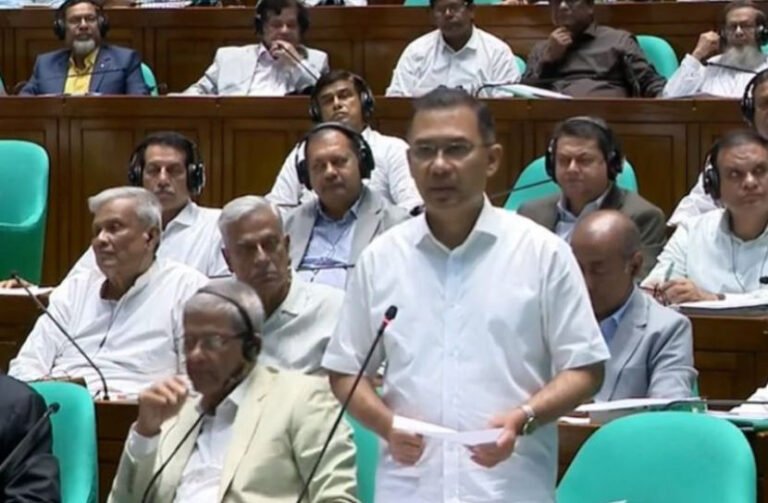
According to sources at the National Board of Revenue (NBR), these changes could be announced when Parliament passes the Finance Bill today.

In addition, the tax-free income threshold for individual taxpayers may be set at Tk4,00,000 for the next two tax years, Tk4,50,000 for the following two years, and Tk5,00,000 for the 2030-31 tax year.
Sources also said the Finance Bill proposed by the finance minister may include additional concessions for taxpayers and businesses.
Speaking to The Business Standard on condition of anonymity, a senior NBR official said, “The highest levels of the government have instructed us to reduce tax rates or simplify provisions in areas where the proposed budget could create additional pressure on taxpayers and businesses.”
“As part of that directive, some of the proposed tax rates may be reduced further,” he added.
However, he acknowledged that the measures could result in lower government revenue collection. Most taxpayers declare holdings of between 30 and 40 bhori of gold in their tax returns, much of which is believed to be fictitious. When they later incur significant expenses, they often claim the funds came from selling that gold. Until now, such proceeds have not been taxed.
The proposed budget sought to classify the difference between the sale price and the acquisition cost of the gold as capital gains, subject to a 15% tax. The proposal drewwidespread criticism.
According to NBR sources, the tax rate may now be reduced to 5%. Meanwhile, the existing 10% tax on the income of private universities may be halved.
The government had also doubled the customs duty on imports of PVC resin and PET resin from 5% in a bid to support local producers. However, following opposition from downstream plastic manufacturers, the duty may be restored to its previous level.
Both materials are essential inputs for manufacturing pipes, water tanks, packaging materials, healthcare products, electronics, automobiles, beverage bottles and pharmaceutical packaging. Industry operators had warned that the higher import duty would significantly increase production costs.
Bangladesh currently imposes a 15% VAT on online advertising, compared with 9% in Singapore and 5% in the United Arab Emirates. Because of Bangladesh’s comparatively higher VAT rate, businesses often process payments for online advertisements through those countries, depriving Bangladesh of tax revenue. The government hopes that lowering the VAT rate will encourage domestic billing and increase overall VAT collection from the sector.
Govt to scrap no-question investment of undisclosed money The government is also expected to withdraw a controversial provision that would have prevented any authority from questioning the source of funds if buyers declared the actual purchase price of property rather than the deed value.
Critics argued that such a provision would effectively create an avenue for laundering illegally acquired wealth. The Centre for Policy Dialogue (CPD) was among the organisations that criticised the proposal.
Although the NBR chairman repeatedly maintained that the budget did not provide a legal avenue for investing undisclosed money, a senior income tax official told The Business Standard that the proposal is now set to be withdrawn entirely.
If the provision is repealed, the previous rules will remain in force. Under those rules, undeclared income can still be invested in any sector by paying the applicable tax along with an additional 10% penalty. However, investors will not receive indemnity. In other words, any authority will still be able to question the source of the funds, effectively closing the door on no-question investment of undisclosed money.
About The Author