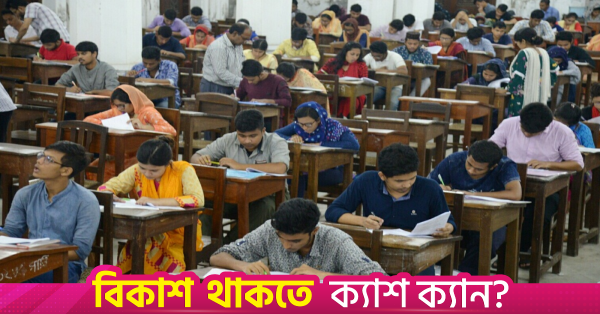
There will be no major changes to the admission test question format in the current academic year.
Representational Image. Photo: Courtesy
“>

Representational Image. Photo: Courtesy
Applications for admission to public universities across Bangladesh for the 2026-27 academic year will open in January, with entrance examinations scheduled to begin in February.
The admission process will start after the publication of the results of Higher Secondary Certificate (HSC) and equivalent examination paper re-evaluations and supplementary examinations.
University Grants Commission (UGC) Chairman Professor Dr Mamun Ahmed disclosed the plan at a press conference following a meeting with public university vice-chancellors at the UGC office today (9 November).

He said the government aims to publish the results of HSC answer script re-evaluations and supplementary examinations by 31 December. Students who pass these examinations will also be eligible to sit for university admission tests.
Emphasising the need to coordinate admission schedules, the UGC chairman said universities would determine and announce their examination dates through mutual consultation.
Vice-chancellors have been requested to consider the holy month of Ramadan while setting the schedules. Universities that have already announced their admission test dates have also been urged to reconsider them in the interest of students, he added.
He said universities must ensure that their admission tests do not clash, allowing students to compete for places at multiple institutions.
The meeting also discussed a proposal to form a central coordination committee comprising representatives from the UGC, the Ministry of Education and universities. The proposed committee would coordinate admission schedules and related activities throughout the year.
There will be no major changes to the admission test question format in the current academic year. Most universities will continue to use the multiple-choice question (MCQ) format, as they did last year.
However, the introduction of subject-based and analytical questions alongside MCQs from the following academic year is under consideration.
The UGC chairman said admission tests should assess not only students’ ability to memorise information but also their subject knowledge, analytical skills and problem-solving abilities.
He added that further decisions would be taken after considering the opinions and preparedness of universities.
Vice-chancellors have also been asked to give due consideration to GPA requirements when determining admission eligibility.
As the number of students passing this year’s HSC and equivalent examinations has declined, the meeting emphasised aligning admission arrangements with the available seats in higher education institutions.
According to UGC data, more than 700,000 students passed the HSC and equivalent examinations in 2025, while the number fell to slightly over 600,000 this year.
Public universities across the country have approximately 63,000 first-year admission seats. Meanwhile, institutions affiliated with the National University, Islamic Arabic University and other public universities have more than one million seats. Private universities offer over 400,000 seats.
The UGC chairman said the coordination initiative would preserve universities’ autonomy and statutory authority.
Universities will continue to conduct admission activities under their respective laws and regulations, while the UGC will facilitate coordination and provide support rather than impose decisions on them, he added.
About The Author