Highlights
- Chattogram faces a public transport shortage as demand outpaces available vehicles.
- 16 city routes have permits for 1,080 buses against a ceiling of 1,232.
- Operators allegedly skip less profitable route sections, forcing passengers to change vehicles.
- Route violations and unapproved fares are increasing commuters’ travel costs and waiting times.
- Transport officials say mobile courts and monitoring are being used to enforce fares and route permits.
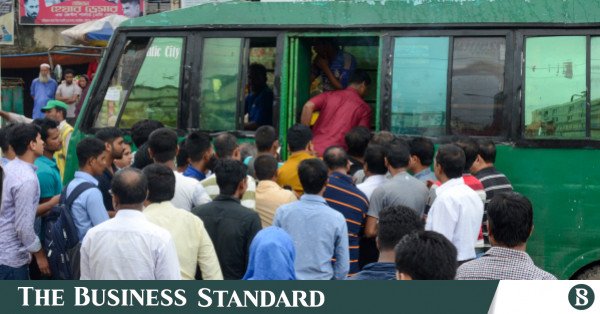
A growing number of people in Chattogram city are relying on public transport for commuting, but the number of vehicles has failed to keep pace with rising demand.
The result is long waits at busy stops, frequent vehicle changes midway through journeys and fares higher than officially approved rates.

The problem is further aggravated by allegations that many buses and tempos do not complete their designated routes. Instead, some operators reportedly focus on sections where passenger demand is higher, leaving commuters travelling between less lucrative stops to suffer.
According to the latest BRTA list of approved bus and minibus routes, 16 city routes have a combined ceiling of 1,232 buses. But route permits have been issued for only 1,080, leaving a shortfall of 152 vehicles.
The EPZ route has the largest gap, with permits for only 105 buses against a ceiling of 200. The Karnaphuli Bridge-New Market route has permits for 22 buses against a ceiling of 80, while Route 2 has 36 permits against a ceiling of 80.
However, transport stakeholders say the actual shortage may be greater because not all permitted vehicles operate regularly or cover their entire routes.
New vehicles not entering the roads
The lack of new vehicles is another major reason behind the growing supply-demand gap, according to transport sector stakeholders.
Registration of new CNG-run auto-rickshaws in the city has remained suspended for nearly two decades. Registration and route approval for auto-tempos and several other vehicles have also effectively remained closed for around seven years.
Transport operators also claim that many vehicles remain idle in garages because they cannot obtain the necessary approvals. They warn that regulating existing vehicles without allowing new ones onto the roads will only deepen the crisis.
Auto-tempos form a significant part of Chattogram’s public transport system. The Chattogram Public Transport Directory shows route permits for 119 tempos on the Chawkbazar-Barik Building route, 88 on Muradpur-Oxygen, 108 on Dewanhat-Naya Bazar and 101 on Bahaddarhat-Rastar Matha.
But permit numbers do not necessarily reflect the number of vehicles actually available to passengers, as route violations and irregular operations further reduce effective transport capacity.
Commuters suffer from route violations
Passengers allege that drivers frequently make repeated trips on busy sections of routes to maximise passenger collection and income.
Tempos on Route 5 are supposed to run from Rastar Matha to Amtal, but many reportedly pick up passengers from Bahaddarhat and turn back at Chawkbazar or Andarkilla instead of going to Amtal.
Similarly, Route 1 tempos are supposed to travel between Chawkbazar and Barik Building, but passengers say they are often dropped off midway so drivers can return for more passengers. Students are particularly affected because Chawkbazar has numerous educational institutions and coaching centres.
Similar complaints have been raised about the white tempos on Route 17 and the Route 7 vehicles, which reportedly turn back at different points instead of completing their designated routes.
Mohammad Shahjahan, general secretary of the Chattogram District Road Transport Owners Group, blamed inadequate monitoring by BRTA and the traffic department.
“BRTA issues route permits but does not properly monitor them afterwards,” he said.
He said route violations were particularly common among tempos and legunas (human haulers), which he claimed were sometimes influenced by local political leaders and therefore did not comply with regulations.
Higher fares add to the burden
Route violations force passengers to change vehicles and pay separate fares for different sections of their journeys, increasing both travel costs and commuting time.
Passenger Md Shaheen said his daily cost of travelling to and from work had doubled from Tk20 to Tk40-50.
Meanwhile, there is no government-approved fare chart for tempos and legunas, unlike buses and minibuses. Passengers allege that fares rise further during rain and after evening falls.
Mehedi Hasan, a private-sector employee, said he usually pays Tk10 for a green tempo from Bahaddarhat to Amtal in the morning, but the fare rises to Tk20 in the evening. He also has to wait nearly an hour for a vehicle.
Passengers also complain of higher fares on buses. On the Kalurghat-Airport Road, Route 10 buses reportedly charge Tk15-20 for distances that previously cost Tk5-10. On the Bahaddarhat-New Market route, passengers allege that buses, minibuses and tempos charge up to Tk20 instead of Tk10.
Mohammad Mozammel Haque Chowdhury, secretary general of Bangladesh Jatri Kalyan Samity, said unscrupulous transport owners and drivers were exploiting the shortage.
“Besides charging passengers excessive fares, they are dropping them off before the final destinations of designated routes,” he said, calling for stronger BRTA and traffic department monitoring.
Laws exist, enforcement questioned
Urban planner Engineer Delwar Majumder identified weak road management as a key reason behind the crisis. He said the city faced both a shortage of public transport and a lack of quality vehicles, alongside a large number of unfit vehicles.
BRTA Chattogram Divisional Deputy Director (Engineering) Rayhana Akter Urthi said mobile courts were continuing to operate to ensure compliance with government-approved fares.
Chattogram Metropolitan Police Additional Commissioner (Traffic) Hossain Mohammad Kabir Bhuiya said the traffic department was working to enforce route permit conditions.
According to the World Bank’s Chattogram Strategic Urban Transport Master Plan, the city generates an estimated 59-67 lakh trips every day, with 65-71% of passengers using buses, tempos and human haulers.
About The Author