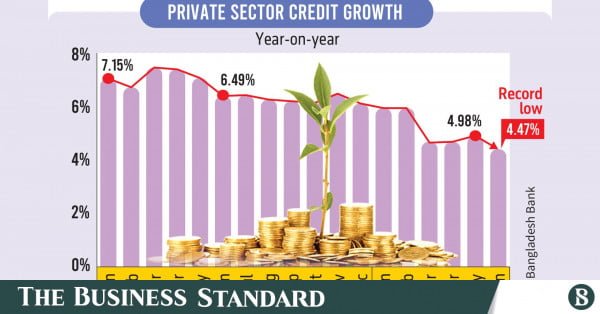
Private sector credit growth in Bangladesh fell to a record low of 4.47% in June as weak investment, factory closures and persistent gas and power shortages sharply reduced demand for bank loans.
According to Bangladesh Bank data, credit growth stood at 4.98% in May, 4.75% in April and 4.72% in March, staying below 5% for four consecutive months. The June reading replaced March’s 4.72% as the lowest on record.

Speaking to The Business Standard, bankers and economists said subdued business confidence, slowing industrial activity, and limited expansion plans have significantly weakened demand for credit, while rising government borrowing from commercial banks has also squeezed financing available to the private sector.
Investment slowdown weighs on lending
Industry insiders said new private investment has slowed considerably, with many large industrial groups shutting factories and others operating well below capacity because of weak demand and an uncertain business environment.
Many manufacturers said they have reduced production by 30% to 40%, while most industrial enterprises have decided against undertaking major new investments or expanding existing operations over the next few years.
Although the national election was held in February, business leaders said the expected investment-friendly environment has yet to emerge.
Bankers identified shortages of gas and electricity as one of the biggest obstacles to business expansion.
They said many planned industrial projects remain stalled because of inadequate gas connections.
Hassan O Rashid, managing director of Eastern Bank, said private sector credit growth has remained weak because of subdued investment caused by the conflict in the Middle East and Bangladesh’s energy situation.
He said, “Credit growth has been slow or on a lower trajectory due to a lack of new investment on the back of war in the Middle East and the local energy and power situation. However, with the help of the Annual Development Programme and policy support from both the government and Bangladesh Bank, I foresee the economy picking up momentum by the first quarter of next year, which will drive credit growth.
“Business confidence will be the key driver since our entrepreneurs have always prevailed against all adversity.”
A deputy managing director of a private commercial bank, speaking on condition of anonymity, said many businesses ceased operations after the fall of the Awami League government, while others continue to operate far below capacity.
He said several factories owned by major business groups, including Nassa Group, Beximco Group and Gazi Group, had closed, reducing demand for bank borrowing.
“When factories were operational, they imported capital machinery. But even the firms still running have reduced production by 60% to 70%,” he said.
Economists urge stronger deposit growth
Economists said improving deposit growth is essential to revive private sector lending, as deposits remain the primary source of funds for commercial banks.
Ahsan H Mansur, former governor of Bangladesh Bank, said higher government borrowing from commercial banks is limiting the availability of credit for private businesses.
He also questioned the recent reduction in the policy rate, arguing that lower interest rates on deposits would discourage savings rather than stimulate lending.
Mansur said, “Government borrowing from commercial banks has increased, affecting private sector credit. Deposits are the main source of funds for lending.
“However, by reducing the policy rate, the government has also lowered deposit interest rates. Reducing the policy rate alone will not solve the problem. Deposit growth must increase.”
Banks had increasingly invested surplus funds in Treasury bills and Treasury bonds as private sector credit demand weakened, making government securities an important source of earnings.
However, bankers said interest rates on Treasury bills and Treasury bonds have declined in recent auctions, reducing returns from those investments.
About The Author