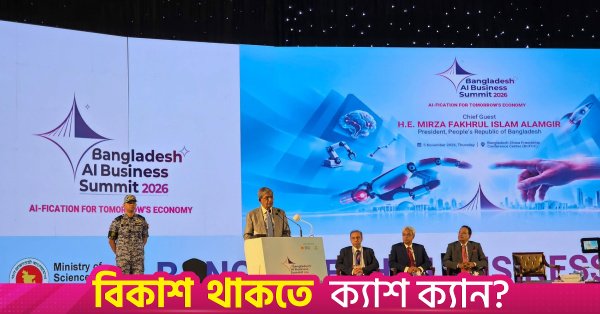
Artificial intelligence must be used as a strategic tool to increase production, modernise industries, attract new investment and create dignified employment opportunities for millions of young people as Bangladesh pursues its ambition of becoming a trillion-dollar economy by 2034, President Mirza Fakhrul Islam Alamgir said today (5 November).
“Artificial intelligence (AI) must be used as a strategy for increasing production, modernising industries, expanding exports, attracting new investment and creating dignified employment opportunities for millions of young people,” he said.
Addressing the inaugural Bangladesh AI Business Summit 2026 at the Bangladesh-China Friendship Conference Centre in Dhaka, the president said AI was no longer merely a futuristic technology but could become one of the principal drivers of Bangladesh’s future development.

Citing international research, he said AI was expected to add trillions of dollars in value to the global economy over the next few years, and Bangladesh must seize this opportunity by developing its capacity to innovate and apply the technology.
“I believe that if the government, private sector, researchers, universities and the younger generation work together, we will be able to overcome the challenges of graduating from the least developed country category and fulfil our dream of becoming a trillion-dollar economy by 2034,” he said.
The president urged businesses to look beyond using AI merely as a tool for reducing costs and instead embrace it as a means of developing new products and services, entering new markets and generating employment.
He compared AI’s transformative potential with the invention of electricity, saying the technology was changing civilisation and would bring even faster changes in the years ahead.
However, he cautioned that the growing influence of AI must not come at the expense of human control, values and employment.
“Technology must be for people, not people for technology,” he said, stressing that AI must be used safely and regulated effectively to prevent potential risks to humanity.
He also warned that AI should not aggravate Bangladesh’s unemployment problem. Technological advancement, he said, must enhance human capabilities, uphold human values and contribute to public welfare.
Identifying the country’s large young population as its greatest strength, the president said young people were technology-friendly and capable of leading the Fourth Industrial Revolution. But they must receive proper education and technological skills to benefit from the emerging opportunities.
He expressed optimism that Bangladesh’s AI industry could establish a new global identity for the country, just as the ready-made garment industry had done.
The president said the government had started work on a human-centric national AI policy, focusing on ethics, human rights, risk-based regulation and responsible innovation. Developing national AI capabilities based on the Bangla language is also part of the initiative.
Business leaders call for AI investment
Dhaka Chamber of Commerce and Industry (DCCI) President Taskeen Ahmed said Bangladesh must become not only an adopter of AI but also a country capable of developing and applying the technology.
He said AI could be a game changer for cottage, micro, small and medium enterprises (CMSMEs), which face constraints in production costs, market analysis, skilled manpower, financing and technology investment.
AI could help smaller businesses improve management and operational efficiency, while sectors such as ready-made garments, agriculture, finance and logistics could use the technology to produce and export higher-value products, he said.
Taskeen called for investment in national AI infrastructure, AI laboratories and research centres in educational institutions, and stronger collaboration between industries and universities.
He also stressed the need for high-speed connectivity, cloud infrastructure, high-performance computing, cybersecurity and skilled manpower to build an AI-enabled economy.
International Chamber of Commerce (ICC) Bangladesh President Mahbubur Rahman said AI could help industries improve production planning, product quality control, market-demand analysis and supply-chain management, particularly in export-orientated sectors such as RMG.
He said the technology could also create opportunities for Bangladesh to develop AI-based software and services for international markets instead of depending solely on imported solutions.
Referring to the extension of Bangladesh’s LDC graduation preparation period until 24 November 2029, he said the additional time should be used to improve productivity, export competitiveness and technological capacity.
He called for affordable AI solutions, training and easier financing for smaller businesses, alongside reskilling programmes to prepare workers for changing job requirements. He also emphasised the importance of data security, privacy, transparency and human oversight in AI deployment.
The summit was attended by Science and Technology Minister Faqir Mahbub Anam, MP; M Ruhul Quddus Talukder Dulu, chairman of the Parliamentary Standing Committee on the Ministry of Science and Technology; Science and Technology Secretary Md Anwar Hossain; and Professor Alamgir Hossain, CEO of Digital Readiness and Intelligent Systems Ltd, UK, and former chairman of the Department of Computer Science and Engineering at the University of Dhaka, who delivered the keynote presentation.
About The Author