The workshop noted that only eight Bangladeshi institutions have so far secured LWG certification. Although around 140 of the 162 allocated tanneries in Savar are operational, most cannot directly export to European and US markets due to a lack of certification.
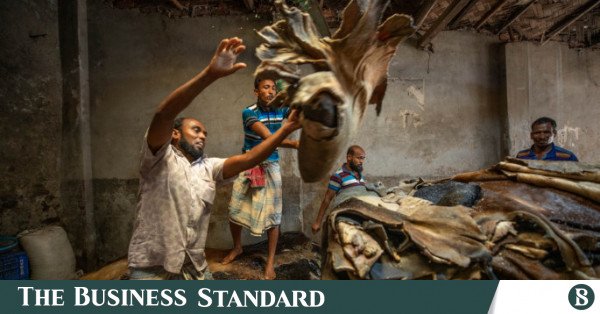
Rawhide being processed in a tannery. File Photo: Mumit M/TBS
“>

Rawhide being processed in a tannery. File Photo: Mumit M/TBS
Highlights:
- Exporters earn one-third of potential price due to lack of LWG certification
- Only 3 of 20 Savar tanneries score above 50% in LWG compliance audit
- Raw leather exported to China at lower prices
- China reprocesses Bangladeshi leather and re-exports to high-value markets
- Weak CETP operation identified as major barrier to investment
A recent audit of 20 tanneries in the Savar Tannery Industrial Estate has found that most are still far from meeting international compliance standards under the Leather Working Group (LWG) protocol – one of the key reasons Bangladesh continues to lose potential share in the high-value global leather market.
Conducted in the current fiscal year, the audit showed only three tanneries scored above 50%, with the highest at 51%. Six others scored above 40%, while the rest performed poorly, according to findings presented at a workshop yesterday (13 May).

The session, titled “Gap Assessment and Follow-up Programme Findings Sharing Workshop on Tanneries Preparedness for LWG Certification,” was jointly organised by the Bangladesh Tanners Association (BTA) and the Business Promotion Council (BPC). Additional Secretary of the Ministry of Industries, Md Nuruzzaman, attended as the chief guest, while BTA President, Md Shaheen Ahmed, chaired the event.
The report flagged the Central Effluent Treatment Plant (CETP) in Savar as only partially functional, discouraging new investment in the sector.
Photo: TBS
“>

Photo: TBS
Sustainable Leather Expert Md Afzal Hossain, presenting the findings, said tanneries must improve occupational health and safety, emergency preparedness, pre-treatment systems, and waste management to qualify for LWG certification.
He noted that out of 1,710 total LWG points, 300 relate to CETP and waste management – an area where Savar tanneries are significantly behind.
He also stressed the need for accurate water-use tracking and monitoring of treated wastewater discharge. Other recommendations included environmentally safe chemical use, formation of skilled technical teams for process control, and at least 10% renewable energy adoption. He further suggested mechanical desalting and separation of soak liquor for salt recovery in leather processing.
The workshop noted that only eight Bangladeshi institutions have so far secured LWG certification. Although around 140 of the 162 allocated tanneries in Savar are operational, most cannot directly export to European and US markets due to a lack of certification.
As a result, they sell raw leather to China at lower prices, where it is processed and re-exported to high-value markets in Europe and the United States, weakening Bangladesh’s position in global value chains.
Additional Secretary Md Nuruzzaman said the existing CETP cannot be replaced immediately, as a new facility would take at least two to three years to build. Efforts are underway to upgrade the current plant while planning a second CETP.
He added that the government is considering soft loans to help non-compliant tanneries install individual effluent treatment plants (ETPs).
Business Promotion Council Director Md Razzaqul Islam said local firms are receiving only one-third of the potential global leather prices due to a lack of LWG certification.
BTA President Md Shaheen Ahmed said entrepreneurs have invested around Tk10,000-Tk12,000 crore in Savar, but the absence of a fully functional CETP has prevented access to global markets.
He said improper salt use and storage during Eid-ul-Azha lowers leather quality and prices. He also urged water metering, solar energy use, and converting solid waste into resources to improve competitiveness.
According to the Export Promotion Bureau (EPB), leather exports reached $1,145.07 million in FY2024-25. The global leather goods market, valued at $440.64 billion in 2022, is projected to reach $738.61 billion by 2030, according to Fortune Business Insights.
Speakers expressed hope that ongoing gap assessments, training, monitoring, and technical support will help Savar tanneries meet international standards and secure LWG certification, boosting export earnings.
About The Author