The national budget for the upcoming fiscal year will be placed in parliament on 11 June, followed by a supplementary budget on 15 June.
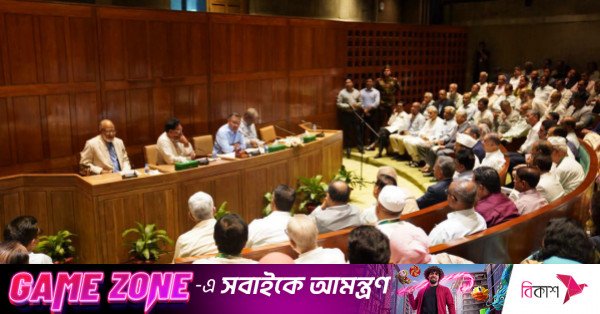
Prime Minister Tarique Rahman chairs a meeting of BNP lawmakers at the National Parliament building, 6 June 2026. Photo: PMO
“>

Prime Minister Tarique Rahman chairs a meeting of BNP lawmakers at the National Parliament building, 6 June 2026. Photo: PMO
Prime Minister Tarique Rahman has emphasised the need for job-oriented education as the performance of seven ministries was reviewed in a parliamentary meeting ahead of the upcoming budget session.
The meeting was held at the National Parliament building from 3pm to 6:20pm today (6 June), chaired by the prime minister.
Representatives from seven ministries presented evaluations of their activities and outlined 120-day action plans.

It was announced that the new national budget for the upcoming fiscal year will be placed in parliament on 11 June, followed by a supplementary budget on 15 June.
Following the meeting, Chief Whip Nurul Islam Moni briefed journalists, stating that the government is prioritising reforms in the education curriculum, with a strong emphasis on vocational and job-oriented learning.
He said the prime minister has directed that any education system which does not prepare students for employment is not effective, and therefore vocational components are being incorporated into the curriculum.
He also mentioned that admission fees for Class XI have been reduced by Tk2,000-3,000, and strict action will be taken against institutions charging extra fees.
On primary education, he noted plans to introduce tablet devices for teachers, improve “happy learning” initiatives, and expand mid-day meal programmes.
In the health sector, Moni said steps are being taken to upgrade hospitals, supply medical equipment, and ensure availability of medicines.
He added that agreements have been signed with China to build five 1,000-bed hospitals, including one in Nilphamari, with at least one designated for women and children.
Referring to the economy, he said rising prices were partly driven by currency depreciation during previous governments, with the exchange rate moving from Tk86 to Tk119-120 per US dollar and contributing to inflation.
He added that the government is working to reduce public hardship through necessary measures despite fiscal challenges.
Responding to a question on constitutional reform, he said that major reforms have already been completed and any future changes will be amendments carried out by the BNP process.
He further said the government is working to establish a welfare-oriented, people-friendly, and democratic state.
About The Author