The BNP leader also alleges the Rakkhi Bahini was used to kill thousands of political activists after independence, and credits Ziaur Rahman with building the modern army.
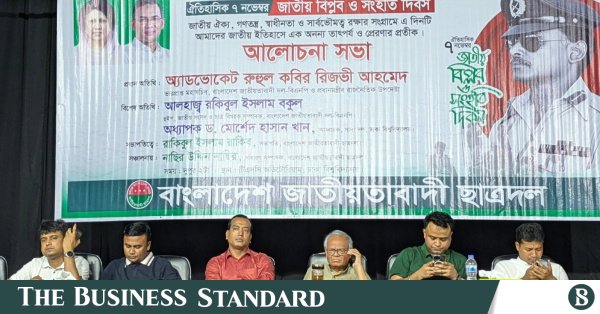
BNP Acting Secretary General Ruhul Kabir Rizvi spoke at a discussion organised by the Bangladesh Jatiyatabadi Chhatra Dal at the Teacher-Student Centre (TSC) auditorium of Dhaka University on 8 November 2026. Photo: TBS
“>

BNP Acting Secretary General Ruhul Kabir Rizvi spoke at a discussion organised by the Bangladesh Jatiyatabadi Chhatra Dal at the Teacher-Student Centre (TSC) auditorium of Dhaka University on 8 November 2026. Photo: TBS
BNP Acting Secretary General Ruhul Kabir Rizvi today (8 November) said the people would never accept ousted prime minister Sheikh Hasina’s return to Bangladesh, questioning whether the sacrifices made during the 2024 July Uprising would be allowed to go in vain.
“After shedding so much blood and ruling the country so brutally, she [Sheikh Hasina] has announced that she will return in December. Will the epic revolution we witnessed, in which so many children, teenagers and young people sacrificed their lives and faced bullets without backing down, go in vain?” Rizvi said.
He made these remarks while speaking at a discussion organised by the Bangladesh Jatiyatabadi Chhatra Dal at the Teacher-Student Centre (TSC) auditorium of Dhaka University this afternoon, marking National Revolution and Solidarity Day.

He asked whether the revolution of Abu Sayed, Mugdha and Ahad, and the sacrifices of Wasim Akram and Faiyaz, would go in vain.
“Will Hasina simply parachute into the country and be welcomed by everyone beating drums? That can never happen. This is Bengal, a land of heroes. Those cowards who fled and did not hesitate to shed the blood of their own country’s children cannot simply fly back and impose themselves on the people, expecting to be accepted. That will never happen,” he said.
Referring to the long years of struggle, Rizvi said Hasina had created an even more severe form of Baksal than the one introduced by her father.
He recalled that many people, including some who had told him directly, believed the government could not be challenged because it had India’s backing and had brought everything under its control, including all security and law enforcement agencies.
“I told them to wait. We would continue our relentless struggle and keep protesting, making use of whatever space we had,” he said.
Turning to the period after independence, Rizvi said, “Back then, anyone who criticised the then government or said anything against it would disappear, or their body would be found lying somewhere. A government organisation, the Rakkhi Bahini, was formed to carry out these killings.
“Through this force, they killed political party leaders and activists — some say 25,000, some 30,000 and others 40,000. In other words, the country was run according to one person’s orders and wishes, and no one could say a word against it. The November 7 uprising freed the country from this situation,” he added.
Referring to the tragic killings of 15 August 1975, Rizvi said those who came to power afterwards were also Awami League men. Khondaker Mostaq Ahmed and everyone in his cabinet, he said, had been in Sheikh Mujib’s cabinet until the day before 15 August.
He said the bloodshed came from their own internal feuds and clashes.
People then thought Baksal was gone, Rizvi said. But when Khaled Mosharraf staged another coup in the army on 3 November, put Ziaur Rahman and his family under house arrest and forcibly made himself army chief, fear gripped the people.
He said the country remained in that stifling situation for four to five days. Then came 7 November, and Ziaur Rahman emerged at the centre of power.
The BNP leader said the modern, powerful army of today was Ziaur Rahman’s contribution.
He alleged that the then Awami League government had destroyed the army’s spirit and built the Rakkhi Bahini in India’s interest, while Colonel Taher and his associates used the army for their own bid for political power.
“They formed committees inside the cantonments. How can this be? A disciplined organisation, and inside it they formed committees of a soldiers’ organisation,” he said.
Rizvi said that after 7 November Zia found himself caught in such plots and conspiracies and, with full understanding of the situation, pursued a very smart and skilful foreign policy.
“He knew where danger could come from and who could cause it. So, he improved relations with the United States, and with China too,” he said.
He noted that China, which had not recognised Bangladesh before 15 August 1975, developed relations with the country from Zia’s time.
About The Author