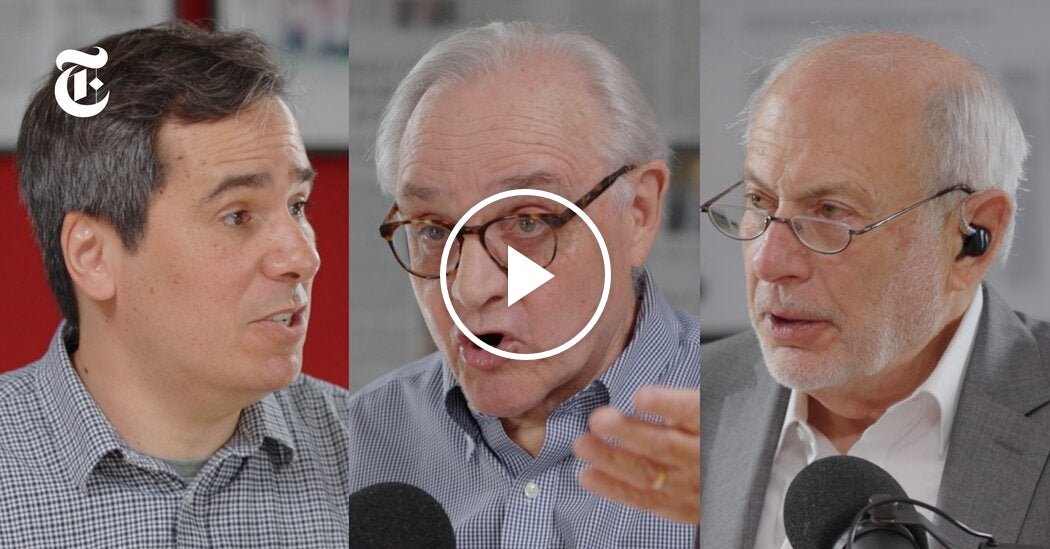
Hi, I’m Robert Siegel. in a conversation about politics once again with my fellow times Opinion contributor, E.J. Dionne. Always great to be with you and returning to join us is Times Opinion columnist Carlos Lozada. Happy to be back. Great to see you. This was a week when a deadline came and went. It was a deadline Donald Trump set in the war against Iran. Rather than resume attacks on Iranian targets Trump declared a continuation of the ceasefire until, in his words, Iran’s leaders and representatives can come up with a unified proposal. Well, not only did Trump keep military action on hold, he also delayed Vice President Vance’s departure to take part in diplomatic action. An Iranian spokesman declared Trump’s extension of the ceasefire to have no meaning, which squares with news that two container ships were seized near the Strait of Hormuz by the Islamic Revolutionary Guards Navy. If you find this confusing. Join the club. We start very far from the straits here on the home front with this question. Has the war in Iran and the economic shocks that it has brought taken the measure of the self-proclaimed master artist of the deal in the White House. E.J. you go first. Are we seeing the limits of Donald Trump’s ability to spin his way out of political trouble. Indeed I mean, the template for Trump’s ability to spin, to lie, to intimidate, to distract from any problems was set when he said he could shoot someone on Fifth Avenue and get away with it, at least with his supporters. But it’s very clear that there were some things that can’t be spun. One is people’s own perceptions of their own economic circumstance. Trump was elected with a promise to on day one to bring down prices, and sent a strong message that was going to be a central purpose of his administration, and he’s done. You could say exactly the opposite of that. The tariffs, whatever their long term effect, will be clearly increased rather than decreased prices. And now this war has increased prices for oil and therefore lots of other things. And voters are noticing that. And no matter what he says about affordability being a word invented by his opponents, people see that. And when you are as ill prepared for this war as Trump clearly was, when you expect your enemy to fold instantly and win as easily as he seemed to win and as he won in Venezuela, you are not prepared for what we face. And when you’re looking at these negotiation attempts, it really underscores how this is the cliff notes presidency. That just doesn’t take detail seriously when President Obama negotiated the deal with Iran, there were all sorts of people there, including physicists like the energy secretary for my hometown, Ernest Moniz. Here you got a real estate guy, his law and the vice president. And the last thing I want to say about what people are noticing about the recklessness in this administration is also connected to cruelty. There was a really powerful piece in The Times this week that I urge folks to read by Elizabeth Bumiller and Eileen Sullivan about what the wreckage of U.S.A.I.D. means for the lives of people there. And not to mention for American interests in the world, and for vastly increasing the suffering of the poorest people around the globe. If you wanted to throw a hand grenade at American respect and influence around the world, you’d wreck U.S.A.I.D. just like that. And people are seeing all of these things. Carlos yeah. One thing I would add this whole notion of Trump as the master dealmaker, as dealmaker in chief. It’s all part of this a long running Trump mythology that was part of the art of the deal, part of “The Apprentice.” I think what we’re seeing now very clearly in the second term is the limits to his deal making prowess, especially internationally. You mentioned, he was going to bring down prices on day one. He was also going to end the Ukraine war in a day. Remember, this was something he said like more than 50 times on the campaign trail. His trade deals have been all over the map, in part because the tariff policy has been all over the map. And the court has put limits on his ability to do that. Sending JD Vance the first time around for a day to negotiate is theater. You can’t conclude negotiations on such an array of complicated issues in one day. I agree, I don’t think Trump has the attention to detail, the patients, frankly, for arduous negotiations that lead to a real deal. I think he wants to save face. He wants to say that whatever he gets was better than the Obama deal, and he wants to get out as soon as he can. You wrote recently about a phrase that Trump has used to describe progress in the war. It’s on schedule or it’s ahead of schedule. Yes, it’s a remarkable thing. He used it right away at the very beginning of the war in early March, he said to CNN that the war was a little ahead of schedule. Then in mid-March, he said it was very far ahead of schedule. And then in a cabinet meeting towards the end of the month, he said, it was extremely really a lot ahead of schedule. And so this is a tick of Trump’s real estate days, when he would always brag that his construction projects were under budget and ahead of schedule. But building is one thing. A war is something else. It feels a very transparent attempt to project a sense of competence, of control. If there’s a schedule, then there must be a plan. And if we’re ahead of schedule, then the plan must be working. Also, a schedule implies an end date, which is very important for a leader who promised to not embark upon endless wars. It seems silly to have to say it, but wars do not progress on neat schedules, especially when it turns out your enemy is more capable than you imagined. And when your partner has different objectives from your own. So you see the president making threats with timelines and ceasefires that come and go and get extended till the schedule, the time frame is meaningless. He’s not really trying to manage a war. He’s trying to manage the news cycle, manage the markets and hold on to his fracturing coalition. No, that was an excellent piece. And you also, by the way, wrote one of the best pieces of exegesis of the art of the deal some time ago, a long time ago, but it still lives. I think one thing about what Carlos said that’s so important is this time thing. We have gotten so inured to Trump constantly saying, wait two weeks, wait three weeks. And it’s his way of where there’s a problem here. If I push it down the road, people might not remember it then. And I can get by that. Wait two weeks, wait three weeks with a war absolutely doesn’t work. And now, instead of being a way to push a problem aside, it’s a way to that there is no plan and there is no easy way out of this. Well, let’s move on to this past week’s election in Virginia, voters there approved a plan to redraw the state’s congressional maps so as to possibly shift as many as four seats to the Democrats. This is the same scheme that California voters had already approved. And this was all a response to Trump’s urging Texas and some other Republican states to redraw maps that would add to the Republican total. E.J., which is more noteworthy, the fact that Virginia approved this plan, or that it did so by just a little over 51 percent of the vote. A good deal less than what Abigail Spanberger polled when she won the governorship a few months ago. Yeah I don’t think anybody was surprised that this vote was closer than that. First, the polls had been very clear going in, and what you really had were Republicans overwhelmingly against the new lines, Democrats overwhelmingly for them, and independents who had voted, given Spanberger a decent vote, were uneasy about overturning the line. So that wasn’t shocking. I think what was so interesting is a lot of the Republican advertising did not make the case for Republicans. They quoted Spanberger and Barack Obama, who were leading supporters of yes, on this, of overturning the lines, things they said in the past about the costs of gerrymandering. So now Democrats fill the airwaves with Obama saying, vote yes on this because we need to go after Trump. I think it shows that Democrats would like to have no gerrymanders anywhere. And they introduced a bill to have national standards outlawing gerrymanders. But when you have Trump threatening like this, they said, we can’t. I am so tired of you can’t bring a knife to a gunfight metaphors. But that’s what you’re hearing out there. And I think they’re right. They can’t just let Republicans gerrymander and sit back and say, we’ll lose five seats here and seven seats there. So they said no. After the win. House Democratic Leader Hakeem Jeffries praised the Democratic Party in a statement, saying when they go low, we hit back hard. Carlos, how do you like the new “when they go low, we go just as low” Democrats? I’m not crazy about the new look. I understand why they’re doing it. I understand the logic why they feel they have to. Republicans stated in Texas, who knows, they may do it in Florida. The Democrats feel they can’t unilaterally disarm. And Jeffries, of course, is riffing off the famous Michelle Obama line. When they go low, we go high. And that was from the 2016 election, which the Democrats went on to lose. So they’re tired of getting kicked around of the knife to a gunfight metaphor. That doesn’t change the fact, as they seem to recognize that gerrymandering makes our democracy less Democratic. Gerrymandering allows politicians to pick voters rather than the other way around. The house has always been the more representative part of the American legislature compared to the Senate. That is eroding with something like this. I will cite no less an authority than the great E.J. Dionne, who in a column for years ago complained about the anti-democratic nature of the Supreme Court’s Rucho v. Common Cause ruling when the court said that we can’t get involved in stopping political gerrymandering. I completely agreed that it was anti-democratic. I think this may be perceived as a defeat for Donald Trump in Virginia, but I think it’s a victory for Trump’s style of politics. And I think we all lose with that result. I don’t entirely agree with that. I do dislike gerrymandering. I do think it’s anti-democratic. And one of the reasons that I dislike that court decision so much is that the court had the power to say that representation should be representation, and they could have set certain standards for the nation where we wouldn’t have these fights. We wouldn’t have Trump going down to Texas and Democrats then going to California. So, yeah, I would much prefer a world like that. But I think the other question about if you will, Jeffries versus Michelle Obama quotations, which I think is exactly the way to cite it, is tactically, I think Democrats are all in on doing whatever they need to do to win. Then there’s the moral question. And it did strike me that when Eric Swalwell was accused of sexual misconduct the whole party, the whole Democratic Party, pretty much said got to get out of the race. There wasn’t a pause there. There wasn’t a well, let’s look at the facts. Now, granted, that doesn’t always happen in these but it was an interesting moment where Democrats decided they’re going to go all in on tactics. But there are certain things that will hurt them if they don’t stand up against what they perceive as moral lapses and the. Well, I want to take note of something else that happened recently in Virginia. Just briefly, Governor Spanberger signed a bill by which Virginia joins the National Popular Vote Interstate Compact. That’s a movement to get states with a combined majority of Electoral College votes. It’s 270 to pledge those votes, not necessarily to the winner in their state, but to the winner of the National popular vote. And if you add Virginia’s 13 electoral votes to those of the states that had already signed on, they’re up to 222. This is a long shot, but a possibility if it turns into a Democratic wave year, that there could be enough states involved to reach 270, which would append the electoral college or reduce it to a ceremonial function. E.J., you wrote about this back in 2007. Is it conceivable to you that this could happen. We’re citing all of E.J.‘s old columns. Exactly I’m being held accountable here. The two things on this that I think are important. One is how we have lost our constitutional imagination. We used to update the Constitution regularly. The framers envisioned us updating the Constitution. Heck, in the case of the electoral college. They updated it really fast after it kind of blew up in the 1800s election. And it’s become almost impossible to amend the Constitution for various political reasons. And I hope we get back to a time, as recently as the 1960s, we had a number of changes to the Constitution that were passed. And I hope we get our constitutional imagination back, because I think the electoral college is an extremely outdated and undemocratic way of choosing a president. I welcome this interstate compact. That’s why I wrote about it when it passed way back when Maryland joined it. And do I think it will happen. I think it’s still a long shot. You need a number of states. You probably need a Democratic trifecta in a number of these states. The idea, just so people understand, is that these states commit themselves, require their electors to cast their votes for the winner of the popular vote. And if you get 270 plus if you get a majority of the electoral college committed to that, then we have direct election of the president. I think it will be litigated and litigated and litigated even if they get there. So I’m not yet confident it will get there. But I really appreciate it because it is reminding us that there’s no democracy in the world that has such a jury rigged system of picking a president. Carlos, it strikes you as a clever workaround or a suspicious end run around the Constitution if you like the compact, it’s a clever and necessary workaround. If you don’t, then it’s an end run on the Constitution. So I recently read Jill Lepore’s new book called “We the People” on the history of efforts to amend the history of mostly failed efforts to amend the Constitution and how difficult it has become to do that. As you say, the bar is high in a logistical sense, but also almost impossible to meet in a country that’s so polarized and so closely divided. The last time that the United States came close to getting rid of the electoral college, to changing the way that we pick the presidents was before I was born. It was the House approved overwhelmingly, an election by popular vote in 1969, and it failed in the Senate. I share your concerns about the electoral college, the undemocratic nature of the electoral college. This feels a little gimmicky to me, and I feel I can see a million ways in which it can go wrong. What if one state reneges under some kind of political pressure. What if the popular vote nationwide is very close. Does that trigger a nationwide recount like everywhere, or is it a recount in just a few states the way it might be now. Also, it feels pretty partisan. You mentioned it would require a Democratic wave. E.J., you mentioned the Democratic trifecta. It would need to make this happen. Somehow I imagine that if Al Gore and Hillary Clinton had each won the electoral college while losing the popular vote, Democrats might be talking about the sage wisdom of the founders in establishing this system. And I don’t know that all these states would be so eager to embrace the compact if it happens. I hope that it would be a step along the way to actually really amending the Constitution, rather than a permanent substitute for that kind of amendment. What I would much prefer an amendment, obviously. But democracies all over the world, France notably has elected their president by popular vote. I mean, if they can do it, we can do it. But you’re raising that 1969 case is really important, because one of the unfortunate things right now is an issue that wasn’t entirely partisan back then. So yes, it would be nice if this issue, which ought to be about Democratic accountability, could become bipartisan or nonpartisan again, but we don’t see that coming anytime soon. Well, onto something else. Our not quite literature conversation right now. One of the signs of spring in years like this one. None dare call it literature. None dare call it literature is the blossoming of books by would be presidents times like with no incumbent able to run in the next presidential election, can probably eliminate unemployment among ghostwriters for months, if not years, to come. I’ve read two of the books that are out. One by Pennsylvania Governor Josh Shapiro, “Where We Keep the Light.” And California Governor Gavin Newsom’s “Young Man in a Hurry.” Shapiro comes off as a suburban everyman. Big Obama supporter who shares Obama’s passion for shooting hoops. Prides himself on listening to people who didn’t and won’t vote for him. And if he were nominated, he would be, I think, the kind of Democrat who would seek broad support and deal with Republicans and wouldn’t be a Bernie Sanders progressive. He is also Jewish and quite observant. His Jewishness could make this interesting, because this is a time when it’s widely believed that there is an increase in anti-Semitism in the U.S. He was in the governor’s mansion when it was firebombed. To contrast the Shapiro book with Newsom’s book, which is very much about family and about his grandparents and his divorced parents and his aunts and his uncles, Shapiro writes this. “We didn’t spend much time with our grandparents. Both of my parents’ had strained relationships with their parents and families.” That’s it for the grandpa. That’s it. That’s the only mention they get. That would be two chapters or three chapters in Gavin Newsom’s book about halfway through his book, Newsom explains this obsession with family, which is the sense in San Francisco that many regarded him because of his family’s closeness to the family of J. Paul Getty. The Getty of Getty Oil that he was regarded as the fifth Getty son, that his successes might be seen as having been driven by Getty wealth, not by his own. And he writes at one point that if he’d stayed in business with one of the Getty’s that could have robbed him of his hard earned story, a theft that would become one of the very reasons for writing this book. Carlos, you’ve slogged through more of these books by would be presidents than I think anyone I maybe anyone on Earth. Why do candidates write these books. I think a lot of them feel they have to write this dutiful campaign memoir, even when they really don’t especially want to do it. As you say, they’re often ghostwritten. They often have these painfully generic titles like “Looking Forward,” “The Truths We Hold,” “American Son,” American fill in the blank, “American Journey,” why do they do it. It’s a chance to sanitize their lives and their records. Place themselves in the most favorable and electoral light. It’s also an opportunity, as you describe, with Gavin Newsom. It’s a chance to try to knock out whatever the prevailing criticism of them is. If Gavin Newsom gives off this sense of the perfect hair rich kid, then he tries to change that perception in this book, as you just explained, it’s also a publicity exercise. They get booked on TV and on podcasts and on and on live events. Talk about the book. So they get to tease the presidential run for the publishers. It’s like a lottery ticket. Because these books often don’t sell well. But if your candidate happens to become the nominee or happens to win the presidency, then the book becomes a best bestseller. Now, those are very few and far between. And instead, you have remainder piles everywhere with “Courage to Stand” by Tim Pawlenty. Those books that really don’t make it. God bless Tim Pawlenty. No offense to the great state of Minnesota. I think it’s really good that we are the first people to cover one of the most important contests in America, the book primary because this happens cycle after cycle. And I actually want to defend these books because I think they can be very revealing, even sometimes to the detriment of the candidate if they are completely empty. And you’ve had historically some interesting ones. Just one of the ones that I’m looking forward to that’s coming out at the end of May is Chris Murphy’s book. And the Senator from Connecticut. It’s not clear whether he’s running for president or not. It’s called the “Crisis of the Common Good: The Fight for Meaning and Connection in a Broken America.” And it’s a real argument that combines populist economics with a serious look at loneliness and social isolation and the breakdown of community. And I think it’s going to spark an interesting debate. You also had people jump the queue. Pete Buttigieg had a very interesting book, “The Shortest Way Home,” that I liked. I reviewed it back then. That came out just before the 2020 election, which was actually a good idea because he wasn’t known by anybody, and it proved to be a pretty good introduction to go to Carlos’s point sold a lot of books when his campaign took off. And of course, Kamala Harris jumped the queue with her memoir on the last campaign. If I can just very briefly shout out three really important ones historically. John F Kennedy’s “Profiles in Courage,” written while he was a senator, debated how much did he write. How much did his speechwriter Ted Sorensen write. But he created a phrase that entered the popular lexicon. Richard Nixon’s “Six Crises.” Yes, I’m going to stand up here for Richard Nixon was a very interesting look that was quite candid about moments relatively speaking, we’re dealing with self-serving books, but relatively candid. Look at six major moments in his life. And the one that really paid off for the publishers, Barack Obama’s “Dreams From My Father,” which wasn’t a bestseller. And then it took off. And it’s a good book. I know you’ve mentioned there is a downside risk — you can write a book that harms you. And one recent example of that would be Kristi Noem’s. Yes, yes. So the journalist Michael Schaffer —— leave out shooting the dog. If you write a book, that would be one of the rules. Never, ever do that. Well, it was amazing. The journalist Michael Schaffer wrote an article in Politico about that episode, and he said that the rule of political books should first, do no harm is the No. 1 rule, and usually they are harmless. I completely agree, I’ve made a living out of mining these books to find the unintentionally revealing detail that they often do. Now what Kristi Noem did is admit that she shot her dog. Not just shot her dog, shot her dog out of anger and embarrassment, and then proceeded to shoot her goat because the goat was right there. And she had never liked the goat either. So it turns out these books can be harmful. They certainly hurt her chances for vice president, which was something that was vaguely in the air at the time, though it did give us a sense of how thoughtlessly and callously she would serve as D.H.S. Secretary. So that proved useful for at least this reader. Are there any actual upsides that can we cite someone whose campaign was aided by a book. So my rule of presidential memoir, if Michael Schaefer’s was do no harm, my rule of presidential memoir memo writing is that the closer the book is to your time in office, whether before or after, the worse the book is right, and the further removed it is from your time, the better you tend to write it. There are three great books to my mind that certainly have aided if not the campaign. The place in history of the writers. One is “Dreams From My Father” as you said E.J. The other is the memoirs of Ulysses S. Grant. And he wrote a beautiful memoir that really didn’t even address his time in the White House. In fact, reading it, you would never think that this guy was a politician. And the last one I will mention is by someone who could have made a living as a writer instead of a politician. That was Jimmy Carter, and my favorite of Jimmy Carter’s books is one called “An Hour Before Daylight,” which is a memoir which he wrote 20 years after the White House, about growing up on his father’s farm in Georgia during the Depression, and really, all three of those were far removed from their political aspirations and from their time in office. And I think that made them better. Well, on that note, we come to our traditional last question, which is let’s set aside politics and wars. What brought some joy into your life since last we met. And E.J., why don’t we start with you. Well, I actually want to stick to books because I was thinking about this. The joy that continuators have brought to my life. Now who are continuators? I happen to love popular fiction mysteries and thrillers, and when a successful writer dies, there are still lots of fans out there who love the series, who love the characters, want to stay with them, and publishers, and often the families of these late authors realize people still want to read these books. And so for me, keeping those series alive has been an awesome thing. Anne Hillerman is a good example. The daughter of Tony Hillerman, the author of the great Navajo series, which are beautiful about the Southwest, about Navajo spirituality. Tom Clancy was “The Hunt for Red October.” This may be the most successful continuator franchise. He’s got a regiment of people, or in his case, I suppose it would be a crew, since it’s mostly naval, a crew of people. Keeping him alive. One of my very favorite set of mysteries are Rex Stout’s “Nero Wolfe.” The enormous detective who lives in a brownstone in New York City, a writer called Robert Goldsborough. was his continuator. I discovered Rex Stout through his continuator and then gobbled up all the rest of the books. So thank you to these folks for keeping a tradition alive and for entertaining an awful lot of us. And I would just add, John Le Carré’s son has —— I was going to mention that one. So thank you. Carlos, I love that you brought up the continuators because it reminded me of my favorite novelist of all time is the late Mario Vargas Llosa, who passed away last year, the greatest Peruvian novelist, Nobel laureate. And in his Nobel speech, he talked about how the first stories he ever wrote were continuations. He didn’t want like, as a little boy. He didn’t want these stories that he loved to end. So he just kept writing, bless you for lifting up my popular fiction tastes into something truly profound. No, because I’m going to bring it. I’m going to bring it right back to where you were because and we did not plan this. But I’m also going to write a talk about books. And, and explain. So one thing that we do as a family at home is we read together, we might read over dinner. Someone reads aloud. And we get through a lot of stories that way. But recently I’m going I’m going to mention one that we read recently, which gave me a lot of personal joy when I was a kid, my parents would get those abridged, condensed books from Reader’s Digest. That would come in four mini novels in one hardcover. I remember those, and there was one by Dorothy Gilman, who was a very popular spy novelist. She wrote these novels called the Mrs. Pollifax novels. And it was this Northeastern elderly woman who somehow was involved with the C.I.A. and was a spy. She wrote a book, Dorothy Gilman called “The Tightrope Walker.” It had all sorts of murder and politics and sex and corruption. And when I was maybe like 12 years old, I just thought this was the greatest novel in the world. But it never occurred to me that there was a fuller version of it. And that it was out there in the world. And I just thought of it a few weeks ago. And so I ordered it. And I got the full one, and that became the story that we read. So it was a chance to have this great communal experience with the kids, but also a throwback for me to finish the novel that I’d never fully read when I was in middle school. Well, I’m going to put in a word for basketball, and that was this. I delighted in watching a game which I really didn’t care about either team. But in watching Victor Wembanyama, the 7 foot 4 inch player who is redefining the game of basketball, it took me back to being a kid. Seeing Wilt Chamberlain play as a rookie in Madison Square Garden, a guy who was changing the game of basketball, not only the biggest man on the court, but the best athlete on the court. And I was so, so thrilled with the way Wembanyama was playing in this game in which they his team beat the Portland Trail Blazers as they were expected to that I tuned in a few nights later to game number two. Just at the moment when I see Wembanyama sprawled on the ground and being taken off or running off to the locker room to be treated under the concussion protocol. And it just reminded me what a risky thing it can to be a professional athlete and how quickly you can lose it. I don’t know when he comes back, but he’s great. He’s an extraordinary talent. I love the notion of watching excellence and innovation like that in sports go together. It’s really an amazing thing. Well, thanks to both of you once again. Carlos Lozada, E.J. Dionne. Thank you Robert. Appreciate it.
About The Author