The project aims to make villages economically self-reliant through locally specialised products, says the state minister.
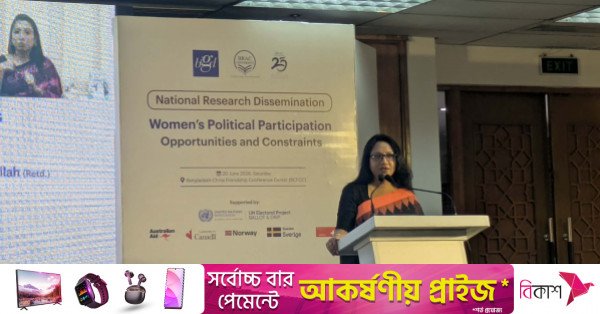
State Minister for the Ministry of Social Welfare, Farzana Sharmin Putul, speaks at a discussion titled “Women’s Political Participation: Opportunities and Constraints”, organised by BRAC Institute of Governance and Development (BIGD) at the China Friendship Conference Centre in Dhaka today, 20 June 2026. Photo: TBS
“>

State Minister for the Ministry of Social Welfare, Farzana Sharmin Putul, speaks at a discussion titled “Women’s Political Participation: Opportunities and Constraints”, organised by BRAC Institute of Governance and Development (BIGD) at the China Friendship Conference Centre in Dhaka today, 20 June 2026. Photo: TBS
State Minister for Social Welfare Farzana Sharmin Putul today (20 June) hinted that the government’s planned “one village, one product” initiative will be launched soon as part of a broader strategy to strengthen rural economies and promote sustainable development across the country.
Speaking at a discussion titled “Women’s Political Participation: Opportunities and Constraints”, organised by BRAC Institute of Governance and Development (BIGD) at the China Friendship Conference Centre in Dhaka, the state minister said the government’s development agenda is increasingly focused on villages rather than urban centres alone.
Highlighting the upcoming programme, Farzana Sharmin said work is underway to implement the initiative, which aims to harness the economic potential of rural communities.

Although detailed information about the project has yet to be disclosed, she said the government would soon announce the full implementation framework and strategy.
The project aims to bring sustainable development to every household and make villages economically self-reliant, she added.
“Our plan is not only to develop Dhaka or the eight divisional cities,” she said. “Most of our initiatives are now village-oriented. Because if we can truly develop a village, the entire country can move forward in a self-reliant way”, she said.
She stressed that development should go beyond conventional infrastructure projects such as roads or upgrading school buildings, and instead focus on holistic transformation.
“True development means the overall and sustainable transformation of a village – where every family’s well-being is ensured, children’s education is accessible, youth have employment opportunities, mothers are safe and receive healthcare and fathers have stable jobs or businesses,” she said.
Earlier, the initiative was outlined in the National Budget for FY2026-27, which was tabled by the Finance Minister Amir Khosru Mahmud Chowdhury on 11 June, with a financial outlay of Tk9.38 lakh crore.
Under the initiative, a range of products linked to the creative economy are being identified, including handloom products, pottery, weaving crafts, shital pati, shataranji, wooden toys, handmade jewellery and terracotta items.
According to the government’s plan, “Creative Hubs” will be established across the country to improve product quality, develop modern designs and enhance the skills of entrepreneurs involved in these sectors.
These planned hubs will be set up at the premises of Shishu Academy and Shilpakala Academy at the district and upazila levels.
As part of the initiative, the government also plans to establish a world-class “Central Creative Hub” on 160 acres of land in Purbachal. The centre is expected to serve as the country’s main hub for research, training, innovation and international market linkages in the creative industries sector.
At the same time, a “National Pool of Designers” comprising renowned designers from across the country will be formed to improve the design and quality of locally produced creative products.
Through this platform, modern and internationally competitive designs will be developed for local products, while fostering collaboration between designers and artisans to strengthen Bangladesh’s creative economy.
About The Author