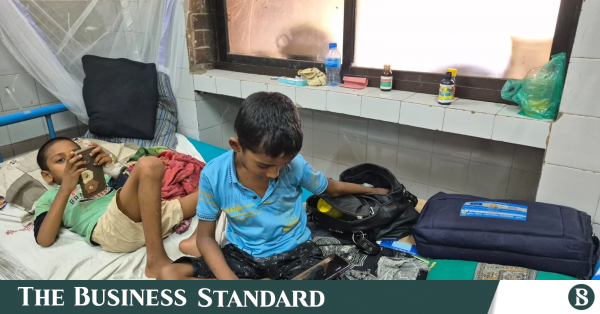
Eight-year-old Ila Moni has been undergoing treatment for dengue at Shaheed Suhrawardy Medical College and Hospital for three days, sharing a single bed with two other children.
As child dengue admissions rise, two to three patients are sharing many of the beds in the hospital’s paediatric wards, while the pressure is also making it difficult for doctors and nurses to provide care.
Ila, a Class 2 student from Mirpur, was diagnosed with dengue three days ago. She was initially taken to Bangladesh Shishu Hospital and Institute, where she was given treatment but referred to Suhrawardy Hospital as no bed was available.

She was admitted there, but has to share a bed in the 20-bed non-paying ward with two younger children.
Her mother, Sanjida Begum, told The Business Standard that the family had spent around Tk5,000 on treatment and tests before Ila was admitted.
She said they were also spending around Tk500 a day on blood tests at the hospital and had not been told how long Ila might need to remain admitted.
Three-year-old Lisa has also been undergoing treatment for dengue at Suhrawardy Hospital for two days and is sharing a bed with another child.
Lisa, from Taltola in Agargaon, suffered convulsions after developing a high fever.
Her father, Mohammad Liton, said they spent Tk3,600 on tests at a private facility before bringing her to the hospital. They are now spending around Tk500 a day on blood tests, he said.
Liton runs a tea stall and has had to keep it closed while staying at the hospital for his daughter’s treatment.
Their experiences reflect the growing pressure on the hospital’s paediatric wards as dengue admissions rise.
Beds stretched beyond capacity
Many beds in the paediatric dengue ward were occupied by two or three children yesterday afternoon. Some were receiving intravenous fluids, while relatives carried other children around the ward.
No mosquito nets were seen over the beds.
Nurses said patients and attendants were reluctant to use mosquito nets because of the heat and overcrowding, despite repeated requests from hospital staff.
They said the number of patients frequently exceeds the designated capacity, forcing two to three children, and sometimes four, to share a bed.
Senior Staff Nurse Shamima Akter said the overcrowding was making it difficult for healthcare workers to provide treatment.
“It becomes particularly difficult when too many attendants stay with the patients, as movement and medical work are disrupted,” she said.
She said inserting cannulas in children was already difficult, and the overcrowding made the task more challenging.
Nurses said 12 nurses are assigned to the 20-bed ward, but managing patients becomes difficult when admissions rise above capacity, particularly during evening and night shifts.
They also said the 30 designated dengue beds have at times accommodated more than 90 children.
Doctors and nurses said most of the children admitted were between three and 12 years old.
45 children in 30 designated beds
Associate Professor Dr Farzana Afrooz, the focal person for the hospital’s dengue ward, told TBS yesterday afternoon that across the three paediatric units, 45 children were being treated against 30 designated beds.
Farzana said dengue admissions had remained higher than discharges over the past several days.
Although only 30 beds are designated for children, patient numbers often remain one-and-a-half to two times higher, forcing the hospital to accommodate as many as three children in a single bed, she said.
“This creates a very difficult situation for patients, attendants, doctors and nurses,” she added.
Farzana said the paediatric department had also been treating measles patients for an extended period, putting further pressure on doctors and nurses. While the number of measles patients has declined somewhat, dengue admissions are increasing, she said.
Despite the pressure, no child has died of dengue in the hospital’s paediatric department so far this year, according to Farzana.
She urged parents not to panic immediately after a child is diagnosed with dengue.
Children who can eat and drink normally can often be monitored at home instead of being admitted to hospital, she said.
She advised giving children adequate fluids, including oral rehydration solution, soup, coconut water and lemon drinks.
However, children should be taken to hospital quickly if they develop warning signs such as excessive vomiting, severe abdominal pain, inability to eat, diarrhoea or bleeding, she said.
Farzana also advised keeping children under mosquito nets, dressing them in full-sleeved clothing and keeping the surroundings of homes clean to prevent mosquito breeding.
Six more dengue deaths nationwide
Meanwhile, six people died of dengue across the country in the latest 24-hour reporting period, while 1,942 patients were admitted to hospitals.
The latest figures took the country’s dengue death toll this year to 239 and the cumulative number of hospitalised cases to 77,672, according to the Directorate General of Health Services.
Of the new admissions, 292 were children. Since January, 12,593 children have been hospitalised with dengue and 44 have died.
About The Author