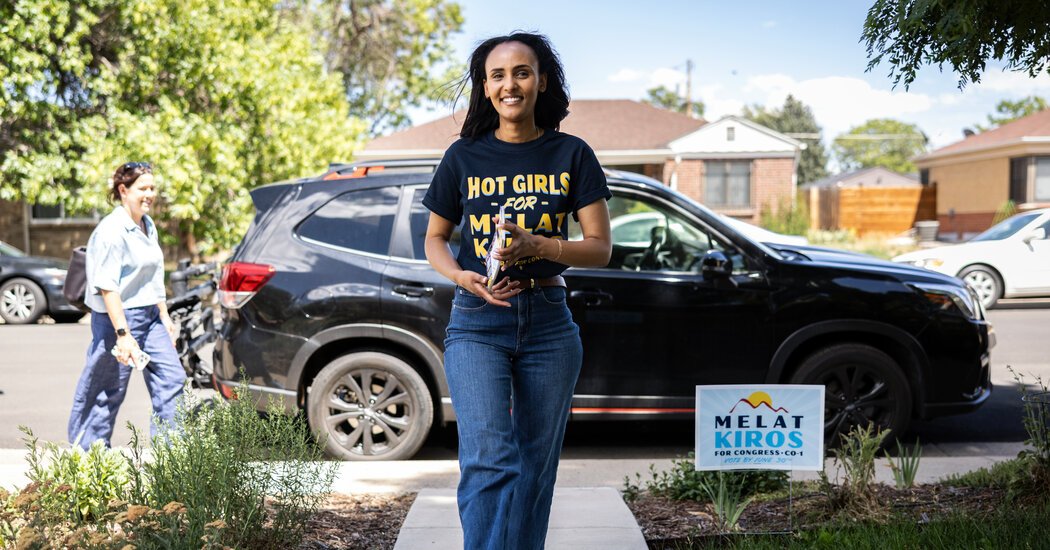
Melat Kiros was fresh out of Notre Dame Law School in 2023 when she was fired by her New York law firm after publishing a lengthy letter sharply criticizing Israel’s government, raising questions about its historical legitimacy and challenging the firm’s response to law students engaging in pro-Palestinian activism.
In Tuesday’s Democratic primary in Colorado, under the banner of the Democratic Socialists of America, Ms. Kiros, 29, is again challenging the establishment. This time, she hopes to defeat Representative Diana DeGette, 68, a liberal Democrat who was elected to her Denver-area seat a year before Ms. Kiros was born.
The showdown is the latest between the mainstream Democratic Party and its ascendant, youthful left wing, but Ms. Kiros represents more than the D.S.A. She is one of several Gen Z candidates this year fueled by the generational frustrations of their pandemic-marred youth, social media-fueled isolation, artificial intelligence and the war in Gaza.
The upset pulled off by Darializa Avila Chevalier, 32, a socialist doctoral student, over Representative Adriano Espaillat, 71, in last week’s New York Democratic primary may have only set the stage for the generational and ideological fights to come — on both sides of the political aisle.
“When you’re living through these kinds of moments on such a regular basis, it feels impossible to be able to change course and believe your vote actually makes a difference,” Ms. Kiros said.
But, she added, “we’re seeing just how broken the system is, and we’re seeing that no one’s coming to save us but us.”
Ms. DeGette sees lawmakers of all ages working together as important, citing her work with younger members of Congress like Alexandria Ocasio-Cortez, 36, and Jake Auchincloss, 38, on Medicare for All legislation. But Ms. DeGette still believes experience and community involvement are tantamount to age.
“What voters look at in these races is they look at who they think is going to most effectively represent them and who can have the power and leadership to fight against Donald Trump,” she said.
For Gen Z voters, youth and recent history have shaped their views. They did not experience the exhilaration of Barack Obama’s hope-fueled 2008 campaign or George W. Bush’s calls to service after the attacks of Sept. 11, 2001. Instead, they have weathered a decade of President Trump’s “American carnage” narrative and the gerontocracy of Joseph R. Biden Jr. Their beefs tend to be less with the other party than their elders.
Gen Z voters express higher levels of party alienation than any other generation; two-thirds of Gen Z respondents in a recent New York Times/Siena poll expressed dissatisfaction with both Democrats and Republicans. Among Gen Z Democrats, 68 percent said they were unhappy with their own party.
But the rise of Gen Z and young millennial candidates demanding change is not limited to Democrats.
Joe Mitchell, the founder of Run GenZ, an organization aiming to elect young conservatives, is vying to fill the seat of Representative Ashley Hinson of Iowa, a Republican running for Senate. Mr. Mitchell, 29, who runs a real estate development company, represents a brand of young male Republicans inspired by Charlie Kirk, the slain conservative activist, and driven by their Christian faith and by values aligned with Mr. Trump’s political movement.
“Everything I do is going to be America first,” said Mr. Mitchell, a former state representative. “Everything we do should be focused on, ‘how can we help the American worker?’”
Brendan Trachsel remembered celebrating his 16th birthday as he watched election results come in for Mr. Trump’s first presidential win in 2016. Although he grew up in a conservative household in the San Diego suburbs, he said he was in “utter shock that someone who is completely OK with treating people so horribly would get into office.”
After starting at Northern Arizona University in 2019, he registered with the Green Party. Now 25, Mr. Trachsel is running for the Arizona House of Representatives in a Democratic-held district near Flagstaff, focusing on labor organizing, data center moratoriums and tighter protections for online privacy.
If he wins, Mr. Trachsel would be the first third-party official in the Arizona Legislature. He cited Zohran Mamdani’s mayoral campaign in New York as an inspiration.
“It was just so people-focused, so intent on just shutting up and hearing what people needed and want,” Mr. Trachsel said.
Startled by Mr. Trump’s return in 2024, Leila Staton, 22, and her mother formed the Insufferable Wenches of Iowa, a progressive group designed in part to link like-minded but socially isolated rural residents. No Democrat had filed to run this year against the two-term Republican state legislator representing her district, so Ms. Staton, who lives in Stout, population around 200, decided to run herself.
College graduates from rural Iowa tend to leave the state. Ms. Staton pointed to a State Legislature, where in 2023 the average age was 54, as unrepresentative of her generation.
Ms. Staton has focused her campaign on public education, which has been drained of cash by a new school voucher program; family farms struggling with rising costs and corporate pressure; drinking water that is contaminated with nitrates; and Iowa’s rapidly rising cancer rates.
“There’s a lack of opportunity, prices are rising, wages are stagnant,” she said, “and our cancer crisis has no clear solution.”
Gen Z politicians are also the first largely born after the Columbine massacre in 1999 and raised amid the drumbeat of school shootings that followed.
Tyler Smith, 26, was in a Los Angeles high school when, in 2018, a gunman killed 17 people at Marjory Stoneman Douglas High School in Parkland, Fla. He joined school walkouts and watched as a young breed of activists emerged from Parkland.
While working for a gun control group, Mr. Smith decided to run as a Democrat for a Texas House seat this year in the Houston area held by a staunch conservative, insisting, “People right now are sick and tired of the same old, same old.”
Braxton Mitchell, a 26-year-old Montana state representative, also became involved in political activism in 2018. But for him, the gun control walkouts that followed Parkland did not represent his “way of life,” so he spearheaded a counter walkout, against gun control, at his high school in Columbia Falls, Mont. After graduation, he got on a plane for the first time and flew to Washington to meet Mr. Kirk, who had been sending him messages of support.
A year and a half later, the state Republican Party chairman, Don Kaltschmidt, encouraged Mr. Mitchell to run for his local legislative seat, then held by a Democrat. He won and is now running for re-election.
“We need all generations at the table, especially in places like the state legislature, because the decisions being made are going to impact my generation the most,” Mr. Mitchell said.
He’s working on a school safety bill to put panic alert systems in rural schools across the state — without gun control.
Covid-19 is another shared experience. James Thibault, the son of a landscaper and a nursing assistant in New Hampshire, had no political aspirations until the pandemic shut down schools. Then politicians reopened them with mask mandates that Mr. Thibault, a high school freshman at the time, found onerous and not conducive to learning.
He protested at school board meetings. He was appointed to a youth legislative council. Then he filed to run for state representative before he graduated from high school. He was elected at 18 as a Republican, becoming the youngest state legislator.
“Covid was a wake-up call,” said Mr. Thibault, 20, who is running for re-election this year.
In Denver, Ms. Kiros also cited the pandemic as consequential to her own politics. “Stagnant” cultural norms that demanded working in offices suddenly gave way to acceptance of remote work, she said. The burning of fossil fuels plunged. Then those social benefits went in reverse.
Her frustrations with current representatives have only grown deeper.
“I don’t know if it’s ego,” Ms. Kiros said. “I don’t know if it’s recklessness. There really is just no sense of preparing or leaving the world better than where they found it.”
About The Author