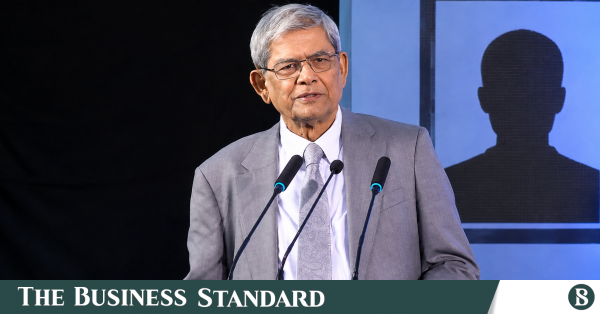
President Mirza Fakhrul Islam Alamgir today (30 August) pledged to ensure justice for victims of enforced disappearances, saying Bangladesh would never again allow “Aynaghar” or secret detention centres to exist.
“Let me state clearly as the President of Bangladesh: there will be no more ‘Aynaghar’ in this independent Bangladesh. No mother will have to shed tears waiting for her child, and no wife will have to wait for her husband,” he said.
The President was addressing a discussion marking the International Day of the Victims of Enforced Disappearances 2026 at the Bangladesh-China Friendship Conference Centre in Dhaka.

He said all perpetrators involved in enforced disappearances would be brought before the law and face the highest punishment as per law.
The President also stressed that the state’s responsibility would not end with punishing the perpetrators.
“The state must also assume responsibility for the dignity, social security, healthcare, education, livelihoods and rehabilitation of families who have endured years of uncertainty, financial hardship and mental suffering while waiting for their loved ones,” he said.
Recalling the victims of enforced disappearances in Bangladesh and elsewhere in the world, the President expressed deep sympathy for their families who have spent years waiting for the return of their loved ones.
He described enforced disappearance as not an ordinary crime but a crime against humanity and a grave violation of human rights.
“Enforced disappearance does not merely take away a person. It takes away the happiness, peace, dreams and economic and social security of their loved ones,” he said.
Referring to the past 15 years, the President said enforced disappearances, secret detention centres and killings were used to silence those who protested against injustice, expressed dissent or demanded democratic rights.
He said state institutions under the previous “fascist government” repeatedly denied such serious crimes.
The President recalled the cases of BNP leader Ilias Ali, ward commissioner Chowdhury Alam and ward-level BNP leader Sajedul Islam Sumon, among others, saying their families continued to live with pain, uncertainty and expectation.
President Fakhrul also referred to lawyer Barrister Arman, retired Lieutenant General Azmi and many dissidents, officials, writers, journalists, social workers, homemakers and ordinary citizens who were kept in the secret detention facility known as “Aynaghar” for years.
Some victims fortunately returned, while many others have never come back, he said.
The President said the culture of enforced disappearances and killing created an atmosphere of fear and terror in a country that was liberated in 1971 through the sacrifices of freedom fighters who fought for democracy, equality, freedom of expression and human dignity.
Calling it a painful and shameful chapter in the country’s history, he said Bangladesh must now pursue justice rather than revenge.
“Now, instead of revenge, we must ensure redress and bring the actual perpetrators under the law,” he said.
Referring to the final report of the Commission of Inquiry on Enforced Disappearances, the President said the commission identified 1,569 incidents as enforced disappearances, of which 287 victims were found to be missing and dead.
He said the report clearly showed an increase in enforced disappearances before elections and the targeted abduction and secret killing of political opponents, demonstrating how state power was misused for partisan and personal interests.
The President said the commission’s report provided an important foundation, but much remained to be done.
He said the Enforced Disappearance Prevention and Remedy Bill, 2026 was placed before Parliament to protect victims and their families and permanently prohibit enforced disappearance.
Bangladesh has also signed the International Convention for the Protection of All Persons from Enforced Disappearance, he said, adding that trials related to enforced disappearances and genocide were progressing through the International Crimes Tribunal while maintaining transparency and international standards.
Mirza Fakhrul said Bangladesh must become a country where political differences exist without political vengeance, freedom of expression exists without a culture of fear, and law enforcement never becomes a means of violating human rights and justice.
“State power will exist, but that power will remain under the control of the Constitution and the law,” he said.
He stressed that a country’s development should not be measured only by economic growth, but also by how democratic, welfare-oriented, just and humane the state is, and how safely and respectfully its citizens can live.
“We are committed to building such a new Bangladesh,” he said.
The President called on all to work together to establish a Bangladesh where democracy, human rights, equality and dignity form the foundation of the state, good governance guides its administration, accountability and freedom of expression strengthen democracy, and justice becomes the right of every citizen.
He prayed for the victims and their families and wished that Bangladesh would move beyond the darkness of enforced disappearance and impunity towards a path of truth, justice and humanity.
About The Author