At 39, Feroza Khatun thought she had survived the worst Myanmar’s Rakhine State could throw at her. Nearly a decade after the 2017 military crackdown drove hundreds of thousands of Rohingyas into Bangladesh, she was forced to flee again – after losing her husband and home.
Feroza lived with her husband and five children in Jabbar Para village in Buthidaung, near Maungdaw. In November 2025, she said, Arakan Army members took her husband away. Soon after, their neighbourhood was burned down. She has heard nothing from him and believes he was killed.
With five children to feed, Feroza survived by begging before crossing into Bangladesh about five months ago. She now lives in Camp 24 at Balukhali, Ukhiya.

Her story reflects a growing displacement from Rakhine, where fighting between Myanmar’s military and the Arakan Army has continued since November 2023. More than 153,000 Rohingyas entered Bangladesh by June this year, according to the RRRC. They have been under Bangladesh-UNHCR joint registration since January 2025.
Between April and June alone, 5,311 Rohingyas from 1,527 families arrived. RRRC data show 92,656 arrivals in 2024, 17,858 in 2025 and 34,690 in the first six months of this year.
Caught between two forces
For Rohingyas remaining in Rakhine, conflict has brought burned villages, destroyed livelihoods, food shortages and forced labour. Some say they are pressured to fight or accused of links to armed groups.
Mohammad Zubayer, 23, arrived with 11 family members in March after their Monibil Para village in Buthidaung was burned two years ago, destroying their clothing business. They later moved to Siogyao, under Arakan Army control.
“There was no work and food was scarce,” Zubayer told The Business Standard. “The Arakan Army made us work in fields and perform night-watch duties without pay.” They fled towards Bangladesh in tarpaulin-covered vehicles, paying 1.2 million kyats per person.
Kamal Ahmed, a madrasa teacher from Maungdaw, fled in October 2024. He said the Arakan Army killed his brother and pressured his children to fight. After being accused of Arsa links, they fled to Bangladesh.
Badrul Islam, a Rohingya boatman at Camp 26, said 102 people from 31 families arrived between April and June. Farming and trade have stopped, he said, causing food shortages.
Rohingyas also face unpaid labour and Tk3 lakh-Tk5 lakh monthly taxes. Heavy rain has slowed arrivals, but they may rise when weather improves.
New arrivals find little room
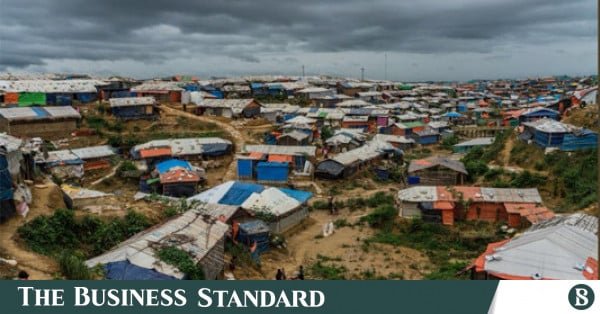
The influx is adding to a population already stretching Bangladesh’s camps to their limits. Nearly 750,000 Rohingyas fled after the 2017 crackdown. Since then, more than 216,000 Rohingya children have been born in Bangladesh, while more than 150,000 additional Rohingyas have arrived in subsequent waves.
More than 1.2 million Rohingyas now live in 33 camps in Ukhiya and Teknaf and one camp on Bhasan Char. The camps occupy roughly 8,000 acres of hilly and forest land, leaving little scope for expansion.
Registered newcomers receive limited food, healthcare and other assistance, but many struggle to find housing. Some stay with relatives or acquaintances, while others rent rooms from locals or fellow Rohingyas.
Feroza received a ration card but could not find a place of her own.
“I had to beg to somehow reach Bangladesh after losing contact with my husband,” she said. “I received a ration card after arriving, but I had nowhere to stay. I now pay Tk1,500 a month to stay in another Rohingya’s room. I have to sell some of my ration rice to pay the rent.”
Aid falls as return remains impossible
The growing Rohingya population is arriving as international funding shrinks. In 2018, with 750,000 refugees in Bangladesh, the $900 million requirement received $600 million.
By 2021, the requirement rose to $980 million for 850,000 refugees, with $620 million funded. In 2025, as the population neared 1.2 million, the requirement fell to $890 million but funding dropped to $410 million.
RRRC official Mohammad Mizanur Rahman said 50-60 new Rohingyas were arriving weekly. “Funding is declining year after year,” he told TBS, adding that health, education, water, sanitation and other services had been reduced.
Repatriation remains stalled. Agreements in 2017 and 2018 produced no meaningful returns, while a China-mediated 2023 pilot to repatriate 1,176 Rohingyas was halted as fighting intensified.
UNHCR’s Cox’s Bazar head Marcel Colun said deteriorating conditions were driving new arrivals, whose experiences resembled those of 2017. He said safe, dignified returns require an end to conflict and rights violations, with guarantees of safety, dignity, peace and stability.
For Feroza, those guarantees remain distant. Having fled twice with five children, she remains in Bangladesh, her only refuge.
About The Author