The government is apparently maintaining strict confidentiality over the leadership structure.
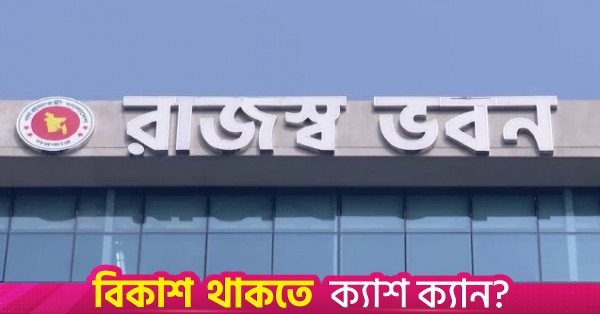
NBR Office in Dhaka. File Photo: Collected
“>

NBR Office in Dhaka. File Photo: Collected
The government may place a bill in the next parliamentary session to advance the long-debated plan to split the National Board of Revenue (NBR) into two separate divisions, as a government-appointed committee has submitted recommendations on the proposed restructuring.
Officials at the NBR and the Finance Ministry told TBS that the report outlines how the restructuring would be implemented and responsibilities distributed between the proposed Revenue Policy Division and Revenue Management Division.
The government is apparently maintaining strict confidentiality over the leadership structure. However, NBR officials said the head of the Revenue Management Division could be selected from among income tax and customs cadre officers.

Finance Minister Amir Khosru Mahmud Chowdhury has reportedly favoured managing the Revenue Policy Division through a council of experts. However, the proposal may not be implemented as administration cadre officials are seeking to retain control of the division, according to sources.
Three NBR officials, speaking on condition of anonymity, said the bill could be placed in the next parliamentary session. They added that even if parliament passes it, completing the necessary procedures could delay full implementation.
The nine-member committee, headed by Prime Minister Tarique Rahman’s Adviser Md Ismail Zabihullah, has submitted its recommendations, although some members reportedly have objections to parts of the proposals.
TBS could not reach Zabihullah, committee member Rashed Al Mahmud Titumir, or NBR Chairman Ahsan Habib for comment despite repeated attempts.
Dr M Masrur Reaz, chairman of Policy Exchange Bangladesh and former senior economist of the World Bank Group, told this newspaper, “The NBR should have been split into two separate divisions much earlier. Still, better late than never.”
He said the split, if implemented effectively, would mark a major step forward in reforming revenue administration.
“Bifurcation should not be undertaken for the sake of bifurcation alone. The government must carefully consider how to ensure that the restructuring achieves its intended objectives,” he added.
Long-running reform dispute
The proposed bifurcation is part of a long-standing reform effort, supported by development partners and the International Monetary Fund, to separate revenue policy formulation from implementation.
On 12 May 2025, the interim government had issued an ordinance separating the two divisions as part of broader revenue reforms.
Income tax and customs cadre officials protested, alleging that the restructuring sidelined them and gave administration cadre officials disproportionate control over the divisions’ leadership, contrary to recommendations by a revenue reform committee.
The dispute escalated after officials defied government directives, forcing the interim government to suspend around 30 officials, send five into retirement and transfer hundreds of others as punishment, according to allegations reported at the time.
Moreover, the Anti-Corruption Commission launched investigations into the assets of several officials.
However, a revised gazette issued in September 2025 eased some concerns, but confidence among field-level officials reportedly remained weak.
A subsequent attempt to operationalise the divisions before the election was reportedly stalled by opposition from administration cadre officials.
On 28 January, Cabinet Division Joint Secretary Tanvir Ahmed sent a legal notice to seven secretaries challenging the legality of abolishing the NBR and establishing the two divisions.
He also sought the annulment of the relevant ordinances.
Sources said some senior administration cadre officials had urged the then finance adviser to cancel plans to appoint secretaries to the divisions before the election.
The initiative subsequently stalled, but the IMF’s recommendations for restructuring the NBR have kept pressure on the government to advance the reform.
About The Author