Every Rohingya refugee must have the opportunity to return to their homeland in safety and dignity, with their citizenship and full rights protected, minister said.
Law, Justice and Parliamentary Affairs Minister Md Asaduzzaman. Photo: BSS
“>

Law, Justice and Parliamentary Affairs Minister Md Asaduzzaman. Photo: BSS
Law Minister Md Asaduzzaman has called for effective international engagement to ensure the safe, voluntary, dignified and sustainable repatriation of Rohingya refugees to Myanmar, saying the crisis cannot be resolved through bilateral efforts by Bangladesh and Myanmar alone.
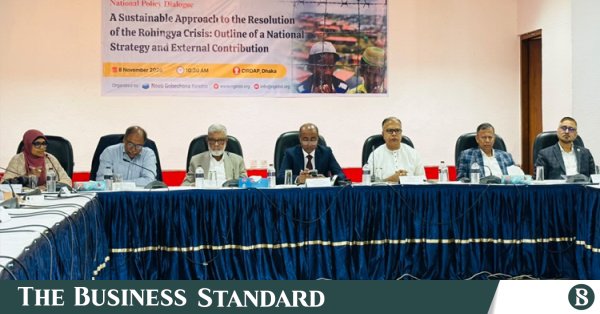
He made the remarks at a policy dialogue on the Rohingya crisis organised by the Centre for Policy Research at the CIRDAP auditorium on Topkhana Road in Dhaka today (8 November).
“The Rohingya crisis is not Bangladesh’s problem alone; it is an international issue. Ensuring their safe, voluntary, dignified and sustainable return to their homeland requires the effective engagement of the international community,” the minister said.

He stressed that repatriation should not simply mean sending Rohingya refugees back to Myanmar.
“Their citizenship, human rights, security, education and dignity must also be guaranteed,” he said.
“The crisis originated in Myanmar, and the responsibility for resolving it also lies with Myanmar. The international community must be involved in finding a sustainable solution,” he added.
Referring to discussions at the UN General Assembly and a meeting with the UN High Commissioner for Refugees (UNHCR) on the sidelines of the session, Asaduzzaman said forcibly returning Rohingya refugees or imposing any decision on them would not resolve the crisis.
Every Rohingya refugee must have the opportunity to return to their homeland in safety and dignity, with their citizenship and full rights protected, he added.
Highlighting the growing pressure on Bangladesh, the law minister said the country is now among the world’s major refugee-hosting nations, with nearly 1.2 million Rohingya living within its borders.
He said around 82 to 90 children are born in Rohingya camps every day, warning that a prolonged crisis would further increase demographic, economic and social pressures on Bangladesh.
The minister also stressed that the crisis involves not only humanitarian concerns but also national security, law and order, and social stability.
A national committee has been formed under the leadership of Prime Minister Tarique Rahman to address the issue, he said.
The committee will work on formulating a national policy to deal with the Rohingya crisis and examine effective initiatives that could be pursued at the international level.
Responding to discussions on ensuring education and other facilities for Rohingya refugees, Asaduzzaman said their rights and dignity deserved serious consideration. However, decisions must also take into account Bangladesh’s economic capacity, social realities and national security concerns.
He said the government intends to pursue an effective resolution to the crisis by drawing on the experiences and approaches of the governments of former prime minister Khaleda Zia and former president Ziaur Rahman.
Welcoming the Centre for Policy Research’s initiative, the minister said the government was keen to learn from experienced researchers and experts and would consider constructive recommendations from policy institutions.
He described such organisations as potential watchdogs and sources of policy guidance for the government, adding that specific proposals and presentations on the crisis would be considered for possible action.
About The Author