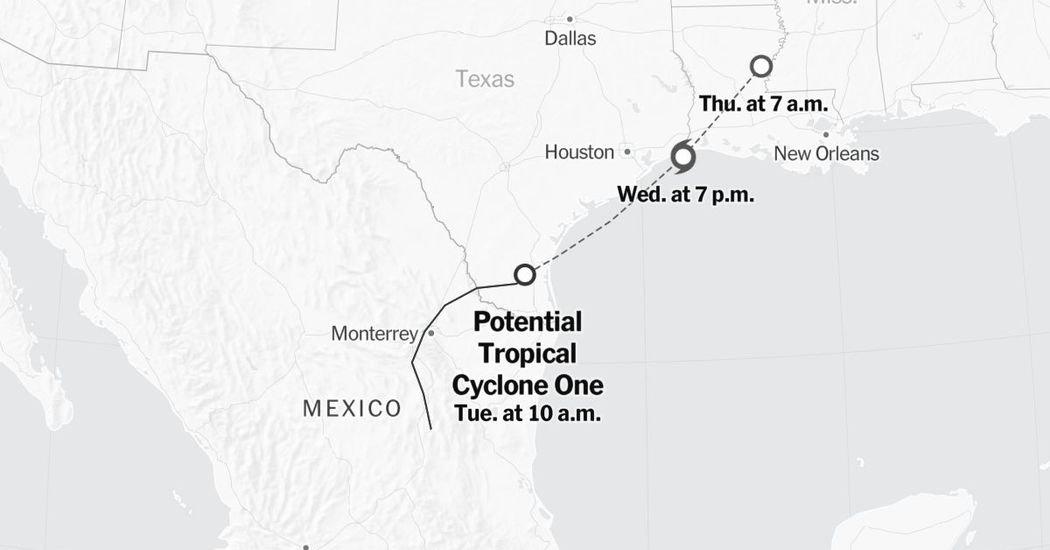
Forecasters were watching a large area of disorganized showers and thunderstorms that could become the first named storm of the Atlantic hurricane season.
The area, called One, was a potential tropical cyclone over Texas Tuesday morning Eastern time, the National Hurricane Center said in its latest advisory.
Forecast wind speeds and direction
Where will it rain?
Flash flooding can occur well inland and away from the storm’s center. Even weaker storms can produce excessive rainfall that can flood low-lying areas.
Tracking One’s rainfall
When a storm comes close enough to land, signals from the United States radar network will begin to bounce off the rainfall within a tropical cyclone, making it easier to locate the more intense section of the storm and the heaviest rainfall. During hurricanes, the storm’s center will be the area on radar void of rain called an eye and completely encircled by the most intense winds and rain called the eye wall. Spiraling out from the center will be bands of rain that vary in intensity.
What does the storm look like from above?
Satellite imagery can help determine the strength, size and cohesion of a storm. The stronger a storm becomes, the more likely an eye will form in the center. When the eye looks symmetrical, that often means the storm is not encountering anything to weaken it.
Where did it rain?
Tropical cyclones typically drop large amounts of rain along and near the storm’s path. The slower and more significant the storm’s size, the higher the likelihood of higher rainfall totals. Some storms can drop well over 30 inches of rainfall, like when Hurricane Harvey dropped over 60 inches near Nederland, Texas, in 2017.
The Atlantic hurricane season started on June 1 and runs through Nov. 30.
In late May, the National Oceanic and Atmospheric Administration, the parent agency of the National Weather Service, predicted that this would be an above-average season, with 13 to 19 named storms. In early August, a revised forecast from NOAA predicted 18 named storms for the season and said up to nine of them could become hurricanes.
Last year, there were 13 named storms, five of which became hurricanes. Four of those hurricanes became what the Hurricane Center calls “major,” or Category 3, 4 or 5 on the Saffir–Simpson scale.
Hurricane Melissa was one of three Category 5 hurricanes last year — and one of the most powerful hurricanes ever recorded. It devastated Jamaica with catastrophic winds and flooding.
Four of last year’s hurricanes underwent what experts call “rapid intensification,” climbing by roughly two categories or more in a 24-hour period. Climate experts have warned rapid intensification is more likely to occur in a warming world.
While Melissa devastated Jamaica, no hurricanes made landfall in the United States last year. It was a start contrast to 2024, which was one of the most costly for hurricanes in the United States. Hurricanes Helene and Milton combined caused about $113 billion in damages and more than 250 deaths. Last year, the Trump administration said it would no longer maintain a database of so-called billion-dollar disasters.
In 2025, the Trump administration slashed the number of employees at many of the agencies traditionally responsible for planning for and responding to natural disasters, including NOAA, the Weather Service and the Federal Emergency Management Agency. The Weather Service has been racing to hire hundreds of new employees since then, but its numbers are still below what they had been in 2024.
Climate change is also affecting the amount of rain that storms can produce. In a warming world, the air can hold more moisture, which means a named storm can hold and produce more rainfall, like Hurricane Harvey did in Texas in 2017, when some areas received more than 40 inches of rain in less than 48 hours.
Researchers have also found that storms have slowed down, staying over areas for more extended periods, over the past few decades.
Sources and notes
Tracking map Tracking data is from the National Hurricane Center. The map shows probabilities of at least 5 percent. The forecast is for up to five days, with that time span starting up to three hours before the reported time that the storm reaches its latest location. Wind speed probability data is not available north of 60.25 degrees north latitude.
Intensity chart Best track and forecast path are from the National Hurricane Center. Forecast models are from University of Wisconsin-Milwaukee.
Wind arrivals table Arrival times are generated from a New York Times analysis of National Hurricane Center data. Geographic locations use data from the U.S. Census Bureau and Natural Earth. Time zones are based on Google. The table shows predicted arrival times of sustained, damaging winds of 58 m.p.h. or more for select cities with a chance of such winds reaching them. If damaging winds reach a location, there is no more than a 10 percent chance that they will arrive before the “earliest reasonable” time and a 50 percent chance they will arrive before the “most likely” time.
Radar map Radar imagery is from the National Oceanic and Atmospheric Administration.
Storm surge map Storm surge data is from the National Hurricane Center. Forecasts only include the United States Gulf and Atlantic coasts, Puerto Rico, and the U.S. Virgin Islands. The actual areas that could become flooded may differ from the areas shown on this map. This map accounts for tides, but not waves and not flooding caused by rainfall. The map also includes intertidal areas, which routinely flood during typical high tides.
Rip currents map Rip current data is from the National Hurricane Center. Rip current risk shown is not always associated with active tropical cyclones.
Satellite map Imagery is from the National Oceanic and Atmospheric Administration and Japanese Meteorological Agency via the Cooperative Institute for Research in the Atmosphere.
Precipitation map Data for multi-day forecasts or observed rainfall totals are from the National Weather Service. The 1-day forecast is from the National Oceanic and Atmospheric Administration.
About The Author