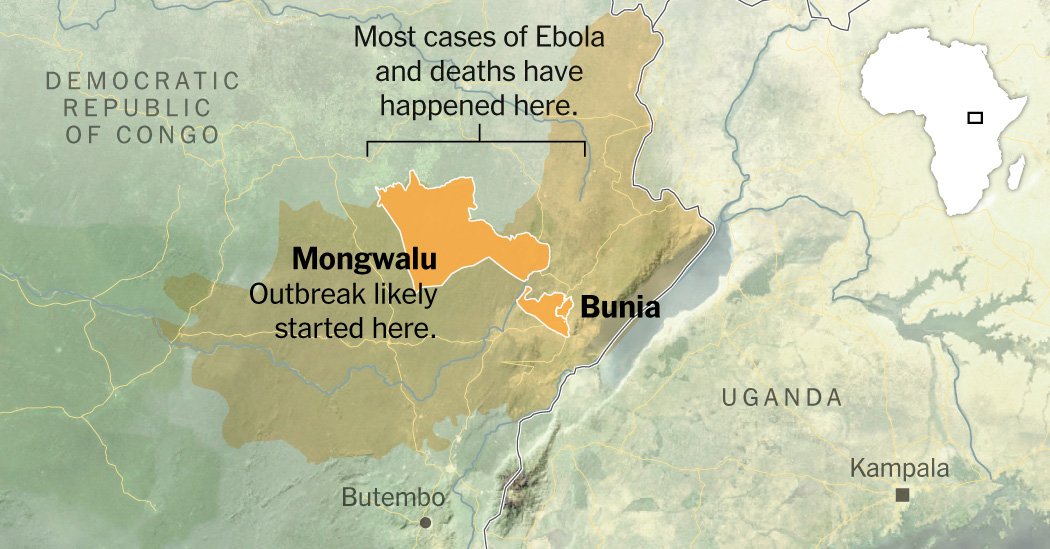
The region of the eastern Democratic Republic of Congo where Ebola broke out has made the virus difficult to contain.
With the area consumed by years of conflict that have displaced more than a million people and stripped health capacity, the rare form of the virus circulated undetected for weeks.
Where Ebola has spread in central Africa
The number of suspected and confirmed deaths is already among the highest for any outbreak in Congo’s history, and officials expect the toll to rise.
A previous Ebola outbreak in the area became the second deadliest ever recorded. It took two years to contain, starting in 2018.
Health officials believe the current epidemic began in Mongwalu in Ituri Province. Heavy population movement is common in the region because of violence and seasonal labor in the gold mines.
Ituri Province borders South Sudan and Uganda, raising concerns about cross-border transmission. Uganda has so far reported two cases in its capital city, including one death. The virus spreads through direct contact with body fluids and is commonly transmitted in health care settings.
Officials have said that a lack of testing capacity in Ituri Province delayed their response to the outbreak. Equipment there, more than 1,000 miles away from the capital, only tests for the most common species of Ebola and not the species causing this current outbreak, so early results came back negative. Samples sent later to Kinshasa, Congo’s capital, identified the rare species, Ebola Bundibugyo.
The unusual species has only been identified in two prior Ebola outbreaks: in Uganda in 2007 and in Congo, just west of Ituri Province, in 2012. The current outbreak has already surpassed the combined toll of these two episodes.
The majority of past Ebola outbreaks on the continent are caused by the most common species, known as Zaire. That form of Ebola caused the deadliest outbreak on record in West Africa more than a decade ago.
Historical Ebola outbreaks
The Bundibugyo species of Ebola is not well understood by scientists, and there are no approved vaccines or therapeutics. Local health officials are working to trace those who may have come in contact with sick people, but warn that contact tracing will be very difficult in a region with so much migration.
The response has also been hampered by the near-absence of the United States, which used to fund disease surveillance and maintained emergency teams in the region.
The World Health Organization has said that while the risk of regional spread is high, the outbreak is not currently a global threat.
About The Author