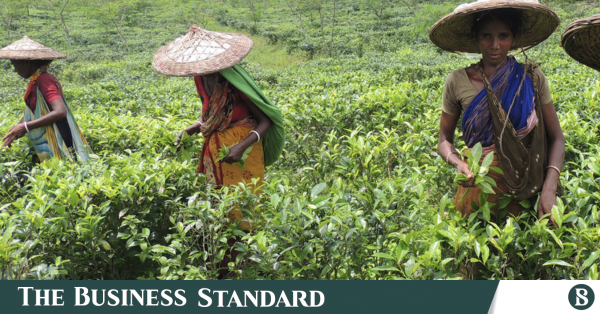
This low yield pushes up the cost of each kilogram of tea, weakening Bangladesh’s competitiveness in international markets. Overall tea production has continued to rise, but the increase in output has failed to translate into higher export earnings
The struggle of Bangladeshi tea workers to raise their minimum wage has been dragging in for years. Photo: Collected
“>

The struggle of Bangladeshi tea workers to raise their minimum wage has been dragging in for years. Photo: Collected
Highlights:
- Bangladesh’s tea productivity remains far below major global producers
- Low yields raise production costs and weaken international competitiveness
- Domestic demand absorbs most tea, leaving limited exportable surplus
- Export earnings fell 25.5% over the past decade
- Bangladesh relies heavily on black tea, limiting product diversification
- Industry needs higher yields, value-added products and global brands
Bangladesh’s tea industry is producing more, yet it is struggling to compete globally. At the heart of the problem is a stubborn productivity gap – the amount of tea produced per hectare remains far below that of major tea-producing countries.
This low yield pushes up the cost of each kilogram of tea, weakening Bangladesh’s competitiveness in international markets. Overall tea production has continued to rise, but the increase in output has failed to translate into higher export earnings.

Much of the additional production is being absorbed by strong domestic demand, while the industry also faces a narrow product mix and a lack of strong international brands.
Tahsin Ahmed Chowdhury, chief operating officer of Finlay Tea Company, said Bangladesh produces around 1,400kg of tea per hectare, compared with about 3,500kg in Kenya and 3,200-3,300kg in Vietnam.
Infograph: TBS
“>

Infograph: TBS
“Because of the low yield, production costs rise, making Bangladeshi tea less competitive in the international market,” he said.
The productivity gap translates directly into costs. Mohammad Moazzem Hossain, member and joint secretary of the Bangladesh Tea Board’s Research and Development Department, said producing a kilogram of tea costs Tk200-220 in Bangladesh, against Tk100-150 in countries such as India and Sri Lanka.
That cost gap makes it difficult for Bangladesh to compete on price, particularly against producers extracting far more tea from the same land.
Domestic demand is tightening the squeeze. Bangladesh produces around 95 million kgs of tea annually, while more than 90 million kgs is consumed at home, Moazzem said. That leaves a shrinking surplus for export.
The industry is also stuck heavily in black tea, even as global demand expands for green, white, dark, and jasmine varieties. Tahsin said Chinese and Japanese producers command higher prices by branding and adding value to organic, white and jasmine teas.
“Bangladesh also needs to focus on value-added tea alongside black tea to increase exports,” he said.
A weak international brand presence compounds the problem. Kazi Arfan Ullah, manager of MM Ispahani Ltd’s Neptune Tea Estate, said Bangladeshi producers lack internationally recognised brands. Tea bought through local auctions is generally marketed abroad by distributors, leaving Bangladesh without a strong global tea identity.
Industry stakeholders say raising productivity and efficiency must be the priority, alongside cutting costs, diversifying products and building international brands.
Moazzem said initiatives are being taken to reduce tea prices, improve workers’ living standards and install solar power in tea estates. Tahsin said unused estate land could generate solar power and support other agricultural activities, creating additional income and easing production costs. He also called for lower interest rates on industry loans.
Export earnings fall despite rising production
Bangladesh’s tea export earnings have declined over the past decade despite fluctuations in production. Export revenue fell from $4.47 million in fiscal 2016-17 to $3.33 million in 2025-26, a decline of $1.14 million or 25.5%.
Earnings fell to $2.77 million in 2017-18 and $2.82 million in 2018-19 before recovering to $3.12 million in 2019-20 and $3.56 million in 2020-21. They then dropped to a decade-low $2.14 million in 2021-22.
Export earnings recovered to $2.34 million in 2022-23, $3.54 million in 2023-24 and $4.10 million in 2024-25. However, earnings fell by $770,000, or 18.8%, to $3.33 million in 2025-26.
Production figures show a different trend. Tea output in January increased from 175,000 kg in 2024 to 309,000 kg in 2025 and 573,000 kg in 2026. January 2026 production was therefore 264,000 kg higher than a year earlier and 398,000 kg higher than in January 2024, making it the highest January output in the three years.
The figures underline the sector’s central dilemma: Bangladesh can increase overall tea production, but unless productivity improves and production costs fall, higher output alone will not make its tea more competitive internationally.
For the industry to overcome its long-standing export stagnation, stakeholders say Bangladesh must raise yields, improve efficiency and move beyond bulk black tea towards differentiated, value-added products supported by strong international brands.
About The Author