Its leaders also urged the government not to involve Bangladesh in any imperialist military or war alliance.
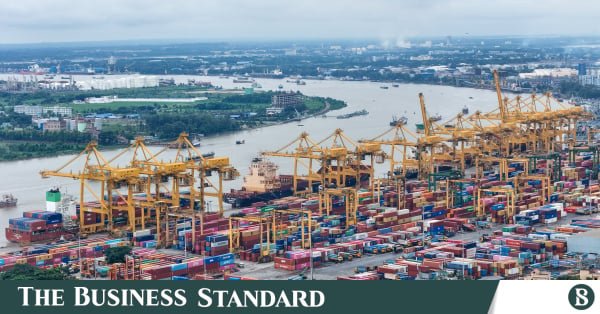
The photo shows a view of the New Mooring Container Terminal of Chattogram Port. A growing logjam of stranded import cargo at the port is eroding nearly two-fifths of the port’s operational capacity, dragging down turnaround times and inflicting severe losses on the country’s trade-driven economy. The photo was taken on Wednesday. Photo: Mohammad Minhaj Uddin
“>

The photo shows a view of the New Mooring Container Terminal of Chattogram Port. A growing logjam of stranded import cargo at the port is eroding nearly two-fifths of the port’s operational capacity, dragging down turnaround times and inflicting severe losses on the country’s trade-driven economy. The photo was taken on Wednesday. Photo: Mohammad Minhaj Uddin
The Imperialism and Anti-War Alliance has demanded the cancellation of Bangladesh’s trade agreement with the United States, a halt to plans to lease the New Mooring Container Terminal at Chattogram port to DP World, and the scrapping of proposals for open-pit coal mining in Phulbari.
The alliance, a platform of left-wing organisations including Communist Party of Bangladesh and Bangladesh Samajtantrik Dal (Basad), made the demands at a rally at the Central Shaheed Minar in Dhaka today (30 October).
Its leaders also urged the government not to involve Bangladesh in any imperialist military or war alliance.

The rally was chaired by Bazlur Rashid Firoz, coordinator of the alliance and general secretary of Basad.
Speakers alleged that the trade agreement signed with the United States by the interim government was “subservient” and posed a serious threat to Bangladesh’s economy, independence, sovereignty and national security.
They also alleged that the current BNP-led government was implementing the agreement while disregarding public opinion.
The speakers said the alliance, comprising left-leaning, progressive, patriotic and democratic forces, remained vocal in its opposition to what it described as an anti-national agreement.
They further alleged that successive governments led by Sheikh Hasina, Muhammad Yunus and Tarique Rahman had taken steps to lease terminals at the country’s main seaport to foreign companies.
According to the speakers, such moves risk placing the port, which they described as the lifeline and heart of Bangladesh’s economy, under foreign control.
They compared the proposed arrangement to attempts by imperialist forces to expand their influence over the country, drawing parallels with the East India Company.
Mushrefa Mishu, general secretary of the Democratic Revolutionary Party, said the people of Bangladesh had yet to achieve genuine emancipation despite the 1971 Liberation War and the 2024 mass uprising.
She called for building a democratic and discrimination-free Bangladesh under the leadership of workers, farmers and working people, rather than merely changing the ruling section of the bourgeois class.
Iqbal Kabir Zahid, general secretary of the Revolutionary Communist Party, said the current government and several political parties shared similar positions on agreements with the United States.
He called for a united movement involving the working class against what he described as imperialist forces to protect the country’s agriculture, industry and economy.
About The Author