Khulna Divisional Forest Officer Nirmal Kumar Pal said crocodiles, as reptiles, have extremely slow metabolic rates and can survive for extended periods without food.
The crocodile, estimated to be 45 years old, has not consumed any food since it was moved to the Wildlife Rescue and Rehabilitation Centre in Khulna on 3 June, despite being offered fish, meat and live ducks. Photo: Collected
“>

The crocodile, estimated to be 45 years old, has not consumed any food since it was moved to the Wildlife Rescue and Rehabilitation Centre in Khulna on 3 June, despite being offered fish, meat and live ducks. Photo: Collected
A rare freshwater crocodile rescued from the historic pond of the shrine of Hazrat Khan Jahan Ali (RA) in Bagerhat has refused to eat for 19 consecutive days after being transferred to a wildlife rehabilitation centre in Khulna.
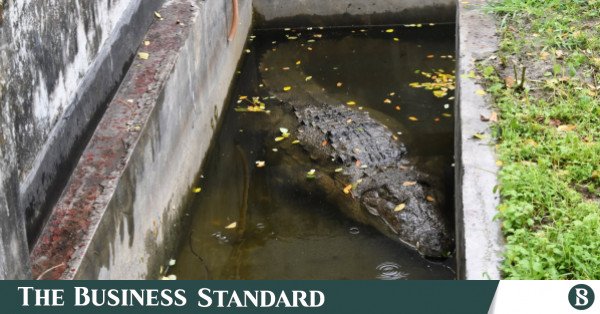
The crocodile, estimated to be 45 years old, has not consumed any food since it was moved to the Wildlife Rescue and Rehabilitation Centre in Khulna on 3 June, despite being offered fish, meat and live ducks.
Forest officials say there is no immediate cause for concern as the animal has significant fat reserves, although wildlife experts believe the crocodile may be experiencing severe psychological stress due to captivity.

The crocodile was captured on 3 June following the death of a seven-year-old child, who was dragged into the shrine’s pond while bathing on 1 June.
The incident triggered widespread panic among local residents and visitors of the shrine. In response, a specialised rescue team from the Forest Department removed the crocodile from the pond at the request of the Bagerhat district administration and transferred it to the Khulna centre for observation and rehabilitation.
The reptile is currently being kept in a designated enclosure, where animal keepers and wildlife rescue personnel are monitoring it round the clock. Its water is changed regularly, and staff have installed an artificial shower system to help maintain its wellbeing.
The crocodile, estimated to be 45 years old, has not consumed any food since it was moved to the Wildlife Rescue and Rehabilitation Centre in Khulna on 3 June, despite being offered fish, meat and live ducks. Photo: Collected
“>

The crocodile, estimated to be 45 years old, has not consumed any food since it was moved to the Wildlife Rescue and Rehabilitation Centre in Khulna on 3 June, despite being offered fish, meat and live ducks. Photo: Collected
Khulna Divisional Forest Officer Nirmal Kumar Pal said crocodiles, as reptiles, have extremely slow metabolic rates and can survive for extended periods without food.
“Particularly in this case, the crocodile became heavily overweight after being overfed by visitors at the shrine pond,” he said.
“The animal weighs between 400 and 500 kilogrammes and has accumulated enough body fat to survive comfortably without food for one to two months.”
Pal said officials had attempted to encourage feeding by offering a variety of food items, including fish, chicken and live ducks to stimulate its hunting instincts.
“The crocodile once caught and bit a chicken but eventually spat it out without eating it,” he added.
According to officials, the crocodile’s excessive body fat limits its movement on land, causing it to become lethargic after walking only a short distance. However, it moves normally in water.
Centre staff have observed that the animal frequently attempts to push against the iron gates of its enclosure after emerging from the water, behaviour they believe reflects a strong urge to roam freely.
Responding to questions about whether the crocodile could be released into the Sundarbans, forest officials ruled out the possibility.
“The rivers and canals of the Sundarbans are highly saline and are home to saltwater crocodiles,” Pal said.
“This animal is a pure freshwater species. Releasing it into a saline environment would prevent it from adapting and could lead to its death.”
Officials said any decision to return the crocodile to the shrine pond would depend entirely on whether the shrine authorities can ensure adequate safety measures for both visitors and the animal.
“If the shrine management can guarantee complete safety for both the crocodile and the thousands of devotees and visitors, it may be returned following approval from higher authorities,” Pal said.
“The crocodile frequently left the pond and wandered into nearby roads and residential areas, posing risks to both people and the animal.”
He added that if effective safety measures are not implemented within a reasonable timeframe, the Forest Department will inform the Ministry of Environment, Forest and Climate Change and pursue a permanent rehabilitation plan.
Under the current arrangement, the crocodile will remain at the Khulna rehabilitation centre for at least another month while officials continue to monitor its behaviour.
The International Union for Conservation of Nature (IUCN) declared freshwater crocodiles extinct in Bangladesh’s natural open water bodies in 2000. The Khan Jahan Ali shrine pond in Bagerhat is considered the country’s last historical refuge for the species.
However, wildlife experts say freshwater crocodiles have been recovered in recent years from rivers in Pabna, Rajshahi, Magura, Faridpur and Barishal, suggesting gradual improvements in the country’s river ecosystems and biodiversity.
Some of the rescued crocodiles have been relocated to specialised conservation facilities, including Bangabandhu Sheikh Mujib Safari Park, while others have been released into suitable freshwater habitats.
The future of the Bagerhat crocodile now depends on improvements to safety infrastructure at the shrine and the Forest Department’s final policy decision.
About The Author