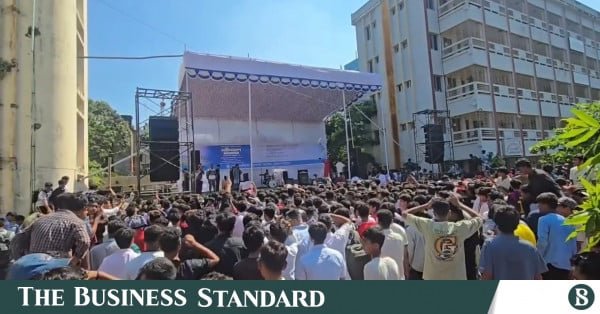
A DU student tore down the photos, Chatradal issued a 24-hour ultimatum, and the university formed three committees to probe recent Ducsu activities.
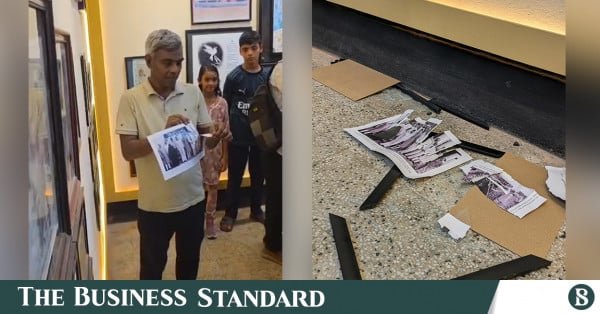
(Left) Screengrab of a video showing former Dhaka University student Abu Taher Habildar ripping a photo of Muhammad Ali Jinnah displayed in the historical archive of the Dhaka University Central Students’ Union on Monday, 14 September 2026. (Right) Scattered pieces of the photo and the broken frame lying on the ground. Collage: TBS
“>

(Left) Screengrab of a video showing former Dhaka University student Abu Taher Habildar ripping a photo of Muhammad Ali Jinnah displayed in the historical archive of the Dhaka University Central Students’ Union on Monday, 14 September 2026. (Right) Scattered pieces of the photo and the broken frame lying on the ground. Collage: TBS
The display of photographs of Pakistan’s founder Muhammad Ali Jinnah and former student leader Abdul Malek at the Dhaka University Central Students’ Union (Ducsu) historical archive sparked protests and counter-actions on campus today (14 September), prompting the university administration to form three investigation committees.
The controversy began after the renovated archive reopened yesterday (13 September), featuring photographs and newspaper clippings related to Jinnah, including his controversial 1948 declaration that Urdu would be the state language of Pakistan.
A fourth-year Urdu Department student, Abu Taher Habildar, tore down two Jinnah photographs from the archive around 2:30pm today, saying Jinnah’s opposition to Bengali and his role in the arrest of students at Curzon Hall in 1948 made him unfit to be represented there.

Later, the Dhaka University unit of Chatradal gave the university administration 24 hours to remove the Jinnah photographs, threatening protest programmes if they were not removed.
Around 3pm, Bangladesh Chhatra Federation’s Dhaka University unit placed a photograph of Jamaat-e-Islami leader Ghulam Azam being beaten with shoes at the archive in protest against the display of Jinnah’s photographs.
Chatradal issues 24-hour ultimatum
GC Roy Shahos, president of Dhaka University Chatradal, announced the ultimatum at a press conference in front of the vice-chancellor’s office.
Shahos said the organisation had asked Vice Chancellor Professor Obaidul Islam, who is the ex-officio president of Ducsu, to ensure the photographs were removed within 24 hours.
He said protest programmes would be announced at the vice-chancellor’s office and the Ducsu archive if the demand was not met.
In a statement, Chatradal President Rakibul Islam Rakibul and General Secretary Nasir Uddin Nasir accused the “Shibir-controlled Ducsu council” of disregarding students’ aspirations and the spirit of the Liberation War through activities including the display of Jinnah’s photograph.
The organisation also alleged that the Ducsu leadership was promoting a political and ideological agenda while failing to address students’ housing and basic rights.
Student tears down Jinnah photos
Abu Taher, who contested the vice-president post in the last Ducsu election, said Jinnah had no place in the union’s archive because of his opposition to the Bengali language and the arrest of students at Curzon Hall.
“In this Ducsu, in this Dhaka University, in this Bangladesh, no villain like Jinnah, no villain like Ghulam Azam or Nizami can be our hero; we will not let them be heroes,” he said.
The photographs were later found lying on the floor.
Ducsu General Secretary SM Farhad defended their inclusion, saying the archive also documented Jinnah’s opposition to the Bengali language.
He said Ducsu had initially decided to allow a week for teachers and students to submit feedback after the archive reopened, adding that several suggestions had already been accepted.
Chhatra Federation puts up Ghulam Azam photo
Later in the afternoon, a group led by Bangladesh Chhatra Federation’s Dhaka University unit Organising Secretary Orko Barua placed a photograph of Ghulam Azam at the archive.
The photograph, showing Ghulam Azam being beaten with shoes in front of Baitul Mukarram National Mosque in 1981, was placed above the spot where a Jinnah photograph had been displayed.
The group said the move was in protest against the Jinnah photographs.
DU forms three committees
Amid the controversy, Dhaka University formed three committees to investigate the display of the Jinnah and Abdul Malek photographs, the “DU Evaluation” teacher-evaluation website and the “Nirbhik July” memorial.
The committees have been asked to submit reports with recommendations within seven working days, after which the university will take further action.
A six-member committee headed by the pro-vice-chancellor (administration) will investigate the “DU Evaluation” website. Two separate five-member committees, also headed by the pro-vice-chancellor (administration), will investigate the “Nirbhik July” memorial and the controversial photographs.
DU warns of action
Earlier, the university administration said action would be taken against those responsible for displaying the Jinnah and Abdul Malek photographs.
In a statement, the administration said displaying photographs of individuals whose roles conflict with the history of the 1952 Language Movement and 1971 Liberation War was unacceptable.
It also said several recent Ducsu activities were inconsistent with university laws and policies, stressing that there was no scope for a parallel administrative system at Dhaka University.
The university specifically criticised the installation of the “Nirbhik July” memorial without approval and the launch of the “DU Evaluation” website without university authorisation.
What is in the archive?
The renovated archive reopened on 13 September and contains photographs and newspaper clippings related to the country’s political history.
Among them are a photograph of Jinnah from his 21 March 1948 speech at the then Racecourse Maidan, a group photograph related to the 1940 Lahore Resolution and a report from Pakistan’s Dawn newspaper on the 1970 election featuring Jinnah.
About The Author