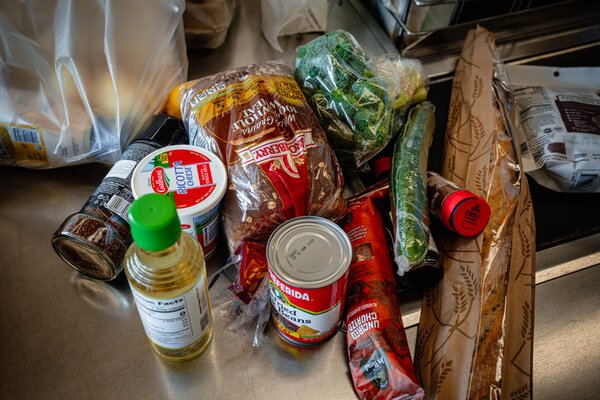
I’ve never been one to stick to a grocery list. My primordial brain grabs packaged salads and barbecue chips without a flicker of thought.
But I recently set out to slash $50 from my typical weekly grocery budget, so I had to start paying attention. My goal was to shop and feed my family of three — breakfast, lunch and dinner, no dining out — for one week for about $200. That sounds like a nice, big number, but broken down, that’s less than $10 a day for each of us.
My wife, Anne, and I live in the Chicago suburbs with our picky 10-year-old boy, Liam. Statistically, we are middle class. For the purposes of this experiment, we looked to the U.S. Department of Agriculture’s Food Plans, whose “Thrifty” option, the least expensive and used to determine SNAP benefits, meant a weekly budget of $196.25 before tax, not counting the salt, oil, rice and leftover snacks already in our pantry. (While many consider the thrifty plan insufficient and out of date, others do still use it as a starting point, as it was for our purposes.)
It is also somewhat unusual for us to cook every meal at home — we do dine out once or twice a week — but I was hoping to approach it as a creative cooking exercise, to learn lessons and write some recipes I could share.
As always, meal planning started on Sunday. But rather than writing down what sounded good and learning the damage at checkout, I worked backward from the number.

Mr. Pang followed the “Thrifty” option of the U.S. Department of Agriculture’s Food Plans.Credit…Jamie Kelter Davis for The New York Times

That put his budget at $196.25 before tax, not counting the salt, oil, rice and leftover snacks already in his pantry.Credit…Jamie Kelter Davis for The New York Times
No more impulse buys permitted, we walked the aisles of our favorite grocery store, Fresh Farms in Niles, Ill., with purpose. Liam’s peanut butter sandwich called for strawberry jam, but grape jelly was cheaper, so grape jelly it was.
We could stretch our budget even further if we didn’t insist on buying some things organic. How big of a difference will it make? Questionable. But we feel good doing so. We don’t buy organic everything, but we do often opt for it when it comes to eggs, milk, cream and certain vegetables that are tougher to wash.
At checkout, we nervously watched the total creep toward $196.25. When it went over, we asked the cashier to swap the $4.35 baba ghanoush for the $3.77 hummus still on the belt.

Making a grocery list — and sticking to it — is an easy way to cut down on impulse buys.Credit…Jamie Kelter Davis for The New York Times
PRODUCE
Fava beans ($6.40), two boxes of cherry tomatoes ($5), two avocados ($5), organic broccoli ($3.41), cauliflower ($2.89), white peaches ($2.15), lacinato kale ($1.99), seedless cucumber ($1.99), organic bananas ($1.90), organic carrots ($1.29), lemons ($1.10), scallions ($1), Idaho potato (92 cents), garlic (88 cents), ginger (67 cents), lime (58 cents), yellow onion (57 cents), jalapeño (15 cents)
MEAT
Pork shoulder ($14.98), ground beef ($8.16), chicken thighs ($7.68), chorizo ($7.29), bacon ($5.49)
DAIRY
Organic 2-percent milk ($6.29), dozen organic eggs ($5.99), organic heavy cream ($5.19), butter ($4.99), ricotta ($4.59), two containers of Greek yogurt ($3.38), shredded cheese ($2.79), sour cream ($1.99), peach kefir ($1.49), mango kefir ($1.49)
BREAD AND PASTA
Granola ($7.99), whole-wheat bread ($4.99), sourdough baguette ($2.99), sesame flatbread ($2.79), noodles ($2.29), flour tortillas ($1.49)
PANTRY AND OTHER ITEMS
Instant coffee ($9.49), mayonnaise ($4.99), Cheddar Sun Chips ($4.99), tomato passata ($4.49), ketchup ($3.99), hummus ($3.77), toasted sesame oil ($3.49), chili powder ($3.45), rice vinegar ($2.99), chunky peanut butter ($2.99), grape jelly ($2.99) soy sauce ($2.29), bucatini ($2.29), canned refried beans ($1.79)
Pretax Total: $196.22
With Sales Tax: $200.63

A sheet pan makes it easy to roast a big pan of vegetables to nibble on all week.Credit…Jamie Kelter Davis for The New York Times
With our shopping done, we did a little meal prep: We roasted broccoli, tomatoes and cauliflower, blanched some fava beans and made pork carnitas (using just water, salt, pepper, and chili powder from our pantry), setting aside a few pork cutlets to fry later in the week to eat atop rice and Japanese curry.
New Recipes: Bacon Cheeseburger Meatballs | Chorizo Amatriciana | Sesame Soy Chicken With Ginger-Scallion Noodles
Day 1
Breakfast: Yogurt and coffee (Kevin); two scrambled eggs, half banana and coffee (Anne); granola, milk and half of a banana (Liam)
Lunch: Hummus, sesame flatbread, cucumber, ricotta, tomatoes and fava beans (Kevin and Anne); peanut butter and jelly sandwich and Sun Chips (Liam)
Dinner: Fava beans on toasted baguette with ricotta, garlic, herbs and lemon zest (Kevin and Anne); sesame flatbread with hummus and cucumber slices (Liam)
Day 2

Liam Pang, the writer’s son, came up with the idea for these mash-up bacon cheeseburger meatballs.Credit…Armando Rafael for The New York Times. Food Stylist: Rebecca Jurkevich.
Breakfast: Poached eggs, wheat toast, peaches and coffee for the grown-ups
Lunch: Flatbread, hummus and roasted broccoli (Kevin and Anne); peanut butter and jelly sandwich and Sun Chips (Liam)
Dinner: Bacon cheeseburger meatballs, burger sauce, oven fries and roasted broccoli
Day 3

Pasta amatriciana made with Spanish chorizo instead of guanciale is more affordable, but equally tasty with a smoky twist.Credit…Armando Rafael for The New York Times. Food Stylist: Rebecca Jurkevich.
Breakfast: Wheat bread, ricotta, roasted cherry tomatoes and fava beans (Kevin and Anne); granola, banana and yogurt (Liam)
Lunch: Grilled cheese with roasted tomatoes (Kevin and Anne); peanut butter and jelly sandwich and potato chips from the pantry (Liam)
Dinner: Chorizo amatriciana
Day 4
Breakfast: Cheese omelet (Kevin and Anne); granola and banana with milk (Liam)
Lunch: Leftover chorizo amatriciana and sautéed kale (Kevin and Anne); grilled cheese sandwich (Liam)
Dinner: Carnitas, flour tacos, guacamole, homemade salsa, pickled onions and shredded Mexican cheese
Day 5

This dish of chicken with ginger-scallion noodles was inspired by a meal Mr. Pang had in a Hong Kong diner.Credit…Armando Rafael for The New York Times. Food Stylist: Rebecca Jurkevich.
Breakfast: Eggs poached in salsa, guacamole and charred flour tortilla (Kevin and Anne); yogurt and banana (Liam)
Lunch: BLT and chips from the pantry
Dinner: Sesame soy chicken with ginger-scallion noodles
Day 6
Breakfast: Scrambled eggs and wheat toast
Lunch: Flour tortilla, cucumbers, pickled onions and roasted tomatoes (Kevin and Anne); Carnitas tacos (Liam)
Dinner: Cauliflower bacon toast, very similar to this (Liam and Anne. Kevin ate at a work event.)
Day 7
Breakfast: Granola, yogurt and coffee for the grown-ups
Lunch: Cauliflower bacon toast (Liam and Anne); stir-fried noodles with leftover ginger-scallion sauce with a fried egg (Kevin:)
Dinner: Japanese curry, rice and fried pork cutlet

Credit…Jamie Kelter Davis for The New York Times
We ate really well all week long, but — and this is a big “but” — it did require a lot more work on the front end. (And I’m a recipe developer by trade who works from home, so I’m ahead of the game.) The additional $50 we’d normally spend is for convenience — a microwavable frozen dinner here, a jar of marinara there — and, for working parents with children, it’s a premium many don’t have a choice but to pay.
In the end, I developed a few money-saving habits that also pushed me to cook more creatively with simple ingredients.
1. Assign a role to everything in your cart.
Instead of buying whatever looks good and figuring out what to do with the leftovers once I had them, I planned for them. I bought a three-pound hunk of pork shoulder with two futures already assigned to it: carnitas and fried cutlets. I sliced several thick cutlets off, and tucked them into the freezer.
2. Give leftovers a new life.
Dinner one night can be transformed to something else entirely the next day with a few additions. We made pasta amatriciana one night, and the following, I added a dollop of ricotta and chili crunch. It tasted like a different dish. Simply changing the texture can make leftovers taste new: Chewy boiled noodles become crispy when stir-fried the next day.
3. Use your sheet pan.
When I took on this challenge, the country was in the throes of a cyclosporiasis outbreak. Lettuce, which would normally fill several lunch and dinner salads, was off the table, so we relied on the Jalen Brunson of kitchen equipment: the sheet pan. We roasted broccoli, cauliflower and tomatoes, then saved them to tuck into grilled cheese, spoon over ricotta toast or pile onto a charred tortilla with cucumbers and pickled onions. We felt so Mediterranean.
4. Buy produce that lasts.
By Day 6, I was running on creative fumes, and it was mainly an inventory problem. Much of the delicate produce — peaches, fava beans — was gone by the third day. Sturdier fruits and vegetables like apples and cabbage, or frozen fruits and vegetables, which often have more nutrients because they are frozen at peak freshness, could have carried us further.
5. Add a twist to traditional dishes to make them exciting.
Try taking a well-known dish and altering one ingredient to make the meal feel novel to get you excited about it. Liam thought of adding bacon and cheese to meatballs, resulting in bacon cheeseburger meatballs, a new family favorite. Instead of guanciale in the pasta amatriciana, I subbed in the less expensive Spanish chorizo, which gave the sauce a lovely smokiness no amatriciana has any business having. It was delicious.
6. Put an egg on it.
There’s nothing more magical than the mighty egg. Now that egg prices have stabilized a bit, we enjoyed them many ways during the week. For breakfast, a soft-boiled egg with one end lopped off and a knob of butter dropped into the yolk became an “egg dipper” to my son. For dinner, I topped ginger-scallion noodles and chicken with a fried sunny-side-up egg.
Sign up for the Cooking newsletter, and in a few weeks, I’ll be in your inbox sharing a few more simple recipes from this meal plan.
If you’d like to share your grocery budget tips and, if you’d like to see this as a series, done in another location or on a different budget, let us know. Drop a line to margaux@nytimes.com.
About The Author