Restoring students’ confidence requires fundamental reform, they say
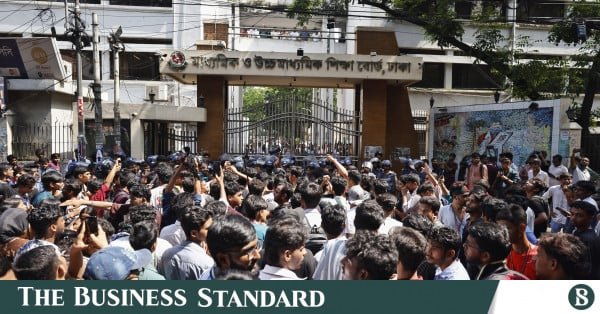
HSC candidates stage a protest and block the road in front of the Secondary and Higher Secondary Education Board on 14 July, demanding the resignation of the Education Minister. Photo: Rajib Dhar
“>

HSC candidates stage a protest and block the road in front of the Secondary and Higher Secondary Education Board on 14 July, demanding the resignation of the Education Minister. Photo: Rajib Dhar
The recent protests by HSC examinees reflect long-standing structural weaknesses in the education system and the lack of meaningful reform, education experts have said.
They also believe the disruption caused by flooding and severe weather is likely to have affected students’ mental preparedness and examination performance.
The nationwide student protests stemmed from the government’s decision to continue HSC examinations despite relentless heavy rain and errors in the physics exam question.

On Tuesday, after demonstrations in several districts, students the next day launched a “Long March to the Ministry of Education”, demanding the education minister’s resignation.
In response, Education Minister ANM Ehsanul Haque Milon in a statement in parliament on Wednesday said students who were unable to sit the examinations because of the severe weather would be allowed to take them under special arrangements.
He also said those responsible for the flawed physics question had been temporarily suspended and that affected candidates would receive full marks.
However, many protesting students remain unconvinced.
Saurav Ahmed, an HSC candidate from Uttara United College, said an apology and the promise of full marks could not undo the damage.
He said the difficult conditions under which students sat the examinations would inevitably affect their performance, making the minister’s resignation necessary.
Analysts do not believe the minister’s resignation alone would resolve the crisis. They said restoring students’ confidence in the long term would require fundamental reform.
Protests aren’t isolated incidents
Educationist Manzoor Ahmed said the protests should not be viewed as isolated incidents. “They reflect long-standing weaknesses in the education system, and accumulated frustration among students.”
He said students taking to the streets over any major issue also reflects a growing lack of confidence in the education system.
“Without long-term reforms to examinations, assessment methods and the quality of teaching, similar crises would continue to recur,” he warned.
Urmi Islam Ima, a teacher at Dhaka Residential Model College, said the decision to continue the examinations may have been based on reports from the field, but the hardship faced by students was far greater in reality.
She said the errors in the Physics First Paper question had particularly disadvantaged high-performing students. “Awarding full marks wouldn’t remove the psychological stress or eliminate the competitive disadvantage they faced,” she said.
Ima added, “Many students feared the incident could affect their chances of securing admission to top universities. Stricter accountability is needed in the question-setting and moderation process to prevent similar incidents in future.”
Political analyst Mohiuddin Ahmed said voluntary resignations remain rare in Bangladesh’s political culture. “Once protests gather momentum, an apology alone is unlikely to calm tensions. The focus shouldn’t be on whether an individual resigns, but on what meaningful reforms are implemented in the education sector,” he added.
Kazi Mahbubur Rahman, political science professor at Dhaka University, said the protests and instability in the education sector also reflected deeper social and political problems.
He said education reform could not be confined to curriculum changes or greater use of technology. The 2010 National Education Policy should be revised to reflect current realities, with experienced educationists playing a central role in the process.
He added that although recent reforms had placed greater emphasis on curriculum design and technology, insufficient attention had been given to improving the quality of learning materials, despite content reform being equally important to raising educational standards.
After taking office, the minister announced a 180-day reform programme, a review of the national curriculum, greater use of technology in education, a “zero tolerance” on question leaks, expansion of technical education, and stronger accountability across the sector.
However, Prof Mahbubur said most of those initiatives have so far remained at the policy or administrative level. “Visible progress on structural reforms to the curriculum, assessment system, teacher training and examination management has been limited.”
About The Author