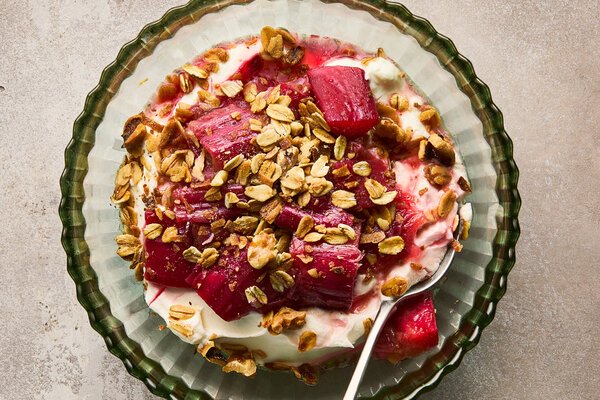
Has my outlook gotten rosier, or has rhubarb been getting redder?
I asked myself this question a few years ago over one of the prettiest Pavlovas I’d ever seen. In a sea of swirly white meringue, fuchsia cubes of rhubarb practically fluoresced, flowing pink into the whipped cream. Then I started noticing it in every restaurant I went to — florid rhubarb compote on my yogurt parfait; bubble-gum rhubarb floating in custard; scoops of rhubarb sorbet in lipstick red.
Yet whenever I cooked rhubarb at home, it melted into a rather muted-looking mass. Why was restaurant rhubarb so much more vibrant?
It turns out that how rhubarb is grown affects its color and texture. Traditionally grown rhubarb — the slim stalks I buy at the farmers’ market — is often green, streaked here and there with red.

Flavor the rhubarb as you like. Vanilla bean, fresh ginger coins and cardamom pods are all welcome additions.Credit…Armando Rafael for The New York Times. Food Stylist: Cyd Raftus McDowell.
Deeply red rhubarb, called forced rhubarb, is typically grown in winter and spring in heated sheds (or under a rhubarb forcer or overturned bucket) in complete darkness so that the plants can’t photosynthesize. This produces ruby stalks that are sweeter and more tender than regular outdoor rhubarb. The technique is thought to have been developed in Yorkshire, England, which has been famous for forced rhubarb since the 19th century.
The practice has become more common in North America over the past decade. If you see scarlet rhubarb for sale in later winter or early spring, it’s probably been forced.
In the kitchen, forced rhubarb and regular rhubarb can be used interchangeably, though since the forced stalks are sweeter, you might cut down on the sugar.
My favorite way to show off either kind is to roast it, which softens the stalks without turning them to mush. You don’t need to add any liquid, just toss sliced rhubarb with a little sugar, pop it in the oven and occasionally give it a stir. As the stalks roast, their sugar melts, turning them into a syrup that will be geranium pink if you’ve used forced rhubarb and more delicately blushing if you haven’t.
You can flavor roasted rhubarb with aromatics or spices — lemon or orange zest, sliced ginger root, vanilla, cardamom or cinnamon. Or leave it plain, sharp and a little grassy tasting. It will last for at least a week in the fridge and freezes well, too, at the ready for spooning over yogurt, ice cream or any cake or cookie lucky enough to cross its pinkish path.
Follow New York Times Cooking on Instagram, Facebook, YouTube, TikTok and Pinterest. Get regular updates from New York Times Cooking, with recipe suggestions, cooking tips and shopping advice.
About The Author