How did a ballast tank meant to hold seawater turn deadly? The question has emerged after nine workers died from hydrogen sulphide (H₂S) at Ferdous Steel Ship Recycling Industry in Sitakunda – the first such fatal incident recorded in Bangladesh’s ship recycling industry, according to the Department of Environment.
The answer remains elusive as high concentrations of H₂S continue to accumulate inside the vessel three days after the incident, preventing investigators from safely entering the tank.
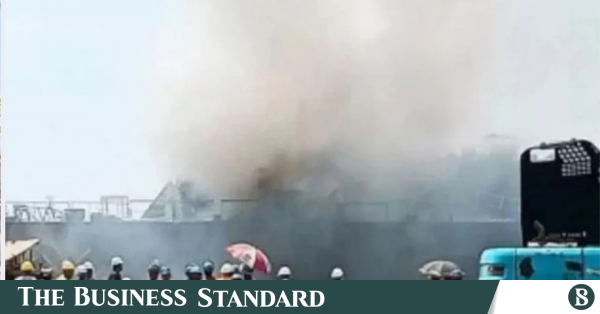
Nine workers were killed and six injured around 8:30am on Friday after toxic gas leaked from a ballast tank of an LNG tanker being dismantled. The workers were exposed while cutting a hole at the bottom of the tank to drain seawater.

Four hours after the tragedy, the Department of Explosives detected 10.8 parts per million (ppm) of H₂S near the opening. A Fire Service Hazmat team initially found the presence of methane, carbon dioxide and ammonia, but no H₂S
However, the team recorded concentrations of 50-80 ppm around 6pm on Saturday, when the tide was low. A further inspection around 10am yesterday (16 August) again found high concentrations, forcing the team to withdraw.
“As long as the gas emission continues, there is no way for the investigation committee to inspect the site safely,” said Shah Imran, deputy assistant director of Chattogram Fire Service and Civil Defence.
The vessel has since been cordoned off, with authorities barring entry until the gas emission is brought under control.
Following discussions with government agencies and the investigation committee, authorities decided to bring in a specialist team to remove sludge and accumulated hazardous gases from the ballast tank.
The vessel will be declared safe only after the team completes the cleaning and issues a written safety certification, after which the Fire Service will conduct another operation before the vessel is finally cleared.
What is a ballast tank?
A ballast tank holds seawater to control a ship’s weight, draft, balance and stability. Unlike cargo tanks, it is not normally designed for petroleum products, LNG or other commercial cargo.
Mohammad Ashraf Uddin, research officer at the Department of Environment, Chattogram, said the presence of H₂S was particularly surprising because gas-free certification normally focuses on spaces where hazardous cargo residues or gases are expected.
“Where gas is supposed to be present, the gas is safely removed before the authorities issue the gas-free certificate. But the presence of gas in a ballast water tank, where it is not supposed to be, is completely surprising,” he said. “No authority would normally expect such gas to be generated inside a ballast water tank.”
Captain Anam Chowdhury, a beaching master and shipbreaking expert with around four decades of experience, said he had never seen a fatal gas incident in Bangladesh’s ship recycling sector originate from a ballast tank.
“Normally, when a ship comes for beaching, we instruct the onboard crew to open every hatch and the covers of the ballast tanks. If there is any gas inside, it can escape naturally,” he said.
Three of the vessel’s eight ballast tanks had already been dismantled using similar procedures without gas-related problems, according to yard officials, making the tank involved in Friday’s accident the central focus of the investigation.
How could H₂S develop?
H₂S can form when organic matter decomposes in oxygen-poor conditions and accumulates in poorly ventilated enclosed spaces.
Engineer Mahbubur Rahman, who examined the incident, said investigators should look for sludge, sediment or other decomposable material inside the tank.
“Different ships have different types of sludge in different tanks. We need to investigate whether tank-cleaning sludge or sediment was deposited somewhere before the vessel was sent to the shipyard,” he said.
LNG, LPG and chemical tankers undergo specialised cleaning before recycling, and residues or contaminated wash water may require separate treatment.
“If organic or other decomposable material remained trapped in a closed, poorly ventilated environment for a prolonged period, it could potentially create conditions for H₂S generation,” Mahbubur said, stressing that this remains a hypothesis, not an established cause.
The continuing fluctuation in gas levels with the tide is another question investigators must resolve. Authorities need to establish whether changes in water level or pressure are allowing trapped gas to escape from the tank.
Did certification and ventilation fail?
The vessel had undergone pre-recycling procedures and received the required certification before dismantling.
Before a ship is imported for recycling, the owner or cash buyer is responsible for cleaning and obtaining certificates, followed by inspections by relevant authorities before cutting permission is issued.
But gas-free certification does not guarantee that an enclosed space will remain safe indefinitely. Experts say its atmosphere must be tested immediately before and during work, particularly if a tank has remained closed.
Captain Anam said ballast tanks and other enclosed spaces should be opened and ventilated as soon as a vessel reaches a recycling yard.
“If there is any residual gas, opening the tank allows it to escape and fresh air to enter,” he said.
Experts also say enclosed spaces should be tested for toxic gases and oxygen deficiency before and during work, as decomposition can create both H₂S and oxygen-depleted conditions.
The continuing presence of the gas has also raised questions over whether monitoring continued throughout the dismantling operation and whether workers had adequate respiratory protection.
Dhaka team to inspect vessel
The Ministry of Industries has formed a three-member expert team to identify the source and nature of the gas leak and recommend measures to eliminate the risk.
The team comprises Buet Professor Md Easir Arafat Khan, Bangladesh Maritime University Director Captain Md Shoyeb Ahmed and Department of Explosives’ Assistant Explosives Inspector Mohammad Mehedi Islam Khan.
Bangladesh Ship Recycling Board Director General AKM Shafiul Alam Talukder told The Business Standard that the team was travelling from Dhaka to the yard. “After the team submits its report, the next decision will be taken,” he said.
The team will assess whether hazardous gases or substances remain inside the vessel and recommend measures to prevent further emissions.
Investigators also need to examine the vessel’s cleaning certificates, tank-cleaning and ballast-water records, sludge disposal documents and inspection reports.
They need to determine whether the tank was opened and ventilated after arrival, whether oxygen and toxic-gas levels were tested before cutting, what substances remained inside and whether cleaning residues entered the ballast system.
They must also establish why H₂S concentrations rose sharply during low tide, whether gas monitoring continued throughout the operation and whether workers had adequate respiratory protection.
Mahbubur said investigators should assess whether ballast-tank cleaning and ventilation procedures are sufficient when vessels remain for long periods with stagnant water or residues.
“The ballast tank is a water tank. The water is seawater. Under normal circumstances, generating H₂S at this concentration is unusual,” he said.
The findings will determine whether the tragedy was unforeseeable or resulted from failures in cleaning, certification, ventilation, gas testing or workplace safety.
About The Author