Cumulative export earnings exceed $14b over two decades
Infographic: TBS
“>

Infographic: TBS
Karnaphuli Export Processing Zone has generated more than $14 billion in cumulative exports and created nearly 80,000 direct jobs over two decades since it was established on the site of the loss-making Chittagong Steel Mills, which was shut down in 1999 with liabilities of Tk980 crore.
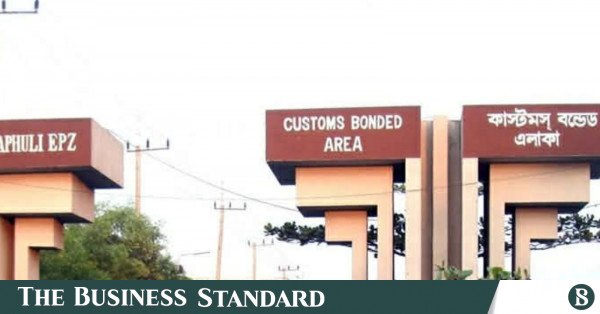
Located on 209 acres in North Patenga, Chattogram, the Karnaphuli EPZ began operations on 12 September 2006 with 258 plots and five standard factory buildings.
The EPZ started with only 174 workers and an investment of $1.91 million. It began exporting in the fiscal 2007-08, when Paolo Footwear (BD) Ltd exported goods worth $9.86 million.
By August 2026, investment in the EPZ stood at $787.33 million, while employment reached 77,465, including 358 foreign nationals. Its cumulative exports stood at $14.16 billion, according to data from the Bangladesh Export Processing Zones Authority (Bepza).

Mahbub Ahmed Siddiq, executive director of Karnaphuli EPZ, told The Business Standard that the zone’s strategic location and investors’ confidence in Bepza had helped drive growth in investment, exports and employment.
From a struggling steel mill to a major industrial hub
Chittagong Steel Mills began full-scale production in 1967 on the bank of the Karnaphuli River, around 10km from the Chattogram city. Around 10,000 workers were employed at the mill at its peak.
The mill was severely damaged by the devastating cyclone in 1991 and subsequently struggled to remain competitive because of a lack of modernisation. It was placed on lay-off in 1998 and permanently shut down on 7 July 1999, with around 2,000 workers still employed.
Salamat Ullah, who served as managing director of Chittagong Steel Mills while it was operational, told The Business Standard that the mill became unsustainable because of a lack of modernisation and institutional mismanagement.
He said the mill’s outdated open-hearth technology resulted in excessive electricity and gas consumption, while the growing dominance of shipbreaking scrap in the market reduced demand for its products.
According to him, only BSRM and National Iron Company purchased billets from the mill, which was insufficient to keep the large facility operational. Labour disputes and negligence also compounded the problems.
At one point, bank loans exceeded Tk500 crore, he said. Following a change of government in 2001, then commerce minister Amir Khosru Mahmud Chowdhury took the initiative to establish an EPZ on the site of the closed mill.
The then prime minister, Khaleda Zia, inaugurated the Karnaphuli EPZ in 2006.
Investment in the EPZ reached $217.12 million by FY12, while employment rose to 26,830 and exports to $489.01 million.
By FY16, cumulative investment had increased to $433.04 million, employment to 63,118 and exports to $2.929 billion.
By FY20, investment stood at $611.54 million, employment at 69,364 and exports at $6.762 billion.
The EPZ currently employs nearly 80,000 people, around 60% of whom are women. Indirect employment has also crossed 1,00,000, according to officials.
Companies operating in the EPZ pay around Tk235 crore a month in wages and allowances to their employees.
The zone’s proximity to Chattogram Port and Shah Amanat International Airport, as well as its investment and production facilities, has helped make it attractive to domestic and foreign investors.
The EPZ also uses measures aimed at improving environmental sustainability. Rainwater is used to recharge groundwater during the monsoon and is extracted during summer, while 15% of its 30MW electricity requirement is met by solar power.
Exports grow
The EPZ recorded its highest annual investment of $45.15 million in FY22. Investment declined to $29.62 million in FY23, $20.29 million in FY24 and $19.02 million in FY25 before rising slightly to $21.22 million in FY26.
Officials said new investment has slowed because all available land has already been allocated.
Exports reached a peak of $1.886 billion in FY23 after standing at $1.449 billion in FY22.
Exports fell to $1.019 billion in FY24 before recovering to $1.259 billion in FY25. They stood at $1.230 billion in FY26.
The EPZ was recognised as the country’s best EPZ in FY22, according to Bepza officials.
Diversifying beyond garments
Karnaphuli EPZ has also expanded the range of products exported from Bangladesh beyond traditional ready-made garments.
Its factories produce tents and camping equipment, bicycles, leather goods, furniture, bags, undergarments, fashion footwear and safety footwear.
The products are supplied to major international brands and buyers, including Timberland, H&M, Zara, Uniqlo, Next, Nike, Adidas, Puma, Decathlon and Ralph Lauren.
There are currently 41 operational companies in the EPZ, including 29 fully foreign-owned companies, three joint ventures and nine locally owned companies. Five more companies are in the process of being established.
Investors from 13 foreign countries, including China, Taiwan, Hong Kong, South Korea, India, Sri Lanka, Japan, the UK, the US, the Netherlands and Malaysia, have established factories in the zone.
About The Author