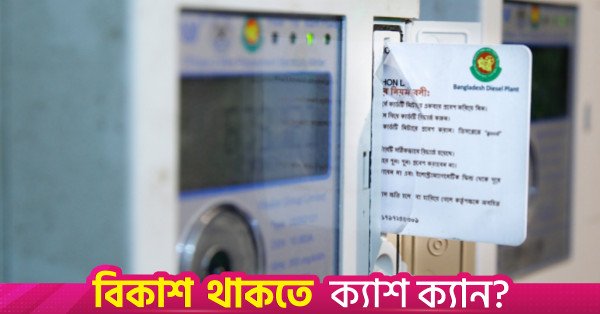
Both the Dhaka Electric Supply Company (Desco) and the Dhaka Power Distribution Company (DPDC) use the exact same government-approved tariff rates set by the Bangladesh Energy Regulatory Commission (BERC) for residential connections.
A monthly electricity bill is calculated using three main components: total energy consumption, a fixed demand charge, and value-added tax (VAT). The unit prices, known as slabs, and the fundamental rules for prepaid meters are exactly the same as postpaid connections. The only difference is when and how the money is deducted.
With a postpaid meter, customers are billed after consuming electricity. However, with a prepaid meter, the system deducts its fixed charges before the money is converted into usable energy.

How do prepaid meter deductions work?
When a customer buys a recharge token, the system deducts mandatory fees instantly. If this is the first recharge of a new calendar month, it will deduct a demand charge and meter rent, along with a 5% VAT from the total recharge amount.
A demand charge is deducted once a month against the sanctioned load. For a standard residential connection, it is Tk42 for every kilowatt (kW). If a customer skips recharging for a given month, the accumulated demand charges arededucted when they next recharge, DPDC clarified in a recent notice.
Additionally, a meter rent of Tk40 per month for single-phase meters is deducted, provided the meter is supplied by Descoor DPDC. If the meter was purchased outright from the open market, this rent is zero.
For any subsequent recharges made later in the same calendar month, only the 5% VAT is deducted, as the fixed monthly charges have already been paid. Customers can monitor their account balances and verify these deductions directly through the Desco Prepaid Customer Portal.
How are the energy slabs calculated?
Whatever money is left after the initial deductions is sent to the meter as an energy balance. As electricity is used, the digital meter quietly ticks down that balance using the exact same progressive rates as a postpaid bill.
The meter resets back to the cheapest rate at midnight on the first day of every new month. Customers fill up the cheaper slabs first, and any leftover units spill into the next, more expensive slab.
|
Unit Range |
Rate per Unit |
|
0-50 units (lifeline) |
Tk4.63 |
|
0-75 units |
Tk5.26 |
|
76-200 units |
Tk8.50 |
|
201-300 units |
Tk9.10 |
|
301-400 units |
Tk9.62 |
|
401-600 units |
Tk15.01 |
|
601+ units |
Tk17.35 |
Note: The lifeline rate applies only if the entire month’s use is 50 units or less.
What happens during a first-of-the-month recharge?
If a customer with a 1 kW load and an instalment meter recharges Tk1,000 on the first day of the month, the deductions are calculated step-by-step before the energy is credited.
From the total Tk1,000 paid, Tk47.62 is deducted for VAT. This is calculated by dividing the total amount by 1.05, then multiplying by 5%. A demand charge of Tk42 for the 1 kW load and a meter rent of Tk40 are also deducted instantly. This leaves a net balance of Tk870.38 sent to the meter.
As an added incentive, prepaid users automatically receive a government rebate, usually 0.5%, added to their final balance.
How does the step-by-step billing work?
To understand how the balance is consumed, consider a customer who uses exactly 200 units in a month. The energy charge is split across the first two regular slabs.
The first 75 units cost Tk394.50 (75 units × Tk5.26), and the remaining 125 units cost Tk1,062.50 (125 units × Tk8.50), bringing the total energy charge to Tk1,457. Adding the Tk42 demand charge brings the subtotal to Tk1,499. Finally, the 5% VAT adds Tk74.95, resulting in a total payable bill of Tk1,573.95 for those 200 units.
For postpaid meters, a small additional meter rent ranging from Tk10 to Tk40 is often included alongside these calculations.
Customers experiencing any confusion regarding their billing, deductions, or meter balances can contact the official helplines of Desco at 16120 and DPDC at 16116 for further clarification.
About The Author