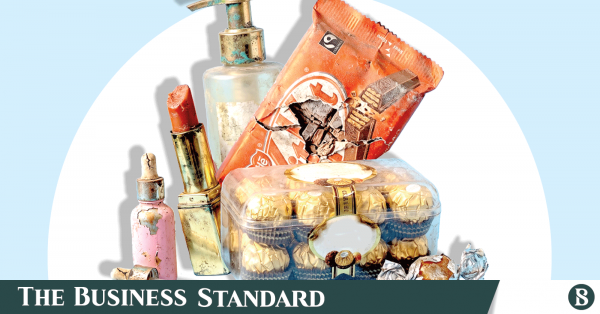
Retailers selling premium and imported products describe the same picture: weakening footfall, unsold stock piling up, and customers who once shopped without hesitation now visiting four or five stores to find a single item or giving up altogether.
TBS Illustration
“>

TBS Illustration
Highlights:
- Inflation above 8% for nearly four years; wages lagging for 50 consecutive months
- Prices of many imported goods have doubled or more
- Lifestyle, fashion product sales down 50–70%; imported food, chocolates down 30–50%
- Supermarket shelves once stocked with global brands now half-empty or replaced by local alternatives
For nearly four years, Bangladesh’s inflation has refused to budge below 8%. Wages have failed to keep pace for 50 consecutive months. And the price of imported goods – from a jar of Nivea cream to shampoo, a pair of Nike trainers or a chocolate – has in many cases doubled or more.
The result is an import-dependent consumer market in a quiet recession.

From Gulshan to Uttara, Dhanmondi to Chattogram, retailers selling premium and imported products describe the same picture: weakening footfall, unsold stock piling up, and customers who once shopped without hesitation now visiting four or five stores just to find a single item or giving up altogether.
Shelves that once displayed rows of Gillette razors, Ferrero chocolates, Head & Shoulders shampoos and Oral-B toothbrushes now sit half-empty. Many popular items have been unavailable for months. In early 2025, Procter & Gamble – present in Bangladesh for nearly three decades – ended its key distribution arrangements in the country, the most visible symbol yet of a market that has lost its shine.
Infograph: TBS
“>

Infograph: TBS
Industry insiders call it the longest and deepest crisis Bangladesh’s import-dependent premium consumer market has ever faced.
Ashraf Bin Taj, managing director of International Distribution Company Bangladesh, one of the country’s largest FMCG importers, said sales of lifestyle and fashion products have fallen by as much as 50% to 70%, reflecting weaker discretionary spending and cautious consumer sentiment.
Imported chocolates and food items have also seen declines of around 30% to 50%, while official sales of global personal care brands such as Gillette, Garnier and Nivea have dropped sharply amid supply shortages and rising prices.
Just four years ago, the shelves of superstores were filled with imported chocolates such as KitKat, Snickers, Cadbury Dairy Milk, Perk, Amul and Ferrero Rocher.
Now, that picture has changed sharply. The shelves remain stocked, but local chocolates dominate, while imported brands appear only in limited quantities.
A senior marketing officer at Shwapno said in 2022, a single KitKat bar sold for just Tk25, but now costs Tk50. A 200-gram Ferrero Rocher box, which was priced at Tk700 four years ago, now sells for around Tk1,600.
He added that nearly 90% of candies sold earlier were imported, coming mainly from the UK, India, Thailand, Myanmar and Malaysia. That share has now fallen by around 50%.
Ashraf said Bangladesh’s chocolate market, worth around Tk2,000 crore, was previously dominated by foreign brands, but imports have now declined by 30% to 50%.
He cited strict import controls, LC restrictions, higher duties, tougher customs valuation and taka depreciation as the key causes.
“With non-essential imports deprioritised, the pressure has now spread across the wider consumer market,” he said.
A survey of major retail chains found persistent shortages in imported skincare, cosmetics, baby products, chocolates, cereals, premium hair care and grooming essentials.
Customers say their shopping habits have changed dramatically.
Gulshan resident Reshma Ara said she now visits four or five supermarkets just to find one specific lotion.
Another customer, Sharmin Haque, said some products appear online but are either heavily overpriced or remain marked “out of stock” for weeks.
Hasnat Reza Mohibbul Alam, head of International Division at NRBC Bank, said compared with 2022, the opening and settlement of letters of credit (LCs) for luxury and premium products has fallen by 30% to 40%.
He said the government imposed restrictions on LCs for luxury goods in 2022 when the dollar crisis began, while banks prioritised essential food and necessary product imports. As a result, imports of luxury items such as chocolates, cosmetics and cars dropped sharply.
He added that even after the restrictions were lifted, demand and imports have not rebounded.
Big brands, harsh reality
Few companies reflect the shift more clearly than DBL Group, which brought global names such as Nike, Puma, Adidas, Levi’s, Bugatti and Giordano into Bangladesh.
MM Jabbar, managing director of DBL Group, said the investments were made based on expectations of continued economic growth and a rapidly expanding premium customer base.
“We launched operations for brands like Nike and Puma in Bangladesh with confidence in the country’s growth trajectory. But the political changes, the Iran war, rising dollar prices and tariff hikes created a different reality,” he said.
“We are offering heavy discounts, yet products are not selling. If old stock does not move, we cannot bring new collections. We have genuinely gone through a very difficult period with premium products.”
Retailers say this is especially painful in fashion and footwear, where the freshness of collections drives store traffic. When new inventory cannot be imported on time, customer visits decline, they say.
Supermarkets no longer look premium
Bangladesh’s supermarkets are increasingly losing the premium look they once offered, as shortages of imported goods and soaring prices reshape shelves and shopping habits.
Rows once filled with global brands such as Nivea, Gillette, Ferrero, Pringles and Head & Shoulders are now often replaced by local alternatives or left partially empty.
Agora said the share of imported goods in its outlets has dropped from around 45% to 30% over the past three years, with cosmetics, skincare and grooming items seeing the sharpest fall.
Agora CEO Khandaker Nur-e-Borhan said many customers initially refused to believe that well-known global brands could vanish from the market, but later accepted the reality after checking multiple stores.
He added that steep price hikes have also discouraged purchases, with some imported items now costing double or more than previous levels.
Meanwhile, Shwapno officials said demand for imported discretionary products has weakened significantly as customers shift toward essential groceries and affordable local substitutes.
A top official of Shwapno said products that once sold for Tk1,200 are now priced at Tk2,500 to Tk3,500, while cereals previously priced at Tk550 now retail at Tk1,000 to Tk1,200.
“Many customers have simply stopped buying imported products altogether,” he said.
The slowdown is also affecting organised lifestyle and fashion chains. Sundora Bangladesh has leaned on discounts of up to 70% to drive sales as demand for premium beauty and lifestyle products weakens.
Luxury watch retailer Timezone is also facing a decline in mall footfall as households scale back discretionary spending. Meanwhile, Masco Group’s retail division, which operates Sana Safinaz, MARIA B, Sapphire and Vasavi, is seeing slower apparel sales as customers delay festive and premium fashion purchases amid inflation and tighter household budgets.
Price shock and MAV pressure
Importers say a fresh blow came through higher Minimum Assessable Value (MAV) revisions introduced in late 2023 and early 2024 across multiple categories.
An importer said a skincare item earlier assessed at $8 per kg is now valued at $20 per kg for customs purposes, pushing total duty incidence to as high as 130% to 140%.
The International Distribution Company has already stopped importing several seasonal Nivea items.
“If prices become too high, customers will not buy. Products will expire on shelves. That wastes foreign exchange and warehouse capacity,” said Ashraf.
Dozens of smaller importers, once key suppliers to mid-sized stores, have reportedly shut operations as the new tax and valuation structure made business unviable.
The biggest psychological blow to Bangladesh’s premium consumer market came with Procter & Gamble’s withdrawal after nearly three decades. Entering in 1994, it ended key distribution arrangements in early 2025. Gillette razors, Pampers, Olay, Whisper and Oral-B quickly became scarce, with insiders citing both global restructuring and Bangladesh’s difficult business environment.
A slowdown year in the making
The downturn is being driven by a combination of persistent inflation, falling consumer confidence, dollar shortages, LC restrictions, higher duties and rapid depreciation of the taka.
The country’s inflation, which stood at 8.71% in March, rose over 9% in April, continuing to erode purchasing power. Even high-income households, though less affected than lower-income groups, are becoming more cautious about spending on imported and aspirational products.
Mohammad Saiful Islam, head of business of Karnaphuli Retail, said when consumers expect further price increases, currency weakness or economic uncertainty, they postpone non-essential purchases. That is particularly damaging for luxury categories, where mood, confidence and timing often matter as much as income.
The weakness is also visible in corporate sentiment. A large share of premium spending comes from salaried executives, entrepreneurs and upper-middle-income professionals. But with slower salary growth, softer bonuses and business uncertainty, many are cutting back on premium purchases first.
Retailers say affluent consumers are still buying but less frequently, more selectively and only when promotions are available.
About The Author