The four key concerns include the influence of broker syndicates in hospitals, shortages of doctors and healthcare personnel, lack of access to free medicines, and the burden of unnecessary diagnostic tests
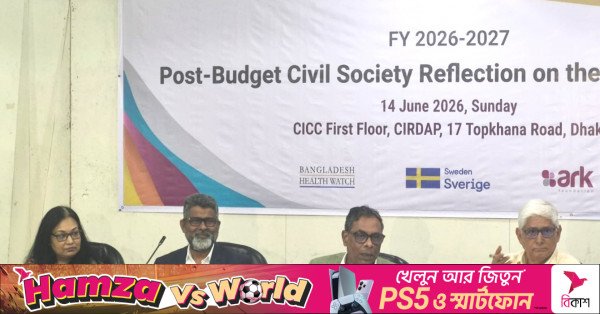
State Minister for Health and Family Welfare Dr Muhit speaks at an event titled “FY 2026–2027 Post-Budget Civil Society Reflection on the Health Budget” held this afternoon at the CIRDAP auditorium, 14 June 2026. Photo: TBS
“>

State Minister for Health and Family Welfare Dr Muhit speaks at an event titled “FY 2026–2027 Post-Budget Civil Society Reflection on the Health Budget” held this afternoon at the CIRDAP auditorium, 14 June 2026. Photo: TBS
State Minister for Health and Family Welfare Dr MA Muhit said the health sector’s “theory of change” should focus on addressing four key concerns identified at the grassroots level and ensure smooth hospital access, care and availability of doctors, medicines and diagnostics .
The four key concerns include the influence of broker syndicates in hospitals, shortages of doctors and healthcare personnel, lack of access to free medicines, and the burden of unnecessary diagnostic tests.
“Our theory of change should be to solve these four problems,” he said, adding that these issues should no longer exist five years from now.

“People’s suffering begins from the moment they enter a hospital,” Dr Muhit said at an event titled “FY 2026–2027 Post-Budget Civil Society Reflection on the Health Budget” held this afternoon (14 June) at the CIRDAP auditorium and jointly organised by Bangladesh Health Watch (BHW) and ARK Foundation.
“A patient should be able to enter a hospital without hassle, avoid harassment, receive treatment from a doctor, and access necessary medicines and diagnostic services. This is what the health budget means to ordinary people,” he added.
Describing the proposed health budget as “a reflection of public expectations”, Muhit said it had been formulated based on recommendations from public health experts and grassroots demands.
The state minister said that within three months of assuming office, the government had attempted to understand the real challenges facing the health sector directly from the public.
“Another form of disorder has emerged through outsourcing. It is difficult even for us to determine who is a hospital staff member and who is an outsourced personnel,” he said.
Highlighting manpower shortages, Muhit said, “If you visit any healthcare facility, you will find that half of the doctors, nurses, officials, employees and cleaners are absent. If there are supposed to be 10 staff members, you will find five.”
He said people expect to receive at least some medicines free of charge.
“If a doctor prescribes five medicines, people hope to get at least two free of cost, but they do not receive them. Similarly, people expect two out of four diagnostic tests to be provided free of charge,” he added.
Muhit further said the proposed budget was not the result of a sudden decision but had been prepared based on two-and-a-half years of planning, research and expert opinions.
He added that commitments made in the election manifesto, including strengthening primary healthcare, introducing a national ambulance service and expanding pharmacy dispensary services, had been reflected in the budget.
However, he identified budget implementation as the biggest challenge.
“Every year, 20-30% of the budget is returned unspent. We now need to enhance our capacity; otherwise, even larger allocations will fail to deliver the expected outcomes,” he said.
Drawing attention to structural issues within the healthcare system, Muhit said the authority and effectiveness of civil surgeons at the district level had weakened and needed to be restored.
He also stressed reducing centralisation and strengthening management at the local level.
“Over the past three months, we have visited various places and hospitals to identify where the problems lie. We have identified the key problems in the health sector and written to 300 MPs, assigning them responsibilities. The involvement of MPs will improve local infrastructure and service quality,” he said.
“We have more or less reached a consensus on the budget. Now the main task is to ensure implementation. Political commitment exists – what we need now is a collective effort,” he added.
About The Author