The capital’s streets are once again caught in a complicated standoff between urban order and livelihoods.
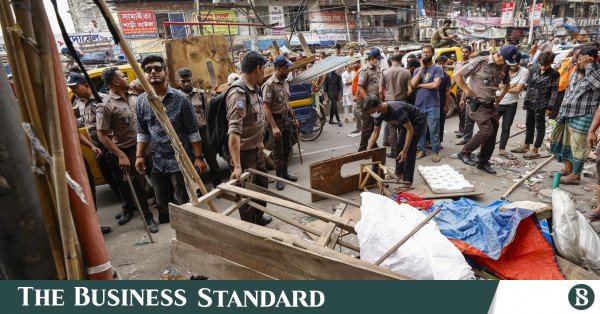
Police seize demolished remains of illegal makeshift shops along the roadside and footpath during an eviction drive led by a special metropolitan magistrate on Elephant Road in the capital in this photo taken recently. Photo: Rajib Dhar/TBS
“>

Police seize demolished remains of illegal makeshift shops along the roadside and footpath during an eviction drive led by a special metropolitan magistrate on Elephant Road in the capital in this photo taken recently. Photo: Rajib Dhar/TBS
Highlights:
- After last month’s drive, hawkers reoccupy footpaths, now expand onto roads
- Gulistan, Motijheel, other busy areas again become congested with roadside stalls, vans
- Authorities now issue digital identity cards to rehabilitate hawkers, triggering criticism
- Allocation of 4ft by 5ft spaces for a hawker not enough to do business
- Return of hawkers to roads increase traffic risks: Pedestrians
A recent drive by the city corporations and the police administration to reclaim Dhaka’s footpaths and roads from hawkers initially brought relief to pedestrians. But that relief proved short-lived.
Within days of the eviction, many of the footpaths were seen reoccupied, while some areas were even marked out to allocate designated spaces for hawkers.

From 1 April to 10 April, authorities conducted the drive to evict hawkers from footpaths and major roads in the capital. Although it temporarily improved pedestrian movement, thousands of hawkers, claiming they had lost their only source of income, soon returned – this time spilling onto roads instead of footpaths.
As a result, the capital’s streets are once again caught in a complicated standoff between urban order and livelihoods. The move to rehabilitate hawkers through digital identity cards has also triggered public criticism.
Dhaka North City Corporation has already distributed digital identity cards to 202 hawkers in Mirpur-1, Mirpur-2 and Mirpur-10. Dhaka South City Corporation has also issued cards to around 100 hawkers.
Through the initiative, authorities aim to legalise and relocate hawkers to designated spaces. However, city corporations have announced plans to distribute more cards in phases, encouraging many hawkers to ignore restrictions and continue operating on roads.
Authorities have allocated four-foot-by-five-foot spaces for each hawker, but many traders say the arrangement is unrealistic.
According to hawkers, many of their vans and product displays extend up to eight or 10 feet, making it impossible to operate within the designated boundaries.
Many hawkers insist they are unwilling to relocate regardless of rehabilitation efforts.
Akhtar Mia, who has been running a footpath business in Gulistan for the past decade, said eviction alone cannot solve the issue.
“They evicted us and expected us to disappear. But where will we go?” he told The Business Standard.
“We pay money to local [political] leaders. Can they remove us so easily? We have returned because this is where our customers are. If we move elsewhere, our businesses will collapse,” he said.
He added that although city authorities promised rehabilitation, relocating traders from Gulistan to areas such as Mirpur would not be practical.
“Officials have already collected our documents and said they will provide hawker cards. But we will not leave this area,” he insisted.
Visits to several areas of the capital revealed that despite joint eviction drives by the Dhaka Metropolitan Police and the city corporations, hawkers have quickly reclaimed roads and footpaths.
In Motijheel, Baitul Mukarram, Sayedabad, New Market and near Dhaka Medical College Hospital, hawkers were seen setting up stalls, benches and vans on roadsides immediately after the drives ended.
In many areas, they now occupy not only footpaths but significant portions of roads, increasing traffic congestion and risks for pedestrians.
Naznin Akhtar, a private sector employee in Gulistan, said walking on roads has become increasingly dangerous.
“There is always a risk of being hit by vehicles from behind,” she feared, saying that the situation is back to square one after all the eviction drama.
Previously, Dhaka South had planned to launch eight night markets across the capital to keep footpaths free during daytime hours. Under the proposal, hawkers would operate only from evening until midnight at designated locations.
However, implementation of the plan remains uncertain.
Shahin, a roadside clothing vendor in front of Ramna Hotel in Gulistan, said authorities carried out eviction drives without consulting traders.
“We have been doing business here for nearly 10 years. They say they will give us alternative spaces, but businesses do not survive everywhere,” he said.
Repeated attempts to contact Dhaka South Administrator Md Abdus Salam for comments were unsuccessful.
About The Author