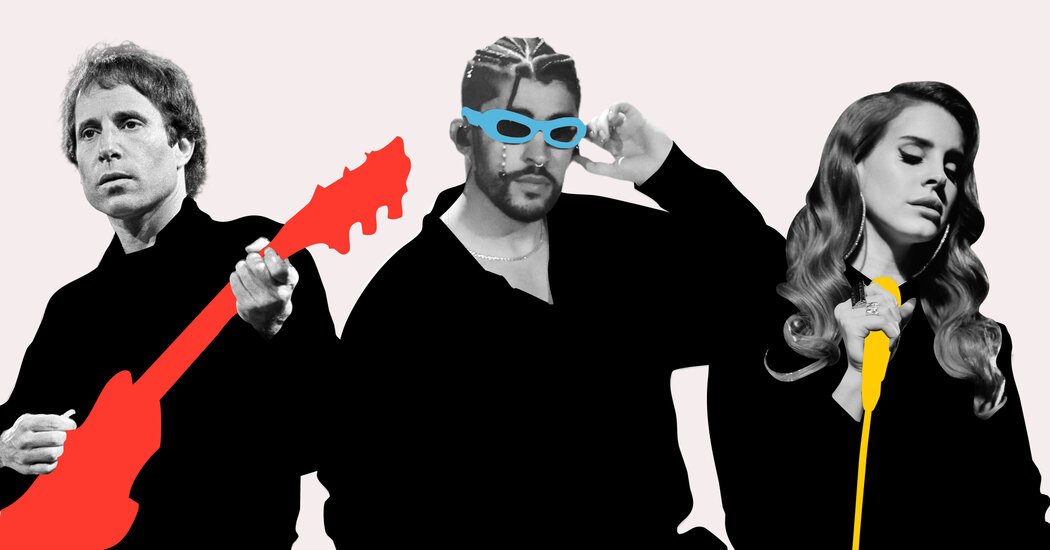
Trying to name the 30 greatest living American songwriters is like trying to choose the 30 best trees in our national parks. Where do you even begin? The sheer volume and variety of American song is daunting — so many traditions, genres, subgenres, even different ways of crafting music, from the lone singer-songwriter clutching a guitar to long-distance collaborators emailing each other sequencer patterns. The pleasures of all that music are equally varied. Sometimes you get wit, wordplay and tidy storytelling; other times, schmaltzy emotion, grimy darkness or wild experimentation. And besides, how do you define “greatness?” Is it about originality? Influence? Mass appeal?
We began by seeking the wisdom of the crowd: We sent out ballots to hundreds of experts, asking which songwriters they considered America’s greatest. We asked musicians, of course — from pop stars to underground favorites — but also critics, historians, industry executives, D.J.s, music supervisors, choreographers. (You can head here to explore a selection of the more than 250 ballots that came back.) They offered up over 700 nominees, covering a wild range: household names and deep-cut experimentalists, behind-the-scenes industry stalwarts and people making tapes in basements. (As for why we excluded the many great American songwriters who are no longer alive, there are two reasons: We wanted to reflect the present state of the craft, and we wanted to be able to ask some of these songwriters how they do what they do.)
We then took the wisdom of the crowd and ran it through a filter: To sort through the hundreds of nominees the first part of our process had generated, we assembled a group of six Times-affiliated critics — each of whom has written about music for decades — for several hourslong sessions. The names that appeared most on our expert ballots would be their starting point, undisputed contenders for any list of 30. The less frequently a songwriter appeared, the more in-the-room consensus and justification were needed to include them on the final list.
What ensued was exactly what you’d imagine: a conversation that was always passionate and often heated. The critics played lot of great music for one another and debated the merits of dozens of songwriters, legendary and obscure. (If you spot a glaring omission from this list, you can be certain that the artist had a champion on our panel who went down swinging.) Along the way, they reckoned with fundamental questions about the art, craft and history of song creation. They pondered the importance of irony, grandeur, idiosyncrasy, political consciousness, personal confession. They argued about the value of formal mastery versus playful disruption. They talked about machines and muses: how music-making technologies, from pianos to Pro Tools, have determined what songs are written and how we hear them.
Some of the issues that had to be resolved were practical ones. Does Joni Mitchell count as an American songwriter? (We elected not to steal that honor from Canada.) Where do we draw the increasingly blurry lines between songwriters, beatmakers and producers? (Several case-by-case arguments arose.) Can we give the nod to surviving members of writing collectives whose partners have died? (Yes.) Some critics stumped for lesser-known innovators; others were bullish on popular taste, eager to steer toward writers who speak to millions. Sometimes one masterwork seemed like enough; other times the critics responded to the scale or depth of a songwriter’s catalog.
The list we settled on reflects a lineage that stretches across eras and idioms, spanning generational and geographic divides. The oldest member of our pantheon, Willie Nelson, was born in the hardscrabble hill country of rural north-central Texas in 1933, eight weeks after the inauguration of Franklin D. Roosevelt; he sold his first song, a country ballad with a gospel theme called “Family Bible,” for $50 cash, in the late 1950s. The youngest honoree, Bad Bunny, is a child of 1990s San Juan, whose bracing blend of reggaeton, trap and R&B, full of sharp-witted lyrics in slang-heavy Puerto Rican Spanish, first came into earshot when he uploaded recordings to SoundCloud as teenager, around 2013.
The list also reflects the quintessentially American qualities of our music, revealing a story of transmission that winds back through centuries to West Africa, the British Isles and countless other points of origin for millions who came to this land. They created a vast body of vernacular song: field hollers and ring shouts and spirituals, murder ballads and sea shanties and jug-band music, parlor songs and vaudeville ditties and ragtime hits, Appalachian folk, Delta blues, gospel, bluegrass, jazz — and on and on. This vast musical heritage is a foundation for contemporary songs as diverse as Missy Elliott’s party anthems and Stephin Merritt’s indie-pop miniatures.
Listen to the 30 Greatest American Songwriters playlist:
History haunts the American songbook. There’s an age-old tradition of Southern musical sentimentality that echoes through the twanging testimonies of Dolly Parton, the courtly love songs of Lionel Richie, even the Auto-Tune-smeared rants of Young Thug. Listening to the varied dialects of New Yorkese in the songs of Carole King and Nile Rodgers and Jay-Z, you hear qualities — professionalism, urbanity, attitude — that can be traced to the foundational New York songwriters of Tin Pan Alley and the Harlem Renaissance. The American greats on our list draw on deep roots, and extend them.
There are other lessons to be found here. Many of the writers we’ve honored have worked within famous “factory” systems — Nashville’s Music Row, Motown, the Brill Building, the hook-and-topline machine behind today’s pop and R&B — churning out songs that strive to reach multitudes and climb charts. Then there are those who embody a more personal, idiosyncratic kind of creation: world-builders like Bruce Springsteen and Fiona Apple and Kendrick Lamar, who reached superstardom by driving deep into their obsessions and bringing a mass audience along for the ride. These divergent approaches are often crudely framed as a clash of commerce and art, pitting crass industrial song production against the noble homespun.
But take a closer look and the borders blur, the clichés dissolve. Consider the work of arguably the biggest current star on our list, a boundary-buster if there ever was one. Taylor Swift served her apprenticeship on Music Row, honing world-class skills as a commercial storyteller and hook-wrangler, before quitting country music and applying that expertise to the scaled-up demands of global diva pop. She remains a consummate craftswoman, a pro’s pro, who can write a hit with the best; she’s also a Byronic bard with an inimitable, sometimes gonzo lyrical voice.
Or take the most hallowed of all American troubadours, Bob Dylan. It was the moment he emerged in the 1960s that music’s center of gravity shifted definitively from the Tin Pan Alley hit-factory model to a musical world dominated by singer-songwriters. Yet Dylan has spent the past quarter-century riffling the pages of the Great American Songbook for inspiration and recording tribute albums to Frank Sinatra. When it comes to categories like “factory built” and “handmade,” Swift and Dylan, like so many of these 30 greats, are both/and — and then some.
What this list says about American music is probably for readers to judge. We considered all sorts of remarkable songwriters — including lots of weird geniuses and underloved influences. But we were drawn back toward the beating-heart story of American song, to people whose music has reverberated through private worlds and across the public square, echoing through headphones, radios, grocery-store aisles, TikTok videos and school-gym ceremonies, blasting out of karaoke machines, club speakers and the windows of passing cars.
Their music has defined what half a century of national life sounds like — and that sound has traveled the world as perhaps the country’s most potent and influential export. Here they are: the 30 greatest living American songwriters.
— The editors
About The Author