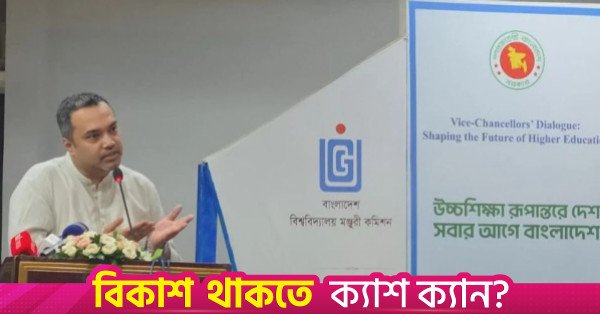
PM’s education adviser Mahdi Amin says the government will support innovation hubs, incubation centres and research initiatives at universities to turn promising ideas into startups and solve local problems.
Prime Minister’s Adviser on Education and Primary and Mass Education Dr Mahdi Amin speaks at the ‘Vice-Chancellors’ Dialogue: Shaping the Future of Higher Education’ in Savar, Dhaka, today (21 August). Photo: BSS
“>

Prime Minister’s Adviser on Education and Primary and Mass Education Dr Mahdi Amin speaks at the ‘Vice-Chancellors’ Dialogue: Shaping the Future of Higher Education’ in Savar, Dhaka, today (21 August). Photo: BSS
Prime Minister’s adviser on education and primary and mass education Dr Mahdi Amin today (21 August) said the government plans to establish innovation hubs, incubation centres and startup ecosystems at universities across the country to promote innovation, entrepreneurship and research.
“The government wants to extend cooperation. If you can build an innovation ecosystem with each university, we can provide support and funding to turn promising ideas into startups,” he said.
He was speaking at the ‘Vice-Chancellors’ Dialogue: Shaping the Future of Higher Education’, a two-day national policy dialogue organised under the Higher Education Acceleration and Transformation (HEAT) Project of the University Grants Commission (UGC) at BRAC CDM in Savar on the outskirts of the capital.

Mahdi said the government wants universities to organise innovation and idea competitions and provide grants to promising ideas that have the potential to address national or local problems.
“We want to see whether innovation hubs can be developed and startups can emerge from universities. We can provide facilities like incubation centres,” he said.
He said almost every district of the country has an industrial cluster, hi-tech park or economic zone, but there is often little connectivity between these facilities and local universities.
“We need to create that connectivity so that students can get opportunities to work there and receive policy support,” he said.
The adviser said the government would facilitate necessary policy and institutional support for students who want to become entrepreneurs, particularly in cases involving licensing and other regulatory complications.
“Our main objective is to create a local ecosystem and connect the dots through policy facilitation so that students can take advantage of the opportunities available around them,” he said.
On research, Mahdi said the government expects a “significant jump” in research funding in the next fiscal year.
“We want research to solve our problems locally as much as possible,” he said, stressing the need to expand access to international journals and improve laboratory and research and development (R&D) facilities.
He also called for transforming brain drain into brain circulation by connecting Bangladeshi academics and researchers working abroad with local universities.
He proposed visiting faculty and fellowship programmes through which overseas-based Bangladeshi academics could spend two, three or six months at Bangladeshi universities, contributing to both teaching and research without requiring full-time appointments.
Mahdi said many Bangladeshi academics produce high-quality research while working abroad but face limitations in Bangladesh due to inadequate journal access, laboratory facilities and R&D support.
“If we can create global collaborations and ties, some of these problems can be solved,” he said.
The adviser also proposed introducing a summer-school culture in Bangladesh and making credit transfers between universities, including foreign universities, easier.
He said global best practices could help make the country’s higher education system more flexible, inclusive and fair.
“Quality should be given more importance than numbers,” he said, adding that the government would provide different policy support to different universities based on their respective contexts and ecosystems.
He expressed optimism that Bangladeshi universities could improve their positions in global rankings if appropriate policy support and research facilities are ensured.
“Our students are doing well at top universities around the world. They are doing well in master’s and PhD programmes and as faculty members and researchers. There is no reason why we should remain behind in rankings,” he said.
Mahdi said the government, under the leadership of the Prime Minister, would work with the Education Ministry, UGC and universities to improve the quality of higher education and create greater opportunities for the country’s large young population.
Finance and Planning Minister Amir Khosru Mahmud Chowdhury, Secondary and Higher Education Division Secretary Abdul Khalek, UGC Chairman Professor DrMamun Ahmed, former UGC Chairman Professor Dr S M A Faiz, and vice-chancellors of public and private universities, among others, attended the programme.
The two-day dialogue brings together vice-chancellors of around 65 public and private universities, policymakers, academics and experts to discuss strategic leadership and governance, quality teaching and assessment, research and innovation, university-industry collaboration, artificial intelligence and digital transformation.
Four sessions were held on the first day, with the remaining sessions scheduled for Saturday.
Education Minister Dr A N M Ehsanul Haque Milon is scheduled to attend the concluding session.
About The Author