Referring to Sheikh Hasina’s remarks after losing the 1991 election, Zahed said she had vowed not to let the government remain in peace even for a day.
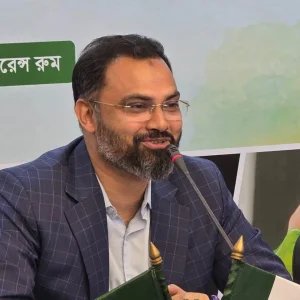
Prime Minister Tarique Rahman’s Information and Broadcasting Adviser Zahed Ur Rahman. Photo: Collected
“>

Prime Minister Tarique Rahman’s Information and Broadcasting Adviser Zahed Ur Rahman. Photo: Collected
The government is sympathetic to garment workers’ demands amid rising living costs and has already formed a wage board to address their concerns, Prime Minister’s Information Adviser Dr Zahed Ur Rahman has said.
“Living costs are rising, making life difficult for garment workers. That is why the government has shown sympathy towards their demands and formed a wage board in advance,” he said at a press conference on the progress of various government activities today (3 November), reports Jamuna TV.
He said the formation of the wage board should have resolved the issue.

However, he said the violent behaviour displayed by some people during the ongoing protests could not be considered typical of garment workers.
Asked about the banned Awami League’s role in creating instability, Zahed said he did not think the party could achieve much politically. However, given the large amount of money it had looted, the party might resort to sabotage in some places.
He also said he did not think such activities would pave the way for Sheikh Hasina’s return in December.
Attempts to create instability could continue even after December, he said.
Referring to Sheikh Hasina’s remarks after losing the 1991 election, Zahed said she had vowed not to let the government remain in peace even for a day.
“She will continue trying to do so for as long as she lives, and we will resist those attempts,” he said.
Distinguishing between an authoritarian government and a democratically elected one, Zahed said the tendency to blame the opposition for every protest did not apply to the current government.
He said the government was holding the opposition responsible based on sufficient information and evidence.
The current government was handling protests much better than the Awami League government had done, although mistakes could still occur in some places, he added.
Police would practise ways to control situations while causing the fewest possible casualties when using firearms, he said.
On the use of lethal weapons, Zahed said the law specifies the circumstances in which police can open fire with the intention to kill. However, whether the use of such force was legally unavoidable in a particular situation must be assessed in accordance with legal procedures.
Regarding the recent increase in LPG prices, Zahed said the decision had been taken with long-term public welfare in mind.
He said the government could no longer afford to cover the gap between the purchase prices of LNG and LPG and their selling prices through subsidies.
Continuing subsidies would require the government to borrow money, which could further fuel inflation, he added.
The situation had been caused by rising global energy prices, he said.
About The Author