The state minister says despite spending Tk400 crore on digitalisation, the National Board of Revenue (NBR) system is not functioning properly.
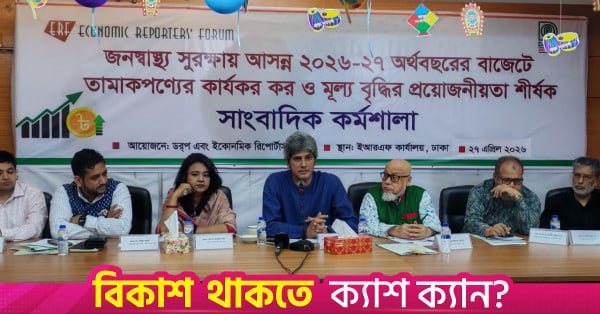
Planning State Minister Zonayed Saki speaks as the chief guest at a workshop in the Economic Reporters Forum (ERF) office in the capital today, 27 April 2026. Photo: TBS
“>

Planning State Minister Zonayed Saki speaks as the chief guest at a workshop in the Economic Reporters Forum (ERF) office in the capital today, 27 April 2026. Photo: TBS
Planning State Minister Zonayed Saki has said the government is giving top priority to removing barriers to private sector investment, ensuring energy security, improving port management and increasing revenue collection.
He made the remarks today (27 April) while speaking as chief guest at a workshop titled “The necessity of effective taxation and price rise on tobacco products in the 2026–27 budget to protect public health”, jointly organised by the Economic Reporters Forum (ERF) and the Development Organisation of the Poor (DORP).
In his address, Saki said there is scope to further increase duties and base prices of tobacco products, adding that it is not appropriate to keep prices low by depriving tobacco farmers and workers of tobacco companies.

“There are leakages in tobacco tax collection. Band rolls are being printed abroad to evade taxes, and domestic tobacco companies are also involved. Therefore, the NBR can introduce a separate monitoring system for the tobacco sector,” he said.
The state minister added that despite spending Tk400 crore on digitalisation, the National Board of Revenue (NBR) system is not functioning properly, requiring monthly expenditure for its management.
Referring to private investment, he said the government aims to ensure a one-stop service to remove barriers, adding that the goal is to reduce dependence on domestic and foreign borrowing and increase revenue collection to meet both operational and development expenditures.
He said the government is working towards building an inclusive trillion-dollar economy, adding that the direction Bangladesh will take over the next five years will be reflected in the upcoming budget.
At the workshop, a keynote paper was presented by Dhaka University Health Economics Institute professor Dr Shafiun Nahin Shimul.
He said although the tax rate on cigarettes in Bangladesh is high, prices remain low, and proposed increasing both prices and tax rates alongside introducing a specific tax.
He added that analysis of data from 170 countries shows that increasing cigarette prices does not lead to a rise in illicit sales, and that tobacco companies spread claims between February and June that illegal cigarette sales will increase to discourage tax hikes.
The workshop was chaired by ERF President Doulot Akter Mala and moderated by its General Secretary Abul Kashem.
About The Author