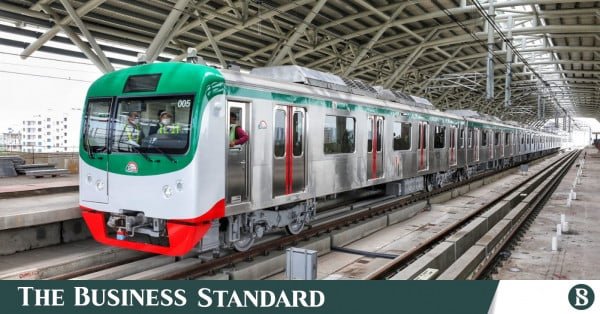
The government plans to resume work on the long-stalled MRT Line-1 and MRT Line-5 Northern metro rail projects with Japanese financing, while also appointing international experts to review what officials described as unusually high cost proposals submitted by Japanese contractors.
The decision was taken yesterday (20 May) at a meeting chaired by Finance and Planning Minister Amir Khosru Mahmud Chowdhury at the Secretariat, where officials reviewed progress, challenges and future plans for Dhaka’s mass rapid transit projects.
Work on MRT Line-1, connecting Airport and Kamalapur, and MRT Line-5 Northern, linking Hemayetpur, Gulshan and Bhatara, has remained effectively stalled for around one and a half years because of disputes over project costs.

Officials attending the meeting told The Business Standard that the government would hold further discussions with the Japan International Cooperation Agency (Jica) and contractors to reduce costs and seek detailed explanations for the high estimates.
The government also plans to compare Bangladesh’s proposed metro construction costs with similar projects in other countries and appoint professional negotiators or technical experts to strengthen negotiations.
“Discussions are ongoing. They will have to justify why the costs are higher. At the same time, they will also be informed about how other countries are implementing similar projects,” Khosru said.
“We will appoint professional negotiators so that the negotiations are handled properly and our interests are fully protected,” he added.
Officials said project implementation agency Dhaka Mass Transit Company Limited (DMTCL) would continue negotiations with contractors, while the Economic Relations Division would engage with Jica.
However, an official present at the meeting said that the timeline for starting implementation of the two projects has not yet been finalised. No specific deadline has been set at this stage.
However, policy-level approval has been obtained from the minister, and several more meetings are expected to be held in the coming days. At the same time, all development project proposals (DPPs) will also need to be revised.
Discussions at the meeting noted that contractors had proposed higher costs after factoring in additional risks, as Bangladesh has never before implemented an underground metro rail system.
Concerns over Dhaka’s soil conditions, densely populated urban environment, vibration risks and the possibility of structural damage to nearby buildings also contributed to the higher cost estimates.
“Since Bangladesh has never had an underground metro line before, contractors are concerned about potential risks and the soil structure,” the official said.
“If tunnel excavation causes damage to buildings or vibration impacts nearby areas in the future, contractors may face compensation liabilities. Risks related to the defect liability period are also being considered.”
MRT Line-1 and MRT Line-5 Northern were approved during the Awami League government in 2019 with Japanese financing. But work stalled after Japanese consultants and contractors proposed costs 90-100% higher than those approved in the original DPPs.
According to a DMTCL evaluation report, the original combined project cost approved by the government was Tk52,561.43 crore. Japanese consultants and contractors later proposed revising the cost to Tk96,422.70 crore – an increase of around 83%.
DMTCL officials said the estimated cost for three underground construction packages from Aminbazar to Bhatara was initially set at Tk13,966.2 crore, but contractor bids later raised the projected cost to Tk30,865 crore.
The original DPP estimated Tk37,655.66 crore for depot construction, underground and elevated tunnel stations, electrical and mechanical works, and rolling stock. That figure has now been proposed at Tk80,099.79 crore.
Stakeholders said the structure of Japanese loan conditions effectively limits competition because consultants must be appointed from Japan, and those consultants prepare tender documents in ways that often favour Japanese contractors.
Although the tenders are formally open, officials said the same two or three companies repeatedly dominate the bidding process, reducing opportunities for broader international competition.
Tensions between DMTCL and Jica over the issue have continued for months. Bangladesh’s side favours cancelling the current tenders and inviting fresh international competitive bids, while Jica maintains that the tender evaluation process followed its procurement guidelines and that higher costs reflect global inflation and underground construction risks.
In a letter sent to the Planning Commission on 28 January this year, DMTCL proposed several reforms aimed at increasing international competition and controlling project costs for MRT Line-1.
The recommendations included opening existing tax exemptions and duty benefits currently enjoyed by Japanese contractors, suppliers and workers to all international firms.
DMTCL also proposed using a “One Stage Two Envelope without Prequalification” bidding system to allow greater participation by qualified international contractors.
The letter further recommended state-level discussions with development partners to identify practical solutions for keeping project costs within acceptable levels, while considering revisions to project scope based on expert advice without undermining core project objectives.
Meanwhile, an official attending yesterday’s meeting said the government was also moving ahead with other metro projects backed by different development partners.
The 13.1km MRT Line-5 Southern project from Gabtoli to Aftabnagar will be financed by the Asian Development Bank and South Korea, while MRT Line-2 connecting Gabtoli, Old Dhaka and Demra will receive World Bank financing.
The official said greater competition among international lenders and contractors could help Bangladesh compare costs, quality and implementation efficiency across metro rail projects.
“There should be a competitive environment among international financing agencies in metro rail projects,” he said. “That would create opportunities to compare project costs, quality and implementation capability.”
About The Author