Jamaat accuses government of failing on reforms and governance.
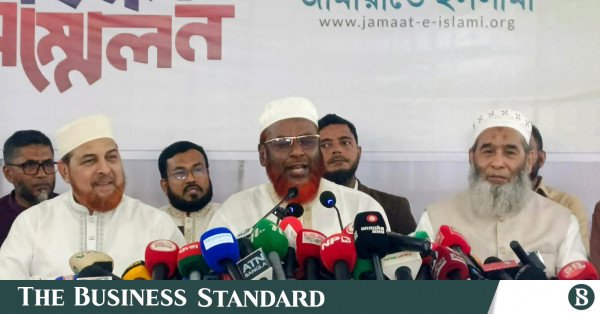
Bangladesh Jamaat-e-Islami held a press conference at Al-Falah Auditorium in Dhaka’s Moghbazar today (18 August). Photo: TBS
“>

Bangladesh Jamaat-e-Islami held a press conference at Al-Falah Auditorium in Dhaka’s Moghbazar today (18 August). Photo: TBS
Highlights
- Porwar raises concerns over deteriorating law and order
- Jamaat criticises government handling of energy crisis
- Party presents eight demands for government action
Bangladesh Jamaat-e-Islami today (18 August) alleged that the BNP-led government was creating scope for the Awami League’s political rehabilitation, with senior officials linked to the party receiving promotions and postings under government patronage, while accusing the BNP-led government of failing to meet public expectations during its first six months in office.
Jamaat Secretary General Mia Golam Porwar made the allegation at a press conference at Al-Falah Auditorium in Dhaka’s Moghbazar today (18 August), where the party presented its assessment of the BNP government’s first six months.

He described the government’s performance as marked by “failure and weakness”, citing what he said were failures to implement the referendum verdict and July National Charter, politicisation of the administration, deterioration in law and order, and the government’s inability to address rising prices and the energy crisis.
On the alleged rehabilitation of the Awami League, Porwar said, “Senior Awami League-affiliated bureaucrats and secretaries are now getting promotions and appointments. With the patronage of the current government, they are raising their heads again everywhere.”
“Last 15 August, with government patronage, the way they moved around the Supreme Court, High Court and various other places compared to the previous year shows that a conspiracy to restore one-party rule and rehabilitate the Awami League in politics has begun,” he said.
Porwar said the government’s failure to implement the referendum verdict was one of its major shortcomings.
He said the BNP had pledged before the election to implement the referendum verdict based on the July Charter but had taken a negative position after coming to power.
He also criticised the failure to establish the proposed constitutional reform council, saying elected lawmakers were supposed to serve as members of the council.
Jamaat alleged that key reforms outlined in the July Charter – including limiting the prime minister’s tenure, introducing a bicameral parliament, ensuring judicial independence, protecting fundamental rights and strengthening local government — had not been implemented.
Law and order
Criticising the law and order situation, Porwar said 605 murders had taken place during the first 110 days of the government’s 180-day tenure.
He also alleged that incidents of robbery, abduction, theft, violence against women and children, and rape were increasing.
On campus violence, he said there had been expectations that universities would not witness bloodshed after the July uprising. However, he alleged that attacks by Bangladesh Chhatra Dal had occurred at institutions including Alia Madrasa, Begum Rokeya University and Jagannath University.
He further alleged that university administrations in some cases had openly supported Chhatra Dal and the BNP.
Foreign policy concerns
Porwar accused the government of “strategic weakness” in foreign policy, saying the “Bangladesh First” policy had yet to be translated into a clear and coordinated foreign policy framework.
He claimed there had been no visible progress on key issues, including the extradition of Sheikh Hasina, Rohingya repatriation and conflicts in the Middle East.
He also alleged that the government had failed to take effective measures to stop the recent increase in “push-ins”.
Porwar further alleged that honest officials who were not aligned with the BNP were being transferred or demoted.
Energy crisis
The Jamaat leader also criticised the government’s handling of the gas and energy crisis.
He claimed the daily gas supply shortfall was around 1,000 million cubic feet, causing industrial production to fall by up to 40%.
According to his claims, around 20 factories had shut down and 20,000 workers had been laid off because of the crisis.
He, however, welcomed the government’s initiative to form a committee to address the energy crisis.
Porwar also criticised the government’s performance on prices and the banking sector.
He said inflation stood at 9.16% in June, while non-performing loans reached around Tk5.88 lakh crore at the end of March.
He claimed that although foreign exchange reserves remained stable, the government deserved no credit for the situation.
Jamaat also accused the government of politicising public institutions and universities through politically motivated appointments, postings and promotions.
Eight demands
At the press conference, Jamaat presented eight demands, including a time-bound roadmap for implementing the referendum verdict and July Charter, an energy security strategy, freeing the administration from political influence, improving law and order, controlling prices, ensuring good governance in the banking sector and reforming the law on enforced disappearances.
About The Author