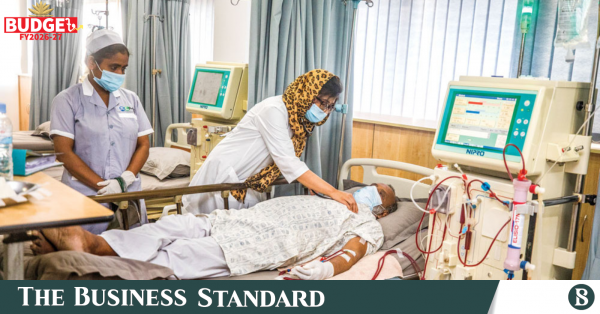
DGHS instructed to submit progress reports every 15 days
Representational image. Photo: TBS
“>

Representational image. Photo: TBS
The government has directed authorities concerned to prepare a comprehensive inventory of unused medical equipment lying idle in government hospitals across the country and swiftly redistribute it to facilities where it is needed and made operational.
The directive was issued in a recent order by the Government Health Management-1 Branch of the Health Services Division under the Ministry of Health.
To implement the decision, the Health Services Division sent a letter to the Directorate General of Health Services (DGHS) on 19 July, instructing its director general to take the necessary measures and submit progress reports to the Division every 15 days.

According to the order, the decision was taken at an Ecnecmeeting on 9 June, during which the decision was taken to ensure the prompt utilisation of medical equipment that has remained unused in hospitals nationwide.
Health Minister Sardar Md Sakhawat Hossain told The Business Standard that poor planning had left many expensive medical devices unused for years. He said unplanned procurement and weak management had resulted in a significant waste of public funds.
He cited the procurement of two radiotherapy machines during the Awami League’s tenure as an example.
“Although each was worth about Tk11 crore, they were purchased for Tk18 crore apiece. The facilities where the machines were installed weren’t even ready to operate them. They were purchased because there was a profit margin of Tk4-6 crore on each machine,” he added.
He said one machine now remains idle in Faridpur, while the other is lying unused in Khulna.
“Similarly, X-ray machines and other medical equipment were procured for hospitals without the necessary technical personnel to operate them. Many have remained unused for years, and in some cases, the only option left is to sell them as scrap,” he said.
The minister said the government has therefore launched the initiative to ensure the proper utilisation of idle medical equipment through redistribution.
52% of diagnostic equipment had remained unused
A recent study by the Power and Participation Research Centre (PPRC) has found that many diagnostic machines in public hospitals, including X-ray and ultrasound equipment, remain underutilised, leaving patients without regular access to essential diagnostic services.
The study, titled “Bridging Gaps in Bangladesh’s Public Health System: A Rapid Facility-Level Assessment of Expenditure Efficiency towards Ensuring UHC-Compliant Health Service Delivery”, assessed 22 public health facilities across all eight administrative divisions.
It reviewed budget and procurement records for FY25 and combined a facility functionality survey and a knowledge, attitude and practice survey of 95 officials with 32 interviews involving hospital managers, national policymakers, suppliers, academics and patients.
The study found that although diagnostic equipment was available in 65% of hospitals surveyed, patients had regular access to those services in only 25% of cases. The study also said 52% of diagnostic equipment had remained unused over the past year.
District hospitals had the highest availability of diagnostic equipment, at 85%, but only 33% were able to provide the services regularly. At upazila health complexes, equipment was available in 46% of facilities, yet regular services were delivered in just 17%. Medical colleges and specialised hospitals reported 54% equipment availability, while only 25% provided regular diagnostic services during the same period.
The study identified non-functional equipment as the main reason for service disruptions, accounting for 79% of cases. Shortages of essential accessories were responsible for a further 14%, while the absence of trained technologists accounted for the remaining 7%.
According to PPRC, the procurement and management of medical equipment remain a major source of irregularities and corruption in the health sector.
The report said hospitals often purchase equipment without assessing actual needs, while broken machines frequently remain unrepaired for long periods due to administrative delays and other excuses.
About The Author