New wage board by October, minister says
Infographic: TBS
“>

Infographic: TBS
Highlights
- RMG workers got last wage increase in 2023
- Amended law requires wage increase every 3 years
- Minimum wage now Tk12,500
- Inflation erodes wage gains
- New wage board to be formed by October
- Not right time to increase wages, owners say
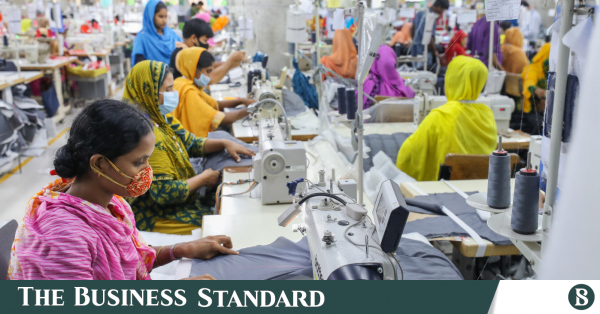
Amid persistently high inflation and mounting pressure from labour leaders, the Bangladesh government is considering forming a new wage board to raise the minimum wage for garment workers from the existing Tk12,500, according to government sources.
The labour and employment minister and secretary sat with senior leaders of two garment owners’ associations four days ago in an informal meeting, and the owners’ representatives “didn’t disagree” with the proposal to form a new wage board, according to the secretary.
“We sat with RMG owners’ leaders, and they didn’t disagree,” Md Abdur Rahman Tarafder, secretary of the labour and employment ministry, told The Business Standard yesterday.

He said, “Primarily, we will form a committee, and there are some processes to complete before forming the board. Hopefully, a new wage board for the RMG sector will be formed by October.”
Garment factory owners, however, raised their objection regarding the timing.
Mohammad Hatem, president of the Bangladesh Knitwear Manufacturers and Exporters Association (BKMEA), told TBS, “RMG sector is going through a tough time, and this is not the right time to increase wages.”
“Export orders are currently declining, while production costs are also rising for various reasons. But we are not getting the corresponding prices from buyers. In such a situation, if wages are increased, the industry will not be able to bear the additional pressure,” he added.
“As a result, more factories will be added to the closure list,” he said.
Labour leaders welcomed the move and demanded a new minimum wage for RMG workers by December, so that workers can start receiving the revised wages from January.
Kalpona Akter, executive director of the Bangladesh Centre for Workers Solidarity (BCWS), told TBS, “We welcome the move, but it should have been taken much earlier, as the amended Labour Act requires a new wage to be set within three years. That deadline will expire next December.”
Mohammad Hatem expressed disagreement, saying, “Some people are misinterpreting the amended Labour Act, as any amendment or change in the law cannot have retrospective effect.”
The government raised the minimum wage for RMG workers to Tk12,500 or about $100 in December 2023, marking an increase of more than 56% from the previous wage. Since then, however, Bangladesh has been experiencing persistently high inflation, with the rate remaining above 9%.
However, in late 2025, the interim government amended the Bangladesh Labour Act (BLA), reducing the interval for minimum wage revisions across all sectors from five years to three. Considering the last wage increase for garment workers, labour leaders say the next new wage is due by December 2026.
To implement the new wage by December, garment workers’ leaders have been demanding that the wage board be formed without delay.
Processes required prior to increasing wages – formation of the wage board, a series of meetings, submission of a wage proposal, government approval and a formal gazette notification – previously took about six months.
Inflation erodes workers’ wage gains
Shompa Akter, a garment worker at Armana Apparels Limited in Dhaka’s Tejgaon area, told TBS, “As our garment factory does not offer overtime work, I earn the government-set minimum wage of Tk12,500. It is quite difficult to manage my family of four on this amount, as the prices of everything have increased.”
“My standard of living has not improved,” she said, adding, “I got an extra Tk4,500 in 2023, but my house rent increased by Tk1,000 at the same time. The prices of all essential goods have increased over the past three years.”
“I have not been able to afford better medical treatment, better food or better accommodation even after the wage hike,” the worker, who has been working in the garment sector for 25 years, said.
Kalpona Akter said alongside increasing wages, the government needs to take effective measures to control the prices of essential goods, house rents and other costs that directly affect workers.
She further said that garment exporters need to build their capacity to negotiate with buyers and secure better prices.
About The Author