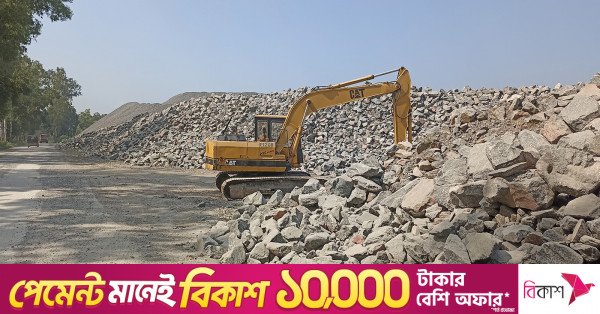
The stone is already being used in riverbank protection projects in Chapainawabganj, Kurigram, Thakurgaon, Pabna and Sirajganj, with plans to expand its use in other erosion-control schemes
Piles of quarried stones stockpiled near the Madhyapara stone mine in Parbatipur, Dinajpur. The state-owned mine has about 10 lakh tonnes of unsold granite worth Tk300 crore because buyers prefer cheaper Indian stones that are readily available, 28th October 2024. Photo: Khorshed Alam/TBS
“>

Piles of quarried stones stockpiled near the Madhyapara stone mine in Parbatipur, Dinajpur. The state-owned mine has about 10 lakh tonnes of unsold granite worth Tk300 crore because buyers prefer cheaper Indian stones that are readily available, 28th October 2024. Photo: Khorshed Alam/TBS
Several ministries, departments and others have begun increasing the use of stone produced by the state-owned Maddhapara Granite Mining Company Limited after Prime Minister Tarique Rahman directed authorities to reduce reliance on imports and revive the loss-making mining company.
The Maddhapara Granite Company has already signed two memorandums of understanding with Bangladesh Railway’s eastern and western zones to supply 202,513 tonnes of ballast stone. By June, it delivered 144,966 tonnes, while discussions are underway to supply additional railway projects.
Moreover, the Bangladesh Water Development Board has instructed its regional offices to include Maddhapara stone in project designs and cost estimates. The directive covers new projects as well as repair, maintenance and rehabilitation works.

Infographic: TBS
“>

Infographic: TBS
The stone is already being used in riverbank protection projects in Chapainawabganj, Kurigram, Thakurgaon, Pabna and Sirajganj, with plans to expand its use in other erosion-control schemes.
On 3 August, the premier held a high-level meeting at his office where he ordered prioritising Maddhapara stone in development projects even if it costs slightly more than imported alternatives.
The meeting was attended by the finance minister, the ministers responsible for road transport, shipping, railways, water resources, and housing and public works, and senior officials.
Officials said the Ministry of Housing and Public Works has been asked to revise the government rates to include Maddhapara stone. Authorities are also considering making its use mandatory in government project tenders.
Maddhapara Granite Managing Director Md Amzad Hossain said the mine’s production strategy was developed in the early 1990s when demand was largely limited to railway and river training projects.
Although national demand has grown sharply with the expansion of the construction sector, the mine’s production strategy was never significantly updated.
Meanwhile, the Water Development Board shifted towards geobags and concrete blocks, while railway contractors increasingly preferred imported stone, leaving large volumes of Maddhapara stone unsold.
“Recently, both the Bangladesh Railway and the Water Development Board have started using Maddhapara stone again,” Amzad said.
“If the government’s procurement directive is implemented, the accumulated stock will gradually be sold, helping the company overcome its liquidity crisis,” he said.
Welcoming the government’s decision, Professor Dr M Shamsul Alam, chairman of the Maddhapara Granite Mining Company board, told TBS, “Making Maddhapara stone mandatory in government projects will help ensure the company’s sustainability.”
He said the mine supplies only 5% to 6% of Bangladesh’s annual stone demand, yet struggles to sell its output while lower-priced imported stone continues to dominate government projects.
The chairman urged the government to review tax and VAT policies, arguing that high production costs and tax burdens have made Maddhapara stone less competitive.
“As a state-owned company, the objective should be sustainable operation rather than maximising profit,” he said, adding that lower prices and VAT exemptions should be considered in the national interest.
Bangladesh’s annual demand for stone is estimated at nearly 21.6 million tonnes, while Maddhapara produces only 1 million to 1.3 million tonnes a year.
According to Maddhapara Granite Mining Company’s June progress report, the mine produced 1.3 million tonnes in FY26 but sold only 1.05 million tonnes, earning about Tk306 crore.
Despite its limited output, the company struggles to sell all its production because imported stone is often cheaper. High production costs and weak marketing have left the company operating at a loss for years.
Total expenditure reached Tk442 crore, resulting in an operating deficit of Tk136 crore and a net loss after tax of Tk124 crore.
The company also suspended production for one month and 22 days during the fiscal year because of a shortage of ammonium nitrate explosives.
Maddhapara Granite currently has around 1.38 million tonnes of unsold stone in stock, including about 880,000 tonnes of railway ballast, 390,000 tonnes of boulder stone and 102,000 tonnes of stone dust, inventory the government hopes to absorb through increased public sector procurement.
About The Author