According to the company’s audited financial statements published on 29 June, it swung from a loss of Tk337.82 crore in the previous fiscal year, when it had yet to start production but incurred management and interest expenses.
Infographics: TBS
“>

Infographics: TBS
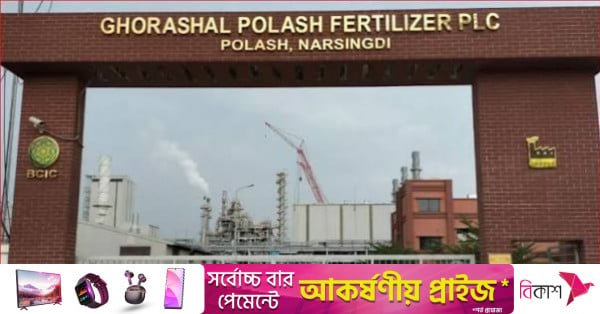
The state-owned Ghorashal Polash Fertiliser, the country’s largest urea fertiliser producer, has reported a net profit of Tk232.69 crore in its first year of commercial production, making it the only profitable urea factory among five government-run plants in FY2024-25.
The turnaround comes after the factory began production in July 2024, nearly eight months after its formal inauguration in November 2023.
According to the company’s audited financial statements published on 29 June, it swung from a loss of Tk337.82 crore in the previous fiscal year, when it had yet to start production but incurred management and interest expenses.
The Ministry of Industries’ annual report shows that the plant earned a profit while the rest of the plants posted losses of Tk414 crore in FY25, mainly because they failed to receive uninterrupted natural gas supply at the pressure and volume required for full-capacity operations.

Speaking to The Business Standard over mobile phone, Managing Director Mohammad Shahidullah Khan said, “Continuous gas supply enabled us to produce fertiliser according to our target. Since the factory operated at full capacity, we were able to make a profit in the very first year.
To strengthen food security and agricultural productivity, the Bangladesh Chemical Industries Corporation built the plant on the eastern bank of the Shitalakkhya in Narsingdi’s Palash upazila at a cost of nearly Tk15,500 crore.
The plant, built on 110 acres of land, has a daily production capacity of 2,800 tonnes and an annual capacity of 924,000 tonnes, making it one of the largest fertiliser facilities in Southeast Asia.
According to the audited accounts, the company generated total revenue of Tk2,632.28 crore in FY25. Fertiliser sales in the domestic market contributed Tk1,733 crore, while government subsidy income accounted for Tk899 crore.
The company’s gross profit stood at Tk901 crore. After deducting operating expenses of Tk170.93 crore, operating profit reached around Tk730 crore.
It also earned nearly Tk30 crore from non-operating sources, primarily interest on fixed deposit receipts and other investments. The company held FDRs worth Tk251 crore during the fiscal year.
However, debt servicing remained a significant expense. The company spent about Tk435 crore on loan interest and principal repayments during the year.
Financial statements show that the plant has long-term liabilities of Tk12,087 crore, including Tk10,295 crore in foreign loans and Tk1,791 crore in government ADP loans.
As of 30 June 2025, outstanding loans included Tk7,169 crore from the Japan Bank for International Cooperation and Tk3,127 crore under a MIGA-supported term loan. During FY2024-25, the company repaid nearly Tk1,286 crore to the two foreign lenders.
Looking ahead, Shahidullah said the company expects to remain profitable in FY2025-26, although earnings are likely to be lower.
“The factory remained shut for around 40 days because of gas shortages. As a result, we achieved about 90% of our production target. The financial accounts have not yet been finalised as the fiscal year has just ended,” he said.
He added that the project was financed through foreign loans and that repayments have been made from the company’s own earnings since operations began.
“Six instalments of the 10-year loan have already been repaid. If we continue to receive adequate gas supplies and maintain uninterrupted production, the company will be able to generate healthy profits in the coming years,” he said.
Four fertiliser factories incur Tk414 crore in losses
According to the Ministry of Industries’ financial report for FY25, the BCIC operates five urea fertiliser plants and two non-urea fertiliser plants. In total, it owns 11 factories outright and operates another 10 through joint ventures.
Among the five fertiliser plants, only Ghorashal reported a profit during the fiscal year. The remaining four plants collectively incurred losses of Tk414 crore.
The biggest loss was recorded by Ashuganj Fertilizer and Chemical Company Limited, which posted a deficit of Tk215.16 crore. Shahjalal Fertilizer Company Limited reported a loss of Tk134 crore, followed by Chittagong Urea Fertilizer Limited with Tk33 crore and Jamuna Fertilizer Company Limited with Tk30 crore.
During FY25, the state-owned factories produced 1.128 million tonnes of urea, 72,000 tonnes of triple super phosphate, and 49,532 tonnes of diammonium phosphate. In addition to domestic production, Bangladesh imported 1.644 million tonnes of urea to meet local demand
About The Author